The Wonderful Birch
by Andrew Lang · from The Red Fairy Book
Adapted Version
Once, there was a happy home. Anna lived with her mother and father.
One day, mother looked for a lost sheep. A witch found her first. The witch was very mean. She did not like happy families. 'Obey or be a black sheep,' witch said. The mother did not do it. But the witch used bad magic. The mother became a black sheep. It was sad.
The witch looked like the mother. She went home with the father. "I found the sheep," she said. The father was happy. He did not know the truth.
Witch told Father to send sheep away. Anna heard. She was scared. She ran to the black sheep.
"Mama, they will send you away!" cried Anna. "Don't eat. Bury my bones," said the sheep.
Soon, the sheep went away. The witch made soup. It smelled bad. Anna did not eat it. She buried the bones by the field. She was careful. A pretty tree grew there. It was a birch tree. It grew fast. It was magic.
The witch was not nice to Anna. She gave her hard work. One day, the palace had a big party. All could go. The witch wanted to go. She said to Anna, "You must stay. Pick these seeds from the ashes. If you don't, I'll be angry."
The witch left. Anna tried to pick the seeds. It was too hard. There were many seeds. She cried by the birch tree. "Why do you cry, my daughter?" said a voice. It was Mama's voice from the tree. "The witch gave me a hard job," said Anna. "I cannot do it." "Do not cry," said the voice. "Hit the ashes with a branch. I will help."
Anna broke a branch. She hit the ashes. The seeds jumped into the pot! The job was done quickly. Anna was happy. "Now," said the tree, "wash here, dry here, and dress here. You will be pretty."
Anna did this. She got pretty clothes. They were blue and shiny. She got a shiny horse. It was white. She rode to the party. She was excited.
The Prince saw her. He thought she was very pretty. He stayed by her side. They talked and laughed. All looked at Anna. No one knew her. She was mysterious.
It was time to go home. Anna left quickly. She did not want to be late. The Prince put sticky stuff on the door. He wanted to find her. Anna's ring got stuck. She left it and ran home. She put her old clothes back on. She was safe.
The next day, there was a new party. The witch gave Anna a new hard job. "Sort these seeds," she said. "If you don't, I'll be angry." Again, the birch tree helped. Again, Anna got pretty. She wore a red dress this time. Again, she went to the party. The Prince put sticky stuff on the door again. This time, Anna's hair clip got stuck. She left it and ran home. She was fast.
The witch found the hair clip. She put it on her own daughter. She tricked the Prince. "My daughter is the girl you like," she said. The Prince thought it was true. He planned to marry the witch's daughter. He was confused.
But Anna was sad. She loved the Prince. She whispered to the Prince. "I am the girl," she said. "The witch tricked you. Look at my ring." The Prince was smart. He believed Anna. He saw the ring. He sent the witch and her daughter away. They ran far, far away. They were gone.
Then the Prince and Anna got married. It was a beautiful wedding. They had a baby. The baby was a boy. They were very happy. They loved each other.
The witch was angry. She came back. She used bad magic. She changed Anna into a deer. The witch's daughter pretended to be Anna. She was not kind.
The baby cried and cried. He wanted his real mama. He was sad. The Prince asked a Wise Woman for help. She was old and wise. "Take the baby to the forest," she said. "I will help. Trust me."
The Wise Woman took the baby to the woods. She sang a soft song. The deer came. She was gentle. She fed the baby. She loved the baby. The baby was happy. He smiled.
The next day, the deer said, "I must go far away. Bring my baby one more time. I need to say goodbye." The Wise Woman told the Prince. They went to the forest. The deer came again. The Wise Woman combed her hair. It was nice. The Prince took the deer skin. He put it in a fire. The fire was warm.
The magic was broken. Anna was a woman again. She was back! She was human. The witch saw this. She was scared. She ran away with her daughter. They never came back. They were gone forever.
Anna, the Prince, and their baby were happy. They loved each other very much. They played together every day. Goodness and trying hard always win, and love is strong. And they were happy always. They lived happily ever after.
Original Story
THE WONDERFUL BIRCH
Once upon a time there were a man and a woman, who had an only
daughter. Now it happened that one of their sheep went astray, and they
set out to look for it, and searched and searched, each in a different
part of the wood. Then the good wife met a witch, who said to her:
‘If you spit, you miserable creature, if you spit into the sheath of my
knife, or if you run between my legs, I shall change you into a black
sheep.’
The woman neither spat, nor did she run between her legs, but yet the
witch changed her into a sheep. Then she made herself look exactly like
the woman, and called out to the good man:
‘Ho, old man, halloa! I have found the sheep already!’
The man thought the witch was really his wife, and he did not know that
his wife was the sheep; so he went home with her, glad at heart because
his sheep was found. When they were safe at home the witch said to the
man:
‘Look here, old man, we must really kill that sheep lest it run away to
the wood again.’
The man, who was a peaceable quiet sort of fellow, made no objections,
but simply said:
‘Good, let us do so.’
The daughter, however, had overheard their talk, and she ran to the
flock and lamented aloud:
‘Oh, dear little mother, they are going to slaughter you!’
‘Well, then, if they do slaughter me,’ was the black sheep’s answer,
‘eat you neither the meat nor the broth that is made of me, but gather
all my bones, and bury them by the edge of the field.’
Shortly after this they took the black sheep from the flock and
slaughtered it. The witch made pease-soup of it, and set it before the
daughter. But the girl remembered her mother’s warning. She did not
touch the soup, but she carried the bones to the edge of the field and
buried them there; and there sprang up on the spot a birch tree—a very
lovely birch tree.
Some time had passed away—who can tell how long they might have been
living there?—when the witch, to whom a child had been born in the
meantime, began to take an ill-will to the man’s daughter, and to
torment her in all sorts of ways.
Now it happened that a great festival was to be held at the palace, and
the King had commanded that all the people should be invited, and that
this proclamation should be made:
‘Come, people all!
Poor and wretched, one and all!
Blind and crippled though ye be,
Mount your steeds or come by sea.’
And so they drove into the King’s feast all the outcasts, and the
maimed, and the halt, and the blind. In the good man’s house, too,
preparations were made to go to the palace. The witch said to the man:
‘Go you on in front, old man, with our youngest; I will give the elder
girl work to keep her from being dull in our absence.’
So the man took the child and set out. But the witch kindled a fire on
the hearth, threw a potful of barleycorns among the cinders, and said
to the girl:
‘If you have not picked the barley out of the ashes, and put it all
back in the pot before nightfall, I shall eat you up!’
Then she hastened after the others, and the poor girl stayed at home
and wept. She tried to be sure to pick up the grains of barley, but she
soon saw how useless her labour was; and so she went in her sore
trouble to the birch tree on her mother’s grave, and cried and cried,
because her mother lay dead beneath the sod and could help her no
longer. In the midst of her grief she suddenly heard her mother’s voice
speak from the grave, and say to her:
‘Why do you weep, little daughter?’
‘The witch has scattered barleycorns on the hearth, and bid me pick
them out of the ashes,’ said the girl; ‘that is why I weep, dear little
mother.’
‘Do not weep,’ said her mother consolingly. ‘Break off one of my
branches, and strike the hearth with it crosswise, and all will be put
right.’ The girl did so. She struck the hearth with the birchen branch,
and lo! the barleycorns flew into the pot, and the hearth was clean.
Then she went back to the birch tree and laid the branch upon the
grave. Then her mother bade her bathe on one side of the stem, dry
herself on another, and dress on the third. When the girl had done all
that, she had grown so lovely that no one on earth could rival her.
Splendid clothing was given to her, and a horse, with hair partly of
gold, partly of silver, and partly of something more precious still.
The girl sprang into the saddle, and rode as swift as an arrow to the
palace. As she turned into the courtyard of the castle the King’s son
came out to meet her, tied her steed to a pillar, and led her in. He
never left her side as they passed through the castle rooms; and all
the people gazed at her, and wondered who the lovely maiden was, and
from what castle she came; but no one knew her—no one knew anything
about her. At the banquet the Prince invited her to sit next him in the
place of honour; but the witch’s daughter gnawed the bones under the
table. The Prince did not see her, and thinking it was a dog, he gave
her such a push with his foot that her arm was broken. Are you not
sorry for the witch’s daughter? It was not her fault that her mother
was a witch.
Towards evening the good man’s daughter thought it was time to go home;
but as she went, her ring caught on the latch of the door, for the
King’s son had had it smeared with tar. She did not take time to pull
it off, but, hastily unfastening her horse from the pillar, she rode
away beyond the castle walls as swift as an arrow. Arrived at home, she
took off her clothes by the birch tree, left her horse standing there,
and hastened to her place behind the stove. In a short time the man and
the woman came home again too, and the witch said to the girl:
‘Ah! you poor thing, there you are to be sure! You don’t know what fine
times we have had at the palace! The King’s son carried my daughter
about, but the poor thing fell and broke her arm.’
The girl knew well how matters really stood, but she pretended to know
nothing about it, and sat dumb behind the stove.
The next day they were invited again to the King’s banquet.
‘Hey! old man,’ said the witch, ‘get on your clothes as quick as you
can; we are bidden to the feast. Take you the child; I will give the
other one work, lest she weary.’
She kindled the fire, threw a potful of hemp seed among the ashes, and
said to the girl:
‘If you do not get this sorted, and all the seed back into the pot, I
shall kill you!’
The girl wept bitterly; then she went to the birch tree, washed herself
on one side of it and dried herself on the other; and this time still
finer clothes were given to her, and a very beautiful steed. She broke
off a branch of the birch tree, struck the hearth with it, so that the
seeds flew into the pot, and then hastened to the castle.
Again the King’s son came out to meet her, tied her horse to a pillar,
and led her into the banqueting hall. At the feast the girl sat next
him in the place of honour, as she had done the day before. But the
witch’s daughter gnawed bones under the table, and the Prince gave her
a push by mistake, which broke her leg—he had never noticed her
crawling about among the people’s feet. She was very unlucky!
The good man’s daughter hastened home again betimes, but the King’s son
had smeared the door-posts with tar, and the girl’s golden circlet
stuck to it. She had not time to look for it, but sprang to the saddle
and rode like an arrow to the birch tree. There she left her horse and
her fine clothes, and said to her mother:
‘I have lost my circlet at the castle; the door-post was tarred, and it
stuck fast.’
‘And even had you lost two of them,’ answered her mother, ‘I would give
you finer ones.’
Then the girl hastened home, and when her father came home from the
feast with the witch, she was in her usual place behind the stove. Then
the witch said to her:
‘You poor thing! what is there to see here compared with what we have
seen at the palace? The King’s son carried my daughter from one room to
another; he let her fall, ‘tis true, and my child’s foot was broken.’
The man’s daughter held her peace all the time, and busied herself
about the hearth.
The night passed, and when the day began to dawn, the witch awakened
her husband, crying:
‘Hi! get up, old man! We are bidden to the royal banquet.’
So the old man got up. Then the witch gave him the child, saying:
‘Take you the little one; I will give the other girl work to do, else
she will weary at home alone.’
She did as usual. This time it was a dish of milk she poured upon the
ashes, saying:
‘If you do not get all the milk into the dish again before I come home,
you will suffer for it.’
How frightened the girl was this time! She ran to the birch tree, and
by its magic power her task was accomplished; and then she rode away to
the palace as before. When she got to the courtyard she found the
Prince waiting for her. He led her into the hall, where she was highly
honoured; but the witch’s daughter sucked the bones under the table,
and crouching at the people’s feet she got an eye knocked out, poor
thing! Now no one knew any more than before about the good man’s
daughter, no one knew whence she came; but the Prince had had the
threshold smeared with tar, and as she fled her gold slippers stuck to
it. She reached the birch tree, and laying aside her finery, she said:
‘Alas I dear little mother, I have lost my gold slippers!’
‘Let them be,’ was her mother’s reply; ‘if you need them I shall give
you finer ones.’
Scarcely was she in her usual place behind the stove when her father
came home with the witch. Immediately the witch began to mock her,
saying:
‘Ah! you poor thing, there is nothing for you to see here, and we—ah:
what great things we have seen at the palace! My little girl was
carried about again, but had the ill-luck to fall and get her eye
knocked out. You stupid thing, you, what do you know about anything?’
‘Yes, indeed, what can I know?’ replied the girl; ‘I had enough to do
to get the hearth clean.’
Now the Prince had kept all the things the girl had lost, and he soon
set about finding the owner of them. For this purpose a great banquet
was given on the fourth day, and all the people were invited to the
palace. The witch got ready to go too. She tied a wooden beetle on
where her child’s foot should have been, a log of wood instead of an
arm, and stuck a bit of dirt in the empty socket for an eye, and took
the child with her to the castle. When all the people were gathered
together, the King’s son stepped in among the crowd and cried:
‘The maiden whose finger this ring slips over, whose head this golden
hoop encircles, and whose foot this shoe fits, shall be my bride.’
What a great trying on there was now among them all! The things would
fit no one, however.
‘The cinder wench is not here,’ said the Prince at last; ‘go and fetch
her, and let her try on the things.’
So the girl was fetched, and the Prince was just going to hand the
ornaments to her, when the witch held him back, saying:
‘Don’t give them to her; she soils everything with cinders; give them
to my daughter rather.’
Well, then the Prince gave the witch’s daughter the ring, and the woman
filed and pared away at her daughter’s finger till the ring fitted. It
was the same with the circlet and the shoes of gold. The witch would
not allow them to be handed to the cinder wench; she worked at her own
daughter’s head and feet till she got the things forced on. What was to
be done now? The Prince had to take the witch’s daughter for his bride
whether he would or no; he sneaked away to her father’s house with her,
however, for he was ashamed to hold the wedding festivities at the
palace with so strange a bride. Some days passed, and at last he had to
take his bride home to the palace, and he got ready to do so. Just as
they were taking leave, the kitchen wench sprang down from her place by
the stove, on the pretext of fetching something from the cowhouse, and
in going by she whispered in the Prince’s ear as he stood in the yard:
‘Alas! dear Prince, do not rob me of my silver and my gold.’
Thereupon the King’s son recognised the cinder wench; so he took both
the girls with him, and set out. After they had gone some little way
they came to the bank of a river, and the Prince threw the witch’s
daughter across to serve as a bridge, and so got over with the cinder
wench. There lay the witch’s daughter then, like a bridge over the
river, and could not stir, though her heart was consumed with grief. No
help was near, so she cried at last in her anguish:
‘May there grow a golden hemlock out of my body! perhaps my mother will
know me by that token.’
Scarcely had she spoken when a golden hemlock sprang up from her, and
stood upon the bridge.
Now, as soon as the Prince had got rid of the witch’s daughter he
greeted the cinder wench as his bride, and they wandered together to
the birch tree which grew upon the mother’s grave. There they received
all sorts of treasures and riches, three sacks full of gold, and as
much silver, and a splendid steed, which bore them home to the palace.
There they lived a long time together, and the young wife bore a son to
the Prince. Immediately word was brought to the witch that her daughter
had borne a son—for they all believed the young King’s wife to be the
witch’s daughter.
‘So, so,’ said the witch to herself; ‘I had better away with my gift
for the infant, then.’
And so saying she set out. Thus it happened that she came to the bank
of the river, and there she saw the beautiful golden hemlock growing in
the middle of the bridge, and when she began to cut it down to take to
her grandchild, she heard a voice moaning:
‘Alas! dear mother, do not cut me so!’
‘Are you here?’ demanded the witch.
‘Indeed I am, dear little mother,’ answered the daughter. ‘They threw
me across the river to make a bridge of me.’
In a moment the witch had the bridge shivered to atoms, and then she
hastened away to the palace. Stepping up to the young Queen’s bed, she
began to try her magic arts upon her, saying:
‘Spit, you wretch, on the blade of my knife; bewitch my knife’s blade
for me, and I shall change you into a reindeer of the forest.’
‘Are you there again to bring trouble upon me?’ said the young woman.
She neither spat nor did anything else, but still the witch changed her
into a reindeer, and smuggled her own daughter into her place as the
Prince’s wife. But now the child grew restless and cried, because it
missed its mother’s care. They took it to the court, and tried to
pacify it in every conceivable way, but its crying never ceased.
‘What makes the child so restless?’ asked the Prince, and he went to a
wise widow woman to ask her advice.
‘Ay, ay, your own wife is not at home,’ said the widow woman; ‘she is
living like a reindeer in the wood; you have the witch’s daughter for a
wife now, and the witch herself for a mother-in-law.’
‘Is there any way of getting my own wife back from the wood again?’
asked the Prince.
‘Give me the child,’ answered the widow woman. ‘I’ll take it with me
to-morrow when I go to drive the cows to the wood. I’ll make a rustling
among the birch leaves and a trembling among the aspens—perhaps the boy
will grow quiet when he hears it.’
‘Yes, take the child away, take it to the wood with you to quiet it,’
said the Prince, and led the widow woman into the castle.
‘How now? you are going to send the child away to the wood?’ said the
witch in a suspicious tone, and tried to interfere.
But the King’s son stood firm by what he had commanded, and said:
‘Carry the child about the wood; perhaps that will pacify it.’
So the widow woman took the child to the wood. She came to the edge of
a marsh, and seeing a herd of reindeer there, she began all at once to
sing—
‘Little Bright-eyes, little Redskin,
Come nurse the child you bore!
That bloodthirsty monster,

That man-eater grim,
Shall nurse him, shall tend him no more.
They may threaten and force as they will,

He turns from her, shrinks from her still,’
and immediately the reindeer drew near, and nursed and tended the child
the whole day long; but at nightfall it had to follow the herd, and
said to the widow woman:
‘Bring me the child to-morrow, and again the following day; after that
I must wander with the herd far away to other lands.’
The following morning the widow woman went back to the castle to fetch
the child. The witch interfered, of course, but the Prince said:
‘Take it, and carry it about in the open air; the boy is quieter at
night, to be sure, when he has been in the wood all day.’
So the widow took the child in her arms, and carried it to the marsh in
the forest. There she sang as on the preceding day—
‘Little Bright-eyes, little Redskin,
Come nurse the child you bore!
That bloodthirsty monster,

That man-eater grim,
Shall nurse him, shall tend him no more.
They may threaten and force as they will,

He turns from her, shrinks from her still,’
and immediately the reindeer left the herd and came to the child, and
tended it as on the day before. And so it was that the child throve,
till not a finer boy was to be seen anywhere. But the King’s son had
been pondering over all these things, and he said to the widow woman:
‘Is there no way of changing the reindeer into a human being again?’
‘I don’t rightly know,’ was her answer. ‘Come to the wood with me,
however; when the woman puts off her reindeer skin I shall comb her
head for her; whilst I am doing so you must burn the skin.’
Thereupon they both went to the wood with the child; scarcely were they
there when the reindeer appeared and nursed the child as before. Then
the widow woman said to the reindeer:
‘Since you are going far away to-morrow, and I shall not see you again,
let me comb your head for the last time, as a remembrance of you.’
Good; the young woman stript off the reindeer skin, and let the widow
woman do as she wished. In the meantime the King’s son threw the
reindeer skin into the fire unobserved.
‘What smells of singeing here?’ asked the young woman, and looking
round she saw her own husband. ‘Woe is me! you have burnt my skin. Why
did you do that?’
‘To give you back your human form again.’
‘Alack-a-day! I have nothing to cover me now, poor creature that I am!’
cried the young woman, and transformed herself first into a distaff,
then into a wooden beetle, then into a spindle, and into all imaginable
shapes. But all these shapes the King’s son went on destroying till she
stood before him in human form again.
Alas! wherefore take me home with you again,’ cried the young woman,
‘since the witch is sure to eat me up?’
‘She will not eat you up,’ answered her husband; and they started for
home with the child.
But when the witch wife saw them she ran away with her daughter, and if
she has not stopped she is running still, though at a great age. And
the Prince, and his wife, and the baby lived happy ever afterwards.[9]
[9] From the Russo-Karelian.
Story DNA
Moral
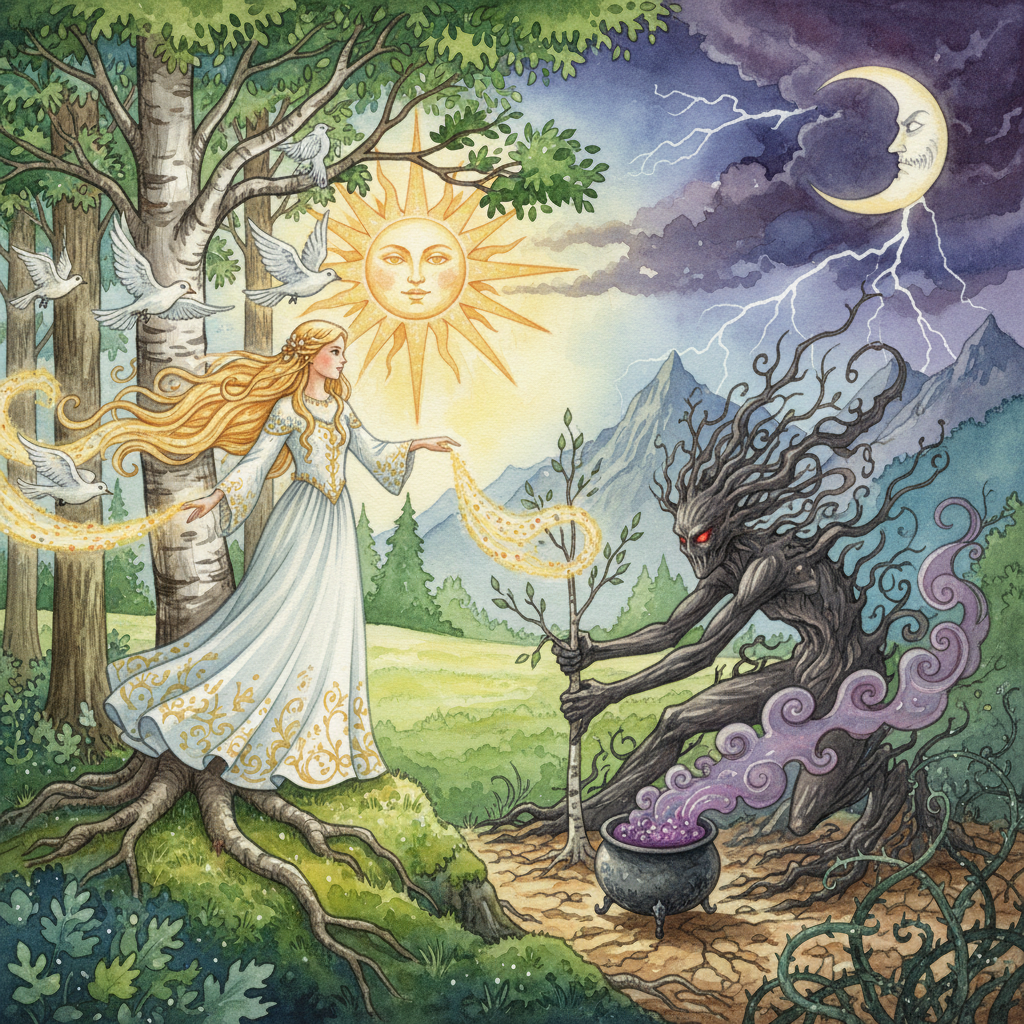
Goodness and perseverance will ultimately triumph over evil and deceit, and true love can overcome even the darkest magic.
Plot Summary
A witch transforms a mother into a black sheep, takes her place, and orders her slaughtered. The daughter buries her mother's bones, from which a magical birch tree grows, offering aid. The witch repeatedly sets impossible tasks to prevent the daughter from attending royal feasts, but the birch tree helps her transform and captivate the Prince. After the witch's daughter is forced to marry the Prince, the true daughter reveals herself, and the witch's daughter is turned into a bridge. The witch then transforms the daughter into a reindeer, but the Prince, with a wise woman's help, restores his wife, and the witch and her daughter flee, allowing the family to live happily ever after.
Themes
Emotional Arc
suffering to triumph
Writing Style
Narrative Elements
Cultural Context
This tale shares common motifs with the 'Cinderella' archetype, particularly the persecuted heroine, magical helper, impossible tasks, and royal ball. The specific transformations (sheep, birch tree, reindeer) and the witch's repeated attempts to usurp the mother/wife role are distinctive.
Plot Beats (16)
- A witch transforms the mother into a black sheep and takes her place in the family.
- The witch orders the black sheep slaughtered; the daughter is warned by her mother not to eat the meat and to bury her bones.
- The daughter buries her mother's bones, and a magical birch tree grows from the spot.
- The witch sets an impossible task (sorting barley from ashes) to prevent the daughter from attending a royal feast.
- The birch tree helps the daughter complete the task, transform into a beautiful maiden, and attend the feast, captivating the Prince.
- The Prince tries to identify her by tarring the door latch, catching her ring, but she escapes.
- The witch sets another impossible task (sorting hemp seeds from ashes) for the second day of the feast.
- The birch tree again helps the daughter attend the feast, where the Prince tries to identify her by tarring the door-posts, catching her circlet.
- The witch's daughter is forced to marry the Prince, as the witch manipulates the evidence to make her seem like the mysterious maiden.
- The daughter whispers to the Prince, revealing her identity, and he turns the witch's daughter into a bridge.
- The Prince and the daughter marry and have a child, but the witch, believing her daughter is the Queen, comes to visit.
- The witch transforms the daughter into a reindeer and takes her place as the Queen.
- The child cries incessantly, leading the Prince to seek advice from a wise widow, who reveals the truth.
- The widow takes the child to the forest, where the reindeer mother nurses it for two days.
- On the third day, the Prince and widow burn the reindeer skin, restoring the daughter to human form.
- The witch and her daughter flee, and the Prince, his wife, and their child live happily ever after.
Characters
Daughter ★ protagonist
Grows into unmatched beauty
Attire: Initially simple peasant clothes, later splendid clothing given by her mother
Kind, obedient, resourceful
Image Prompt & Upload
A young woman in her late teens with long, flowing chestnut hair, wearing a simple but sturdy blue linen dress with a white apron. She stands with a determined expression, her posture straight and alert, one hand resting on her hip while the other holds a worn leather-bound book against her side. Plain white background, full body visible head to toe, single figure, no watermark, no text, no signature.
Witch ⚔ antagonist
Ugly, capable of shapeshifting
Attire: Inferred: Dark, simple clothing; later pretends to be the wife in peasant dress
Cruel, manipulative, power-hungry
Image Prompt & Upload
An elderly woman with sallow green skin and a sharp, hooked nose, wearing a tall, crooked black pointed hat and tattered, layered black robes. She has a sinister, toothy grin, deep-set eyes, and wild, stringy gray hair. She stands hunched over a bubbling cauldron in a dark, misty forest clearing, her bony fingers stirring the potion. Gnarled trees and glowing mushrooms surround her. Plain white background, full body visible head to toe, single figure, no watermark, no text, no signature.
Mother (as Sheep/Birch Tree) ◆ supporting
As a sheep: black wool. As a tree: lovely birch with strong branches
Attire: As a sheep: natural fleece. As a tree: leaves
Protective, loving, magical
Image Prompt & Upload
A gentle, middle-aged woman with soft, woolly white hair styled in a loose bun, her skin subtly patterned like birch bark with faint horizontal lines. She wears a flowing, layered dress of cream and brown hues, resembling both wool fibers and papery birch bark. Her expression is warm and nurturing, with kind eyes and a soft smile. She stands in a relaxed, welcoming pose with one hand slightly extended as if offering support. The background is a soft, dreamlike forest clearing with dappled sunlight. Plain white background, full body visible head to toe, single figure, no watermark, no text, no signature.
Prince ◆ supporting
Not described, but inferred to be handsome
Attire: Royal attire, including fine fabrics and jewelry
Kind, persistent, easily deceived initially
Image Prompt & Upload
A young man in his late teens with short, neatly styled golden hair and bright blue eyes. He wears a royal blue military-style jacket with gold epaulettes and intricate embroidery, a white sash across his chest, dark trousers, and polished black knee-high boots. He stands tall with a confident yet gentle posture, one hand resting on the pommel of a sheathed ceremonial sword at his hip, a faint, kind smile on his face. Plain white background, full body visible head to toe, single figure, no watermark, no text, no signature.
Father ○ minor
Not described
Attire: Simple peasant clothing
Peaceable, quiet, easily influenced
Image Prompt & Upload
A middle-aged man with a warm, gentle expression and kind brown eyes. He has short, slightly graying brown hair and a neatly trimmed beard. He wears a simple peasant-style tunic in earthy brown tones with a leather belt at the waist, dark trousers, and worn leather boots. His posture is relaxed and welcoming, standing with hands gently clasped in front of him. His face shows subtle laugh lines around his eyes and mouth, suggesting a life of warmth and care. He has broad, sturdy shoulders suggesting years of hard work. His clothing is slightly weathered but well-maintained, with rolled-up sleeves revealing strong forearms. Plain white background, full body visible head to toe, single figure, no watermark, no text, no signature.
Widow Woman ◆ supporting
Wise and observant
Attire: Simple, practical clothing
Helpful, clever, discreet
Image Prompt & Upload
An elderly woman in her late sixties with a kind, weathered face and deep-set eyes. She has silver hair pulled back into a neat bun. She wears a long, simple dress of dark, faded wool, with a high collar and long sleeves, covered by a heavy, worn shawl draped over her shoulders. Her hands are clasped gently in front of her. She stands with a slight, weary posture but a gentle, resilient expression, looking softly into the distance. Plain white background, full body visible head to toe, single figure, no watermark, no text, no signature.
Locations
Edge of the field
Where the black sheep's bones are buried
Mood: peaceful, hopeful
Birch tree miraculously grows from mother's bones
Image Prompt & Upload
Twilight settles over the untamed edge of a vast, overgrown field. A low, mossy mound of dark earth marks a forgotten grave, from which a single, weathered sheep's skull and a few sun-bleached ribs emerge, half-buried in tangled grass and wild violets. The sky is a bruised wash of deep purple and faded gold, with the first pale stars appearing. Crooked, ancient fence posts lean into the scene, trailing rusted wire. The atmosphere is still, melancholic, and quietly haunting, with a cool, misty haze clinging to the ground. No border, no frame, no watermark, no text, no signature, edge-to-edge illustration.
Birch tree
A very lovely birch tree that sprang up from the buried bones
Mood: magical, comforting
Daughter receives magical help and transformation
Image Prompt & Upload
A single, slender birch tree with luminous white bark and delicate, trembling leaves grows from a small mound of dark, rich earth. Pale, ancient bones—fragments of ribs and a skull—are partially visible, cradled by the tree's gnarled roots and scattered across the mossy ground. The scene is set in a misty, twilight forest clearing. Soft, ethereal light filters through the canopy, casting long, gentle shadows and illuminating the tree with a soft, otherworldly glow. The air is still and quiet, with a hint of silver mist clinging to the ground. Colors are muted: cool blues, deep greens, and the stark white of the birch. no border, no frame, no watermark, no text, no signature, edge-to-edge illustration.
Royal Palace Courtyard
Pillar for tying horses
Mood: festive, grand
Daughter arrives in disguise, ring catches on latch
Image Prompt & Upload
Late afternoon sunlight casts long shadows across a grand royal palace courtyard, with warm golden rays illuminating intricate marble pillars and arched stone walkways. At the center stands a tall, ornate iron pillar for tying horses, its surface etched with royal crests and wrapped in subtle ivy. The courtyard features polished flagstone floors, decorative potted topiaries, and a distant marble fountain softly splashing. The sky is clear with soft amber clouds, and the air feels serene and majestic. No border, no frame, no watermark, no text, no signature, edge-to-edge illustration.
Edge of the marsh in the wood
Where reindeer herd roams
Mood: wild, secretive
Reindeer nurses the child; wife regains human form
Image Prompt & Upload
Twilight settles over the edge of a vast, misty marsh bordering a dark coniferous forest. The sky is a deep gradient of indigo and violet, pierced by the first pale stars. A low, silvery mist clings to the dark, mirror-still water, weaving between clusters of tall reeds and sedges. On the firm ground between the trees and the water, a herd of reindeer grazes peacefully, their silhouettes dark against the glowing marsh. Ancient, gnarled birch trees with white bark stand sentinel, their leaves touched with the last amber light of the setting sun. The air is cool, still, and filled with the soft sounds of evening. no border, no frame, no watermark, no text, no signature, edge-to-edge illustration.