Blockhead Hans
by Andrew Lang · from The Yellow Fairy Book
Adapted Version
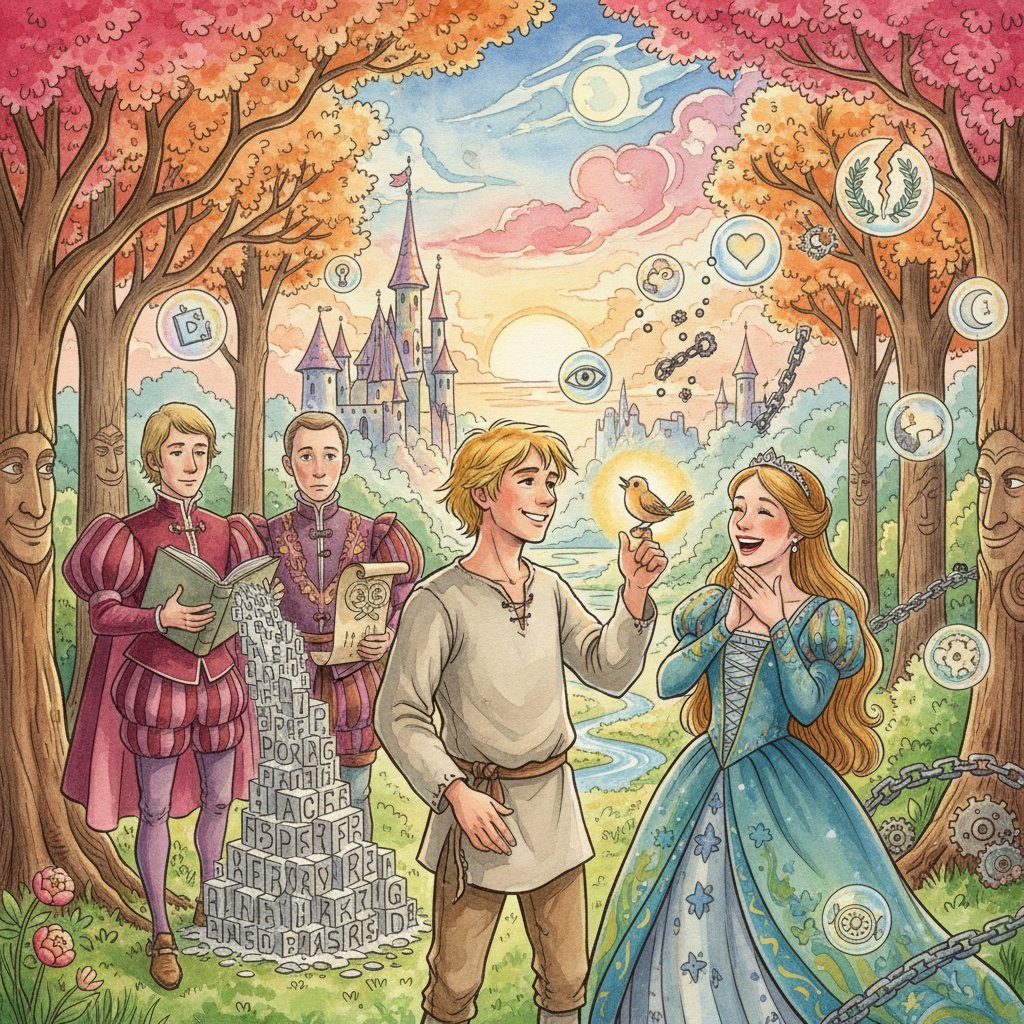
Once upon a time, there were three brothers. Two brothers were very clever. They had many books. They wanted to marry a princess. The princess would choose the smartest man.
The clever brothers got fine horses. They rode away. The youngest brother was Hans. "I want to go too!" said Hans. His father said no. "You cannot have a horse," he said.
Hans saw his goat. "I can ride my goat!" he said. He sat on the goat. Clip-clop! He rode down the road.
Hans found a crow. "What a find!" he said. "I will give this to the princess!" His brothers laughed at him.
Hans found an old shoe. "Look!" he shouted. "I will give this too!" His brothers laughed again.
Hans found squishy mud. "This is the best!" he said. He put mud in his pocket.
The clever brothers arrived first. There were many other boys. They waited in a big room.
The first brother went in. "It is hot in here," he said. The princess said, "We are roasting chickens!" The brother forgot his words. He could not speak. "Take him out," said the princess.
The second brother went in. "It is hot," he said. The princess said, "We are roasting chickens!" He could not talk well. "Take him out," said the princess.
Clip-clop! Hans rode his goat inside. "It is hot in here!" said Hans. "We are roasting chickens," said the princess. "Good!" said Hans. "Can I roast my crow too?"
"Yes!" said the princess. "But do you have a pot?" "I have this shoe!" said Hans. He put the crow in the shoe.
"Do you have soup?" asked the princess. "I have mud!" said Hans. He took mud from his pocket.
"I like you!" said the princess. "You are clever. I will marry you!"
A man with a book was writing. "He writes everything down," said the princess. Hans threw mud at the man. It hit his face.
"That was funny!" laughed the princess.
Hans became king. He married the princess. They were very happy.
Hans was clever because he used his head. Being smart and kind is the best way to win. Hans became king. He and the princess lived happily ever after. The end.
Original Story
BLOCKHEAD-HANS
Far away in the country lay an old manor-house where lived an old
squire who had two sons. They thought themselves so clever, that if
they had known only half of what they did know, it would have been
quite enough. They both wanted to marry the King’s daughter, for she
had proclaimed that she would have for her husband the man who knew
best how to choose his words.
Both prepared for the wooing a whole week, which was the longest time
allowed them; but, after all, it was quite long enough, for they both
had preparatory knowledge, and everyone knows how useful that is. One
knew the whole Latin dictionary and also three years’ issue of the
daily paper of the town off by heart, so that he could repeat it all
backwards or forwards as you pleased. The other had worked at the laws
of corporation, and knew by heart what every member of the corporation
ought to know, so that he thought he could quite well speak on State
matters and give his opinion. He understood, besides this, how to
embroider braces with roses and other flowers, and scrolls, for he was
very ready with his fingers.
‘I shall win the king’s daughter!’ they both cried.
Their old father gave each of them a fine horse; the one who knew the
dictionary and the daily paper by heart had a black horse, while the
other who was so clever at corporation law had a milk-white one. Then
they oiled the corners of their mouths so that they might be able to
speak more fluently. All the servants stood in the courtyard and saw
them mount their steeds, and here by chance came the third brother;
for the squire had three sons, but nobody counted him with his
brothers, for he was not so learned as they were, and he was generally
called ‘Blockhead-Hans.’
‘Oh, oh!’ said Blockhead-Hans. ‘Where are you off to? You are in your
Sunday-best clothes!’
‘We are going to Court, to woo the Princess! Don’t you know what is
known throughout all the country side?’ And they told him all about
it.
‘Hurrah! I’ll go too!’ cried Blockhead-Hans; and the brothers laughed
at him and rode off.
‘Dear father!’ cried Blockhead-Hans, ‘I must have a horse too. What a
desire for marriage has seized me! If she will have me, she will
have me, and if she won’t have me, I will have her.’
‘Stop that nonsense!’ said the old man. ‘I will not give you a horse.
You can’t speak; you don’t know how to choose your words. Your
brothers! Ah! they are very different lads!’
[Illustration: Then They Oiled the Corners of Their Mouths]
‘Well,’ said Blockhead-Hans, ‘if I can’t have a horse, I will take the
goat which is mine; he can carry me!’
And he did so. He sat astride on the goat, struck his heels into its
side, and went rattling down the high-road like a hurricane.
Hoppetty hop! what a ride! ‘Here I come!’ shouted Blockhead-Hans,
singing so that the echoes were roused far and near. But his brothers
were riding slowly in front. They were not speaking, but they were
thinking over all the good things they were going to say, for
everything had to be thought out.
‘Hullo!’ bawled Blockhead-Hans, ‘here I am! Just look what I found on
the road!’—and he showed them a dead crow which he had picked up.
‘Blockhead!’ said his brothers, ‘what are you going to do with it?’
‘With the crow? I shall give it to the Princess!’
‘Do so, certainly!’ they said, laughing loudly and riding on.
‘Slap! bang! here I am again! Look what I have just found! You don’t
find such things every day on the road!’
[Illustration: Hans Fills his Pocket with the Mud]
And the brothers turned round to see what in the world he could have
found.
‘Blockhead!’ said they, ‘that is an old wooden shoe without the top!
Are you going to send that, too, to the Princess?’
‘Of course I shall!’ returned Blockhead-Hans; and the brothers laughed
and rode on a good way.
‘Slap! bang! here I am!’ cried Blockhead-Hans; ‘better and better—it
is really famous!’
‘What have you found now?’ asked the brothers.
‘Oh,’ said Blockhead-Hans, ‘it is really too good! How pleased the
Princess will be!’
‘Why!’ said the brothers, ‘this is pure mud, straight from the ditch.’
‘Of course it is!’ said Blockhead-Hans, ‘and it is the best kind! Look
how it runs through one’s fingers!’ and, so saying, he filled his
pocket with the mud.
But the brothers rode on so fast that dust and sparks flew all around,
and they reached the gate of the town a good hour before
Blockhead-Hans. Here came the suitors numbered according to their
arrival, and they were ranged in rows, six in each row, and they were
so tightly packed that they could not move their arms. This was a very
good thing, for otherwise they would have torn each other in pieces,
merely because the one was in front of the other.
All the country people were standing round the King’s throne, and were
crowded together in thick masses almost out of the windows to see the
Princess receive the suitors; and as each one came into the room all
his fine phrases went out like a candle!
‘It doesn’t matter!’ said the Princess. ‘Away! out with him!’
At last she came to the row in which the brother who knew the
dictionary by heart was, but he did not know it any longer; he had
quite forgotten it in the rank and file. And the floor creaked, and
the ceiling was all made of glass mirrors, so that he saw himself
standing on his head, and by each window were standing three reporters
and an editor; and each of them was writing down what was said, to
publish it in the paper that came out and was sold at the street
corners for a penny. It was fearful, and they had made up the fire so
hot that it was grilling.
‘It is hot in here, isn’t it!’ said the suitor.
‘Of course it is! My father is roasting young chickens to-day!’ said
the Princess.
‘Ahem!’ There he stood like an idiot. He was not prepared for such a
speech; he did not know what to say, although he wanted to say
something witty. ‘Ahem!’
‘It doesn’t matter!’ said the Princess. ‘Take him out!’ and out he had
to go.
Now the other brother entered.
‘How hot it is!’ he said.
‘Of course! We are roasting young chickens to-day!’ remarked the
Princess.
‘How do you—um!’ he said, and the reporters wrote down. ‘How do
you—um.’
‘It doesn’t matter!’ said the Princess. ‘Take him out!’
Now Blockhead-Hans came in; he rode his goat right into the hall.
‘I say! How roasting hot it is here!’ said he.
‘Of course! I am roasting young chickens to-day!’ said the Princess.
‘That’s good!’ replied Blockhead-Hans; ‘then can I roast a crow with
them?’
‘With the greatest of pleasure!’ said the Princess; ‘but have you
anything you can roast them in? for I have neither pot nor saucepan.’
[Illustration: The Reporters giggled & each
dropped a blot of ink on the floor
Then I will give the Editor the best! said Blockhead-Hans
That was neatly done! said the Princess]
‘Oh, rather!’ said Blockhead-Hans. ‘Here is a cooking implement with
tin rings,’ and he drew out the old wooden shoe, and laid the crow in
it.
‘That is quite a meal!’ said the Princess; ‘but where shall we get the
soup from?’
‘I’ve got that in my pocket!’ said Blockhead-Hans. ‘I have so much
that I can quite well throw some away!’ and he poured some mud out of
his pocket.
‘I like you!’ said the Princess. ‘You can answer, and you can speak,
and I will marry you; but do you know that every word which we are
saying and have said has been taken down and will be in the paper
to-morrow? By each window do you see there are standing three
reporters and an old editor, and this old editor is the worst, for he
doesn’t understand anything!’ but she only said this to tease
Blockhead-Hans. And the reporters giggled, and each dropped a blot of
ink on the floor.
‘Ah! are those the great people?’ said Blockhead-Hans. ‘Then I will
give the editor the best!’ So saying, he turned his pockets inside
out, and threw the mud right in his face.
‘That was neatly done!’ said the Princess. ‘I couldn’t have done it;
but I will soon learn how to!’
Blockhead-Hans became King, got a wife and a crown, and sat on the
throne; and this we have still damp from the newspaper of the editor
and the reporters—and they are not to be believed for a moment.
Story DNA
Moral
True wit and resourcefulness, even in an unconventional form, are more valuable than superficial knowledge or pretense.
Plot Summary
Two overly confident, 'clever' brothers set out to win a princess who values verbal skill, armed with rote knowledge. Their younger, underestimated brother, Blockhead-Hans, decides to join them, riding a goat and collecting seemingly useless items: a dead crow, an old wooden shoe, and mud. While his brothers fail to impress the princess with their prepared speeches, Hans uses his found objects to cleverly respond to her challenges, demonstrating genuine wit and resourcefulness. The princess chooses Hans, who then further proves his unconventional nature by throwing mud at a critical editor, securing his place as king.
Themes
Emotional Arc
underestimation to triumph
Writing Style
Narrative Elements
Cultural Context
Hans Christian Andersen, the original author, often incorporated contemporary elements like newspapers into his fairy tales, reflecting the changing world around him.
Plot Beats (14)
- Two 'clever' brothers, sons of a squire, prepare to woo a princess who values verbal skill.
- The brothers, one knowing a dictionary by heart and the other corporation law, are given fine horses by their father.
- Their younger brother, Blockhead-Hans, decides to join them, despite being mocked and denied a horse, so he rides a goat.
- Hans finds a dead crow on the road and declares he will give it to the princess, to his brothers' amusement.
- Hans then finds an old wooden shoe and adds it to his collection, again mocked by his brothers.
- Finally, Hans collects mud from a ditch, filling his pocket, further solidifying his brothers' belief in his foolishness.
- The 'clever' brothers arrive at the court, where many suitors are already lined up.
- The first brother, overwhelmed by the court and reporters, fails to respond wittily to the princess's comment about roasting chickens.
- The second brother also fails to impress the princess with his stammering response to the same question.
- Blockhead-Hans rides his goat directly into the hall and, when asked about the heat, offers to roast his crow with the princess's chickens.
- When the princess asks for a cooking implement, Hans produces the wooden shoe, and for soup, he offers the mud from his pocket.
- Impressed by his quick and unconventional answers, the princess declares she will marry Hans.
- Hans, upon learning reporters are documenting everything, throws mud in the editor's face, which the princess finds admirable.
- Blockhead-Hans becomes King, marries the princess, and rules, with the story concluding by discrediting the reporters' accounts.
Characters
Blockhead-Hans ★ protagonist
Not described in detail, but implied to be less refined than his brothers
Attire: Simple, perhaps patched clothing, contrasting with his brothers' Sunday-best attire. Rides a goat instead of a horse.
Simple, honest, quick-witted, unconcerned with appearances
Image Prompt & Upload
A young man in his early twenties with a kind, slightly bewildered expression. He has messy, straw-colored hair and a gentle, open face. He wears a simple, slightly too-large roughspun tunic of faded blue, brown patched trousers, and worn leather boots. He stands with a curious, slightly slouched posture, head tilted as if listening intently. Plain white background, full body visible head to toe, single figure, no watermark, no text, no signature.
The King’s daughter ◆ supporting
Not described, but implied to be discerning and intelligent
Attire: Royal attire, befitting a princess of the time
Intelligent, discerning, unconventional, appreciates wit and honesty
Image Prompt & Upload
A young woman in her late teens with a kind and gentle expression, soft brown hair partially braided and adorned with a simple golden circlet. She wears a modest yet elegant gown of sky-blue velvet with delicate silver embroidery along the neckline and sleeves. Her posture is poised yet approachable, standing with her hands lightly clasped before her. Plain white background, full body visible head to toe, single figure, no watermark, no text, no signature.
The Brother who knew the dictionary ⚔ antagonist
Not described in detail, but implied to be well-groomed
Attire: Fine clothes, riding a black horse
Arrogant, bookish, easily flustered, relies on rote memorization
Image Prompt & Upload
A gaunt man in his late twenties with sharp, angular features and a cruel sneer. He wears a tailored black waistcoat over a crisp white shirt, the sleeves rolled up to reveal pale forearms. His dark hair is slicked back severely, and his cold, intelligent eyes glare with contempt. He holds a massive, leather-bound dictionary aloft as if about to strike, his posture tense and predatory. The scene is set in a shadowy, wood-paneled study filled with towering bookshelves. Plain white background, full body visible head to toe, single figure, no watermark, no text, no signature.
The Brother who knew corporation law ⚔ antagonist
Not described in detail, but implied to be well-groomed
Attire: Fine clothes, riding a milk-white horse
Arrogant, legalistic, easily flustered, relies on specialized knowledge
Image Prompt & Upload
A middle-aged man with sharp, calculating eyes and slicked-back dark hair stands with an authoritative posture. He wears a tailored charcoal grey suit over a crisp white dress shirt, unbuttoned at the collar without a tie. His expression is a cold, confident smirk, one hand adjusting his cufflink while the other rests in his pocket. He is positioned in a dimly lit, imposing office with a large mahogany desk covered in legal documents and a city skyline visible through the window behind him. Plain white background, full body visible head to toe, single figure, no watermark, no text, no signature.
The Editor ○ minor
Not described, but implied to be pompous and easily offended
Attire: Professional attire of the time
Pompous, easily offended, humorless
Image Prompt & Upload
A young teenage figure with a focused expression, sitting at a large, ornate wooden desk. They wear a slightly oversized tweed waistcoat over a crisp white shirt, with ink stains on their fingers and cuffs. Their hair is neatly combed but has a few rebellious curls. They hold a glowing quill pen, poised above a sprawling manuscript covered in edits and symbols. Floating around them are enchanted, self-organizing papers and open books. The posture is slightly hunched, concentrating intently on their work. Plain white background, full body visible head to toe, single figure, no watermark, no text, no signature.
Locations
Old Manor-House Courtyard
Servants stand watching as the two elder brothers mount their fine horses.
Mood: Anticipatory, slightly mocking of Blockhead-Hans
The two elder brothers depart to woo the princess, leaving Blockhead-Hans behind.
Image Prompt & Upload
An old manor-house courtyard at dawn, soft golden light filtering through a misty morning air. Ancient, moss-covered cobblestones form a wide clearing surrounded by ivy-draped stone walls and the towering facade of the manor, its windows dark and reflective. A weathered wooden mounting block stands beside a stone water trough. Two ornate iron hitching posts are embedded in the ground. Climbing roses cascade down a corner wall, their pale pink petals catching the light. Long, cool shadows stretch across the scene. The atmosphere is still, quiet, and steeped in history. no border, no frame, no watermark, no text, no signature, edge-to-edge illustration
Road to the Town
A dusty road where Blockhead-Hans finds a dead crow, a wooden shoe, and mud.
Mood: Playful, absurd
Blockhead-Hans collects strange gifts and interacts with his brothers.
Image Prompt & Upload
A dusty, winding dirt road stretches through a late afternoon golden hour in a forgotten countryside. The sun hangs low, casting long shadows and bathing the scene in warm, hazy light. Along the road's edge, a single, worn wooden shoe lies half-buried in thick, dark mud. Nearby, the delicate, black silhouette of a dead crow rests on the pale dust. The road is lined with tall, dry grass and a few gnarled, leafless trees. In the far distance, the faint, rustic rooftops of a small town are visible under a soft, peach-colored sky. The atmosphere is still, quiet, and slightly melancholic. no border, no frame, no watermark, no text, no signature, edge-to-edge illustration.
King's Throne Room
A crowded hall with the King's throne, reporters by the windows, and a glass-mirrored ceiling.
Mood: Anxious, formal, judgmental
The suitors are interviewed by the princess, and Blockhead-Hans wins her over with his unusual gifts and responses.
Image Prompt & Upload
Grand throne room bathed in late afternoon golden light streaming through tall arched stained-glass windows, casting long colorful patterns across the polished marble floor. An ornate, gilded throne sits upon a raised dais at the far end, flanked by heavy velvet curtains. The vast ceiling is a magnificent glass mirror, reflecting the entire hall below, including the glittering crystal chandeliers and the intricate, gilded ceiling supports. The air is still and silent, the space feeling both immense and intimate. Rich, deep reds and golds dominate the color palette, with accents of royal blue and emerald green from the carpets and banners. The architecture is grand and gothic, with high, vaulted ceilings and towering pillars. no border, no frame, no watermark, no text, no signature, edge-to-edge illustration