The Ratcatcher
by Andrew Lang · from The Red Fairy Book
Adapted Version
Once, a small town had many rats. The rats were everywhere. They were in the houses. They were in the shops. They were in the streets. The rats were big and small. They made noises all night. The people were very sad. They could not sleep well. They could not eat their food. They needed help quickly. They asked the Town Leader. "Please help us," they cried. "Our town is full of rats." The Town Leader was worried. He did not know what to do.
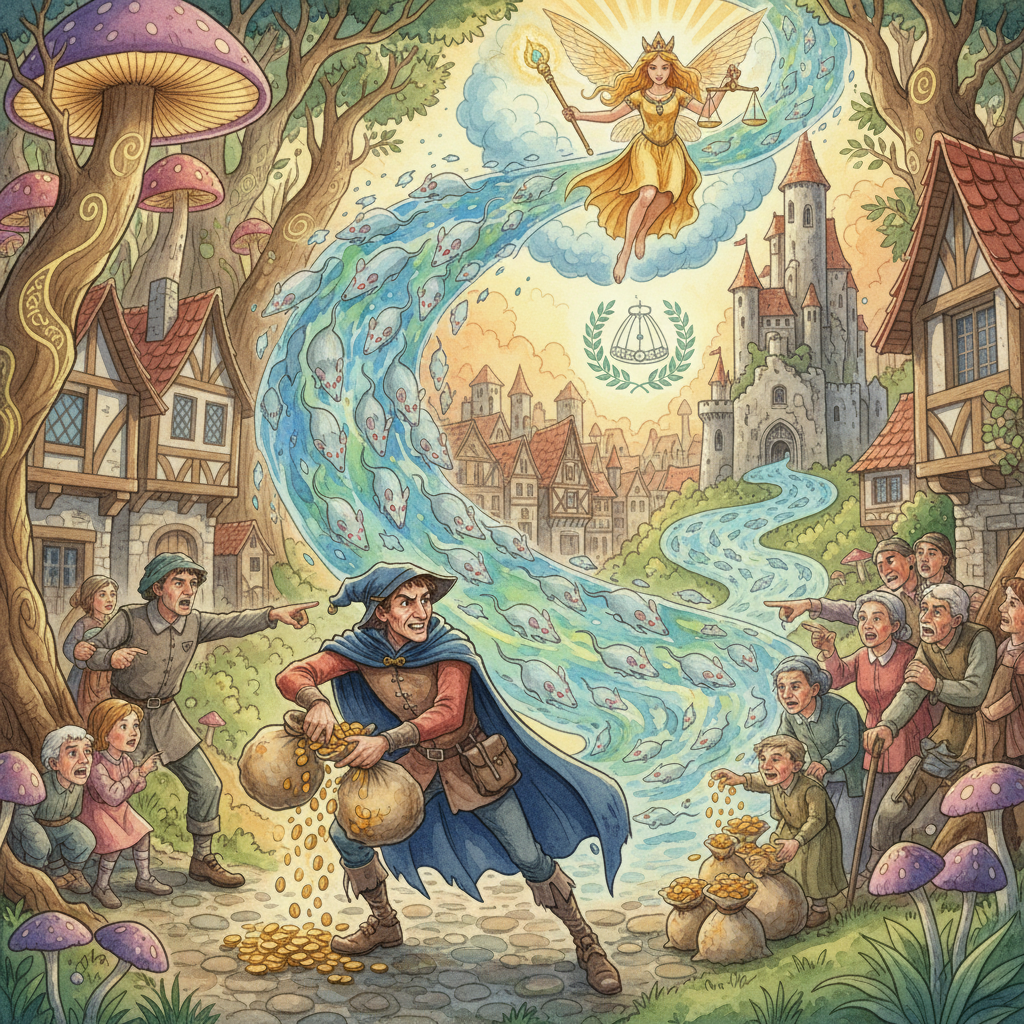
A man came to town one day. He had a pipe in his hand. "I can help you," he said. "I can take away all the rats." "Give me one coin for each rat." The people were happy to hear this. They talked to the Town Leader. "Should we pay him?" they asked.
The Town Leader was clever. He said, "Yes, we will pay." But he did not mean it. He thought he could cheat. He planned to pay less money. "We will save money," he thought.
The piper played his pipe. The music was very pretty. It was sweet and nice. The piper played his pipe again. All the rats heard the music. They came out of the houses. They came out of the shops. They followed the piper closely. The piper walked to the river. The rats followed him closely. They went away into the water. The town had no more rats. The people were very happy now. "No more rats!" they cheered.
The next day, the piper came back. He said, "I helped many rats." "Please pay me now for my work." He waited for his money. The Town Leader came out to see him. The Town Leader laughed at him. He said, "No, we will not pay." "We will not pay you much." He gave the piper only a little money. It was not enough at all. "This is all you get," he said.
The piper was very angry. He said, "You broke your promise." "That is not fair to me." "The children will have to pay." He put on his hat and left. The piper walked away slowly.
The people in the town laughed. They did not believe him. They thought he was just joking. They went back to their homes. "He is just a silly man," they said.
On Sunday, the piper came back again. It was a sunny day. He played his pipe once more. The music was very happy. It sounded like fun and joy. The piper played his pipe sweetly. All the children heard the music. They came out of the houses. They came out of the school. They followed the piper happily. They danced and smiled as they walked. "Come with me!" the music seemed to say.
The piper walked to a hill. There was a big cave there. The children went inside to play. It looked like a great adventure. The piper smiled at them all. "Follow me!" he said gently.
Three children were slow that day. They could not keep up with others. They stayed outside the cave. They told their parents what happened. "Our children are gone!" the parents cried. The parents were very scared.
They looked for the cave quickly. It was closed very tightly. They could not open it. They felt very worried and sad. They called for help loudly. "Where are our children?" they cried.
The Town Leader was very sad. He had five children inside. He said, "I was wrong." "I should have kept my promise." "You must keep promises," the people said. The Town Leader said he was sorry. "I am truly sorry," he said.
"We will pay!" he called. "We are truly sorry!" The town called out together. Then the cave opened slowly. The children came out smiling. They were happy and safe. The piper was there waiting. The Town Leader paid him fairly. "Thank you," said the piper kindly. "Always keep your promises from now." The town learned a good lesson. They were all happy again. "Promises are important," they said.
Original Story
The ratcatcher.’
The town council had just assembled to consider once more this plague
of Egypt, from which no one could save the town.
The stranger sent word to the counsellors that, if they would make it
worth his while, he would rid them of all their rats before night, down
to the very last.
‘Then he is a sorcerer!’ cried the citizens with one voice; ‘we must
beware of him.’
The Town Counsellor, who was considered clever, reassured them.
He said: ‘Sorcerer or no, if this bagpiper speaks the truth, it was he
who sent us this horrible vermin that he wants to rid us of to-day for
money. Well, we must learn to catch the devil in his own snares. You
leave it to me.’
‘Leave it to the Town Counsellor,’ said the citizens one to another.
And the stranger was brought before them.
‘Before night,’ said he, ‘I shall have despatched all the rats in Hamel
if you will but pay me a gros a head.’
‘A gros a head!’ cried the citizens, ‘but that will come to millions
of florins!’
The Town Counsellor simply shrugged his shoulders and said to the
stranger:
‘A bargain! To work; the rats will be paid one gros a head as you
ask.’
The bagpiper announced that he would operate that very evening when the
moon rose. He added that the inhabitants should at that hour leave the
streets free, and content themselves with looking out of their windows
at what was passing, and that it would be a pleasant spectacle. When
the people of Hamel heard of the bargain, they too exclaimed: ‘A gros
a head! but this will cost us a deal of money!’
‘Leave it to the Town Counsellor,’ said the town council with a
malicious air. And the good people of Hamel repeated with their
counsellors, ‘Leave it to the Town Counsellor.’
Towards nine at night the bagpiper re-appeared on the market place. He
turned, as at first, his back to the church, and the moment the moon
rose on the horizon, ‘Trarira, trari!’ the bagpipes resounded.
It was first a slow, caressing sound, then more and more lively and
urgent, and so sonorous and piercing that it penetrated as far as the
farthest alleys and retreats of the town.
Soon from the bottom of the cellars, the top of the garrets, from under
all the furniture, from all the nooks and corners of the houses, out
come the rats, search for the door, fling themselves into the street,
and trip, trip, trip, begin to run in file towards the front of the
town hall, so squeezed together that they covered the pavement like the
waves of flooded torrent.
When the square was quite full the bagpiper faced about, and, still
playing briskly, turned towards the river that runs at the foot of the
walls of Hamel.
Arrived there he turned round; the rats were following.
‘Hop! hop!’ he cried, pointing with his finger to the middle of the
stream, where the water whirled and was drawn down as if through a
funnel. And hop! hop! without hesitating, the rats took the leap, swam
straight to the funnel, plunged in head foremost and disappeared.
The plunging continued thus without ceasing till midnight.
At last, dragging himself with difficulty, came a big rat, white with
age, and stopped on the bank.
It was the king of the band.
‘Are they all there, friend Blanchet?’ asked the bagpiper.
‘They are all there,’ replied friend Blanchet.
‘And how many were they?’
‘Nine hundred and ninety thousand, nine hundred and ninety-nine.’
‘Well reckoned?’
‘Well reckoned.’
‘Then go and join them, old sire, and au revoir.’
Then the old white rat sprang in his turn into the river, swam to the
whirlpool and disappeared.
When the bagpiper had thus concluded his business he went to bed at his
inn. And for the first time during three months the people of Hamel
slept quietly through the night.
The next morning, at nine o’clock, the bagpiper repaired to the town
hall, where the town council awaited him.
‘All your rats took a jump into the river yesterday,’ said he to the
counsellors, ‘and I guarantee that not one of them comes back. They
were nine hundred and ninety thousand, nine hundred and ninety-nine, at
one gros a head. Reckon!’
‘Let us reckon the heads first. One gros a head is one head the
gros. Where are the heads?’
The ratcatcher did not expect this treacherous stroke. He paled with
anger and his eyes flashed fire.
‘The heads!’ cried he, ‘if you care about them, go and find them in the
river.’
‘So,’ replied the Town Counsellor, ‘you refuse to hold to the terms of
your agreement? We ourselves could refuse you all payment. But you have
been of use to us, and we will not let you go without a recompense,’
and he offered him fifty crowns.
‘Keep your recompense for yourself,’ replied the ratcatcher proudly.
‘If you do not pay me I will be paid by your heirs.’
Thereupon he pulled his hat down over his eyes, went hastily out of the
hall, and left the town without speaking to a soul.
When the Hamel people heard how the affair had ended they rubbed their
hands, and with no more scruple than their Town Counsellor, they
laughed over the ratcatcher, who, they said, was caught in his own
trap. But what made them laugh above all was his threat of getting
himself paid by their heirs. Ha! they wished that they only had such
creditors for the rest of their lives.
Next day, which was a Sunday, they all went gaily to church, thinking
that after Mass they would at last be able to eat some good thing that
the rats had not tasted before them.
They never suspected the terrible surprise that awaited them on their
return home. No children anywhere, they had all disappeared!
‘Our children! where are our poor children?’ was the cry that was soon
heard in all the streets.
Then through the east door of the town came three little boys, who
cried and wept, and this is what they told:
While the parents were at church a wonderful music had resounded. Soon
all the little boys and all the little girls that had been left at home
had gone out, attracted by the magic sounds, and had rushed to the
great market-place. There they found the ratcatcher playing his
bagpipes at the same spot as the evening before. Then the stranger had
begun to walk quickly, and they had followed, running, singing and
dancing to the sound of the music, as far as the foot of the mountain
which one sees on entering Hamel. At their approach the mountain had
opened a little, and the bagpiper had gone in with them, after which it
had closed again. Only the three little ones who told the adventure had
remained outside, as if by a miracle. One was bandy-legged and could
not run fast enough; the other, who had left the house in haste, one
foot shod the other bare, had hurt himself against a big stone and
could not walk without difficulty; the third had arrived in time, but
in harrying to go in with the others had struck so violently against
the wall of the mountain that he fell backwards at the moment it closed
upon his comrades.
At this story the parents redoubled their lamentations. They ran with
pikes and mattocks to the mountain, and searched till evening to find
the opening by which their children had disappeared, without being able
to find it. At last, the night falling, they returned desolate to
Hamel.
But the most unhappy of all was the Town Counsellor, for he lost three
little boys and two pretty little girls, and to crown all, the people
of Hamel overwhelmed him with reproaches, forgetting that the evening
before they had all agreed with him.
What had become of all these unfortunate children?
The parents always hoped they were not dead, and that the rat-catcher,
who certainly must have come out of the mountain, would have taken them
with him to his country. That is why for several years they sent in
search of them to different countries, but no one ever came on the
trace of the poor little ones.
It was not till much later that anything was to be heard of them.
About one hundred and fifty years after the event, when there was no
longer one left of the fathers, mothers, brothers or sisters of that
day, there arrived one evening in Hamel some merchants of Bremen
returning from the East, who asked to speak with the citizens. They
told that they, in crossing Hungary, had sojourned in a mountainous
country called Transylvania, where the inhabitants only spoke German,
while all around them nothing was spoken but Hungarian. These people
also declared that they came from Germany, but they did not know how
they chanced to be in this strange country. ‘Now,’ said the merchants
of Bremen, ‘these Germans cannot be other than the descendants of the
lost children of Hamel.’
The people of Hamel did not doubt it; and since that day they regard it
as certain that the Transylvanians of Hungary are their country folk,
whose ancestors, as children, were brought there by the ratcatcher.
There are more difficult things to believe than that.[16]
[16] Ch. Marelles.
THE TRUE HISTORY OF LITTLE GOLDEN HOOD
You know the tale of poor Little Red Riding-hood, that the Wolf
deceived and devoured, with her cake, her little butter can, and her
Grandmother; well, the true story happened quite differently, as we
know now. And first of all the little girl was called and is still
called Little Golden-hood; secondly, it was not she, nor the good
grand-dame, but the wicked Wolf who was, in the end, caught and
devoured.
Only listen.
The story begins something like the tale.
There was once a little peasant girl, pretty and nice as a star in its
season. Her real name was Blanchette, but she was more often called
Little Golden-hood, on account of a wonderful little cloak with a hood,
gold- and fire-coloured, which she always had on. This little hood was
given her by her Grandmother, who was so old that she did not know her
age; it ought to bring her good luck, for it was made of a ray of
sunshine, she said. And as the good old woman was considered something
of a witch, everyone thought the little hood rather bewitched too.
And so it was, as you will see.
One day the mother said to the child: ‘Let us see, my little
Golden-hood, if you know now how to find your way by yourself. You
shall take this good piece of cake to your Grandmother for a Sunday
treat to-morrow. You will ask her how she is, and come back at once,
without stopping to chatter on the way with people you don’t know. Do
you quite understand?’
‘I quite understand,’ replied Blanchette gaily. And off she went with
the cake, quite proud of her errand.
But the Grandmother lived in another village, and there was a big wood
to cross before getting there. At a turn of the road under the trees,
suddenly ‘Who goes there?’
‘Friend Wolf.’
He had seen the child start alone, and the villain was waiting to
devour her; when at the same moment he perceived some wood-cutters who
might observe him, and he changed his mind. Instead of falling upon
Blanchette he came frisking up to her like a good dog.
‘’Tis you! my nice Little Golden-hood,’ said he. So the little girl
stops to talk with the Wolf, who, for all that, she did not know in the
least.
‘You know me, then!’ said she; ‘what is your name?’
‘My name is friend Wolf. And where are you going thus, my pretty one,
with your little basket on your arm?’
‘I am going to my Grandmother, to take her a good piece of cake for her
Sunday treat to-morrow.’
‘And where does she live, your Grandmother?’
‘She lives at the other side of the wood, in the first house in the
village, near the windmill, you know.’
‘Ah! yes! I know now,’ said the Wolf. ‘Well, that’s just where I’m
going; I shall get there before you, no doubt, with your little bits of
legs, and I’ll tell her you’re coming to see her; then she’ll wait for
you.’
Thereupon the Wolf cuts across the wood, and in five minutes arrives at
the Grandmother’s house.
He knocks at the door: toc, toc.
No answer.
He knocks louder.
Nobody.
Then he stands up on end, puts his two fore-paws on the latch and the
door opens.
Not a soul in the house.
The old woman had risen early to sell herbs in the town, and she had
gone off in such haste that she had left her bed unmade, with her great
night-cap on the pillow.
‘Good!’ said the Wolf to himself, ‘I know what I’ll do.’
He shuts the door, pulls on the Grandmother’s night-cap down to his
eyes, then he lies down all his length in the bed and draws the
curtains.
In the meantime the good Blanchette went quietly on her way, as little
girls do, amusing herself here and there by picking Easter daisies,
watching the little birds making their nests, and running after the
butterflies which fluttered in the sunshine.
At last she arrives at the door.
Knock, knock.
‘Who is there?’ says the Wolf, softening his rough voice as best he
can.
‘It’s me, Granny, your little Golden-hood. I’m bringing you a big piece
of cake for your Sunday treat to-morrow.’
‘Press your finger on the latch, then push and the door opens.’
‘Why, you’ve got a cold, Granny,’ said she, coming in.
‘Ahem! a little, a little...’ replies the Wolf, pretending to cough.
‘Shut the door well, my little lamb. Put your basket on the table, and
then take off your frock and come and lie down by me: you shall rest a
little.’
The good child undresses, but observe this! She kept her little hood
upon her head. When she saw what a figure her Granny cut in bed, the
poor little thing was much surprised.
‘Oh!’ cries she, ‘how like you are to friend Wolf, Grandmother!’
‘That’s on account of my night-cap, child,’ replies the Wolf.
‘Oh! what hairy arms you’ve got, Grandmother!’
‘All the better to hug you, my child.’
‘Oh! what a big tongue you’ve got, Grandmother!’
‘All the better for answering, child.’
‘Oh! what a mouthful of great white teeth you have, Grandmother!’
‘That’s for crunching little children with!’ And the Wolf opened his
jaws wide to swallow Blanchette.
But she put down her head crying:
‘Mamma! Mamma!’ and the Wolf only caught her little hood.
Thereupon, oh dear! oh dear! he draws back, crying and shaking his jaw
as if he had swallowed red-hot coals.
It was the little fire-coloured hood that had burnt his tongue right
down his throat.
The little hood, you see, was one of those magic caps that they used to
have in former times, in the stories, for making oneself invisible or
invulnerable.
So there was the Wolf with his throat burnt, jumping off the bed and
trying to find the door, howling and howling as if all the dogs in the
country were at his heels.
Just at this moment the Grandmother arrives, returning from the town
with her long sack empty on her shoulder.
‘Ah, brigand!’ she cries, ‘wait a bit!’ Quickly she opens her sack wide
across the door, and the maddened Wolf springs in head downwards.
It is he now that is caught, swallowed like a letter in the post.
For the brave old dame shuts her sack, so; and she runs and empties it
in the well, where the vagabond, still howling, tumbles in and is
drowned.
‘Ah, scoundrel! you thought you would crunch my little grandchild!
Well, to-morrow we will make her a muff of your skin, and you yourself
shall be crunched, for we will give your carcass to the dogs.’
Thereupon the Grandmother hastened to dress poor Blanchette, who was
still trembling with fear in the bed.
‘Well,’ she said to her, ‘without my little hood where would you be
now, darling?’ And, to restore heart and legs to the child, she made
her eat a good piece of her cake, and drink a good draught of wine,
after which she took her by the hand and led her back to the house.
And then, who was it who scolded her when she knew all that had
happened?
It was the mother.
But Blanchette promised over and over again that she would never more
stop to listen to a Wolf, so that at last the mother forgave her.
And Blanchette, the Little Golden-hood, kept her word. And in fine
weather she may still be seen in the fields with her pretty little
hood, the colour of the sun.
But to see her you must rise early.[17]
[17] Ch. Marelles.
Story DNA
Moral
Betrayal and greed, especially when dealing with those who hold power, will inevitably lead to severe and unexpected retribution.
Plot Summary
The rat-infested town of Hamel hires a mysterious ratcatcher who promises to rid them of their plague for a high price. The Town Counsellor, intending to cheat him, agrees. The ratcatcher successfully lures all the rats into the river, but when he demands payment, the townspeople refuse and mock him. Enraged, the ratcatcher returns on Sunday and, with his magical pipes, lures all the town's children into a mountain, which closes behind them, never to be seen again, leaving the town in profound sorrow and regret for their greed.
Themes
Emotional Arc
initial relief to profound sorrow and regret
Writing Style
Narrative Elements
Cultural Context
This story is a retelling of the legend of the Pied Piper of Hamelin, a German folk tale dating back to the Middle Ages, often interpreted as an allegory for various historical events, including child crusades, plagues, or emigration.
Plot Beats (15)
- Hamel is overrun by rats, and the town council is desperate.
- A stranger, the ratcatcher, offers to remove all rats for a 'gros' per head.
- The Town Counsellor, believing he can outsmart the ratcatcher, agrees to the exorbitant price, intending to renege.
- The ratcatcher plays his pipes, luring all the rats out of the town and into the river, where they drown.
- The ratcatcher returns for payment, stating the exact number of rats (990,999).
- The Town Counsellor refuses full payment, offering only a small recompense and mocking the ratcatcher.
- The ratcatcher, enraged, vows to be paid by their heirs and leaves Hamel.
- The townspeople, including the Town Counsellor, laugh at the ratcatcher's threat.
- The next day, Sunday, while the adults are at church, the ratcatcher returns and plays his pipes again.
- All the children of Hamel are drawn by the music and follow the ratcatcher to a mountain.
- The mountain opens, and the ratcatcher leads the children inside, after which it closes, trapping them.
- Three children, due to various physical impediments, are left behind and recount the event to the horrified parents.
- The parents desperately search the mountain but cannot find the opening or their children.
- The Town Counsellor is particularly devastated, having lost five children, and is reproached by the townspeople.
- Years later, merchants from Bremen suggest that German-speaking people in Transylvania are the descendants of Hamel's lost children.
Characters
The Ratcatcher ★ protagonist
Implied to be unremarkable until angered, then eyes flash fire
Attire: Implied to wear traveling clothes, perhaps with a distinctive hat
Proud, easily angered, skilled
Image Prompt & Upload
A young man in his late teens with a lean, wiry build and a determined yet weary expression. He has messy, dark hair swept by the wind and sharp, watchful eyes. He wears a patched, earth-toned tunic over faded trousers, cinched with a rope belt. A small leather satchel hangs at his hip. He stands barefoot on a dirt path, one hand resting on a simple wooden flute tucked into his belt, the other holding a worn, wide-brimmed hat. His posture is alert, slightly crouched as if ready to move. Plain white background, full body visible head to toe, single figure, no watermark, no text, no signature.
Town Counsellor ⚔ antagonist
Not described, but implied to be well-fed and self-important
Attire: Formal town council attire, reflecting his position
Treacherous, greedy, manipulative
Image Prompt & Upload
A stern middle-aged man with sharp, angular features and a severe expression. He has slicked-back dark hair with streaks of grey at the temples, cold calculating eyes, and a thin, cruel smile. He wears a high-collared, dark velvet doublet with intricate silver thread embroidery over a pristine white shirt. His posture is rigid and authoritative, standing tall with his hands clasped firmly behind his back, exuding an air of condescending power. Plain white background, full body visible head to toe, single figure, no watermark, no text, no signature.
Blanchet ○ minor
Large, white with age
Loyal, dutiful
Image Prompt & Upload
A young adult with fair skin and light brown hair pulled back in a simple bun. They wear a plain white linen blouse with long sleeves, tucked into a dark grey wool skirt that falls below the knees. Their expression is calm and observant, standing with a relaxed posture, hands gently clasped in front of them. Plain white background, full body visible head to toe, single figure, no watermark, no text, no signature.
The Children ◆ supporting
Not described
Attire: Sunday best clothing
Innocent, easily led
Image Prompt & Upload
A group of five diverse children, ages 6 to 12, standing together in a sun-dappled forest clearing. They have varied hair colors—curly brown, straight black, fiery red, blonde braids—and wear simple, timeless clothing: patched trousers, cotton dresses, woolen vests, and worn leather shoes. Their expressions are a mix of awe, curiosity, and playful mischief as they look slightly upward. They stand close, some holding hands, one child pointing toward something unseen in the trees. Plain white background, full body visible head to toe, single figure, no watermark, no text, no signature.
Locations
Town Hall of Hamel
A place where the town council assembles, with a large square outside
Mood: tense, then treacherous
The ratcatcher makes a deal with the council and is later betrayed.
Image Prompt & Upload
Golden hour bathes the grand Town Hall of Hamel in warm, honeyed light, casting long shadows from its tall clock tower across the cobblestone square. The building features tall, arched windows, a steeply pitched slate roof, and a facade of pale stone wrapped in creeping ivy. In the large square, empty wooden market stalls and wrought-iron benches sit quietly. Flower boxes overflow with red geraniums on the ground-floor windows. The sky is a gradient of orange and soft purple, with a few wispy clouds. A single, old oak tree stands in a corner of the square, its leaves rustling in a gentle breeze. The atmosphere is serene, historic, and full of silent stories. no border, no frame, no watermark, no text, no signature, edge-to-edge illustration
Streets of Hamel
Narrow alleys and main streets filled with houses, leading to the town hall and the river
Mood: eerie, surreal
The rats are lured from their hiding places and follow the piper.
Image Prompt & Upload
Cobblestone streets and narrow alleys at dusk, lined with leaning half-timbered houses with warm lamplight glowing from leaded windows. The winding main street leads to a grand, timber-framed town hall with a tall clock tower, its weathervane silhouetted against a deep purple and orange twilight sky. A gentle mist rises from the river at the street's end, reflecting the last light and the dark silhouettes of willow trees. Soft, volumetric light from gas lanterns illuminates the wet stones and flower boxes, creating long shadows. Atmospheric, cozy, and slightly mysterious fairy tale mood, detailed architectural textures, muted earthy tones with pops of warm golden light. no border, no frame, no watermark, no text, no signature, edge-to-edge illustration
River at the Foot of the Walls of Hamel
A deep river with a strong current and a whirlpool
Mood: ominous, watery
The rats are drowned in the whirlpool.
Image Prompt & Upload
A deep, turbulent river with a powerful current and a dark, swirling whirlpool at its center, churns against the base of ancient, moss-covered stone walls at dusk. The sky is stormy, with bruised purple and grey clouds, casting a dim, ethereal light over the scene. The water is a deep, murky blue-green, frothing white where it crashes against the weathered stonework. The fortress walls rise steeply, their surfaces damp and glistening, adorned with patches of emerald moss and creeping ivy. Gnarled, leafless trees cling to the riverbanks, their twisted roots exposed by the eroding earth. The atmosphere is ominous and foreboding, with a mist rising from the churning water, illuminated by a faint, cold glow from the hidden moon. no border, no frame, no watermark, no text, no signature, edge-to-edge illustration.