The Slaying of the Tanuki
by Andrew Lang · from The Pink Fairy Book
Adapted Version
Once upon a time, a kind man and his wife lived near a forest. The man had a friend. His friend was a hare. They were very good friends.
A badger lived in the forest too. He was not kind. He was mean. He liked to cause trouble for the man. He took food for the hare. The man was very angry.
One day, the man caught the badger. He tied the badger up. "I will scold you," the man said. He left the badger with his wife. The man went to get wood.
The badger tricked the wife. "Please untie me," he cried. "My arms hurt. I can help." The kind wife felt sorry for him. She untied the ropes.
The badger did a bad thing. Then she was gone. The badger put on her clothes. He pretended to be her. He made food for the man.
The man came home. He ate the food. The badger laughed. "I did a mean thing," he said. He ran away into the forest.
The man was very sad. He said goodbye to his wife. He cried and cried. "I will make the badger pay," he vowed.
The hare came by. He heard his friend crying. "What is wrong?" asked the hare. The man told him all. The hare was angry. "I will help you," said the hare.
The hare went to the badger. "Let us be friends," he said. The badger was tricky. They walked in the forest.
The hare cut some big branches. "They are too heavy," he said. The greedy badger put them on his back. The hare tied them on tight.
The hare made the wood very hot. The badger felt it. "What is that sound?" he asked. "It is just stones," said the hare. The badger's back got very hot and unhappy. He yelled and jumped.
The hare had some stinging cream. "This will help," he said. He put it on the badger. It stung a lot! The badger yelled more. The hare ran to tell his friend.
The man and the hare made a plan. They built two boats. One boat was wood. One boat was clay. They painted them the same.
The hare went to the badger. "Let us go fishing," he said. The badger was still hurt. But he was hungry. He went with the hare.
The badger saw the big clay boat. "I want that one," he said. He got in the clay boat. The hare got in the wood boat.
They went on the water. The hare hit the clay boat. The boat broke! The badger fell in the water. He got very wet and scared. He swam away. He would not cause trouble again.
The hare went back to his friend. "The badger is gone," he said. The man was happy. He and the hare lived as one. They were happy and safe.
Being mean is wrong, and good friends can help make things right. The man and the hare lived happy ever after, knowing that kindness and smartness win against meanness.
Original Story
The Slaying of the Tanuki
From the Japanische Murchen und Sagen.
Near a big river, and between two high mountains, a man and his wife
lived in a cottage a long, long time ago. A dense forest lay all round
the cottage, and there was hardly a path or a tree in the whole wood
that was not familiar to the peasant from his boyhood. In one of his
wanderings he had made friends with a hare, and many an hour the two
passed together, when the man was resting by the roadside, eating his
dinner.
Now this strange friendship was observed by the Tanuki, a wicked,
quarrelsome beast, who hated the peasant, and was never tired of doing
him an ill turn. Again and again he had crept to the hut, and finding
some choice morsel put away for the little hare, had either eaten it if
he thought it nice, or trampled it to pieces so that no one else should
get it, and at last the peasant lost patience, and made up his mind he
would have the Tanuki’s blood.
So for many days the man lay hidden, waiting for the Tanuki to come by,
and when one morning he marched up the road thinking of nothing but the
dinner he was going to steal, the peasant threw himself upon him and
bound his four legs tightly, so that he could not move. Then he dragged
his enemy joyfully to the house, feeling that at length he had got the
better of the mischievous beast which had done him so many ill turns.
‘He shall pay for them with his skin,’ he said to his wife. ‘We will
first kill him, and then cook him.’ So saying, he hanged the Tanuki,
head downwards, to a beam, and went out to gather wood for a fire.
Meanwhile the old woman was standing at the mortar pounding the rise
that was to serve them for the week with a pestle that made her arms
ache with its weight. Suddenly she heard something whining and weeping
in the corner, and, stopping her work, she looked round to see what it
was. That was all that the rascal wanted, and he put on directly his
most humble air, and begged the woman in his softest voice to loosen his
bonds, which her hurting him sorely. She was filled with pity for him,
but did not dare to set him free, as she knew that her husband would be
very angry. The Tanuki, however, did not despair, and seeing that her
heart was softened, began his prayers anew. ‘He only asked to have his
bonds taken from him,’ he said. ‘He would give his word not to attempt
to escape, and if he was once set free he could soon pound her rice for
her.’ ‘Then you can have a little rest,’ he went on, ‘for rice pounding
is very tiring work, and not at all fit for weak women.’ These last
words melted the good woman completely, and she unfastened the bonds
that held him. Poor foolish creature! In one moment the Tanuki had
seized her, stripped off all her clothes, and popped her in the mortar.
In a few minutes more she was pounded as fine as the rice; and not
content with that, the Tanuki placed a pot on the hearth and made ready
to cook the peasant a dinner from the flesh of his own wife!
When everything was complete he looked out of the door, and saw the old
man coming from the forest carrying a large bundle of wood. Quick as
lightning the Tanuki not only put on the woman’s clothes, but, as he was
a magician, assumed her form as well. Then he took the wood, kindled the
fire, and very soon set a large dinner before the old man, who was very
hungry, and had forgotten for the moment all about his enemy. But when
the Tanuki saw that he had eaten his fill and would be thinking about
his prisoner, he hastily shook off the clothes behind a door and took
his own shape. Then he said to the peasant, ‘You are a nice sort of
person to seize animals and to talk of killing them! You are caught in
your own net. It is your own wife that you have eaten, and if you want
to find her bones you have only to look under the floor.’ With these
words he turned and made for the forest.
The old peasant grew cold with horror as he listened, and seemed frozen
to the place where he stood. When he had recovered himself a little,
he collected the bones of his dead wife, buried them in the garden, and
swore over the grave to be avenged on the Tanuki. After everything was
done he sat himself down in his lonely cottage and wept bitterly, and
the bitterest thought of all was that he would never be able to forget
that he had eaten his own wife.
While he was thus weeping and wailing his friend the hare passed by,
and, hearing the noise, pricked up his ears and soon recognised the old
man’s voice. He wondered what had happened, and put his head in at the
door and asked if anything was the matter. With tears and groans the
peasant told him the whole dreadful story, and the hare, filled with
anger and compassion, comforted him as best he could, and promised to
help him in his revenge. ‘The false knave shall not go unpunished,’ said
he.
So the first thing he did was to search the house for materials to make
an ointment, which he sprinkled plentifully with pepper and then put in
his pocket. Next he took a hatchet, bade farewell to the old man, and
departed to the forest. He bent his steps to the dwelling of the Tanuki
and knocked at the door. The Tanuki, who had no cause to suspect the
hare, was greatly pleased to see him, for he noticed the hatchet at
once, and began to lay plots how to get hold of it.
To do this he thought he had better offer to accompany the hare, which
was exactly what the hare wished and expected, for he knew all the
Tanuki’s cunning, and understood his little ways. So he accepted the
rascal’s company with joy, and made himself very pleasant as they
strolled along. When they were wandering in this manner through the
forest the hare carelessly raised his hatchet in passing, and cut down
some thick boughs that were hanging over the path, but at length,
after cutting down a good big tree, which cost him many hard blows, he
declared that it was too heavy for him to carry home, and he must just
leave it where it was. This delighted the greedy Tanuki, who said that
they would be no weight for him, so they collected the large branches,
which the hare bound tightly on his back. Then he trotted gaily to the
house, the hare following after with his lighter bundle.
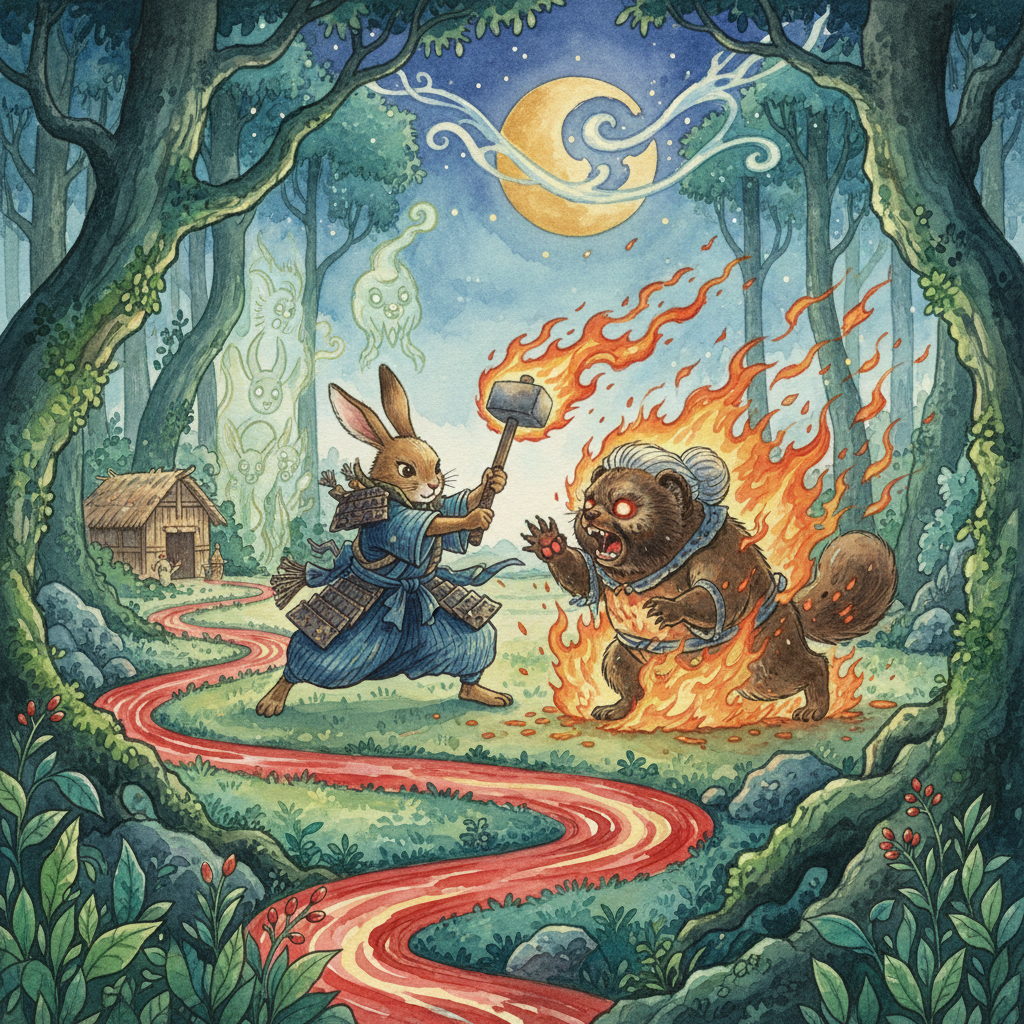
By this time the hare had decided what he would do, and as soon as they
arrived, he quietly set on fire the wood on the back of the Tanuki. The
Tanuki, who was busy with something else, observed nothing, and only
called out to ask what was the meaning of the crackling that he heard.
‘It is just the rattle of the stones which are rolling down the side of
the mountain,’ the hare said; and the Tanuki was content, and made no
further remarks, never noticing that the noise really sprang from the
burning boughs on his back, until his fur was in flames, and it was
almost too late to put it out. Shrieking with pain, he let fall the
burning wood from his back, and stamped and howled with agony. But the
hare comforted him, and told him that he always carried with him an
excellent plaster in case of need, which would bring him instant relief,
and taking out his ointment he spread it on a leaf of bamboo, and
laid it on the wound. No sooner did it touch him than the Tanuki leapt
yelling into the air, and the hare laughed, and ran to tell his friend
the peasant what a trick he had played on their enemy. But the old man
shook his head sadly, for he knew that the villain was only crushed for
the moment, and that he would shortly be revenging himself upon them.
No, the only way every to get any peace and quiet was to render the
Tanuki harmless for ever. Long did the old man and the hare puzzle
together how this was to be done, and at last they decided that they
would make two boats, a small one of wood and a large one of clay. Then
they fell to work at once, and when the boats were ready and properly
painted, the hare went to the Tanuki, who was still very ill, and
invited him to a great fish-catching. The Tanuki was still feeling angry
with the hare about the trick he had played him, but he was weak and
very hungry, so he gladly accepted the proposal, and accompanied the
hare to the bank of the river, where the two boats were moored, rocked
by the waves. They both looked exactly alike, and the Tanuki only saw
that one was bigger than the other, and would hold more fish, so he
sprang into the large one, while the hare climbed into the one which was
made of wood. They loosened their moorings, and made for the middle of
the stream, and when they were at some distance from the bank, the hare
took his oar, and struck such a heavy blow at the other boat, that it
broke in two. The Tanuki fell straight into the water, and was held
there by the hare till he was quite dead. Then he put the body in his
boat and rowed to land, and told the old man that his enemy was dead at
last. And the old man rejoiced that his wife was avenged, and he took
the hare into his house, and they lived together all their days in peace
and quietness upon the mountain.
Story DNA
Moral
Cruelty and treachery will eventually be met with cunning and justice.
Plot Summary
A peasant captures a mischievous Tanuki, but the Tanuki tricks his wife, kills and cooks her, then serves her flesh to the unsuspecting peasant before escaping. Devastated, the peasant vows revenge, aided by his loyal friend, a clever hare. The hare systematically tricks the Tanuki, first burning its back with flaming wood and applying a painful ointment, then luring it into a flimsy clay boat. The hare then smashes the clay boat, drowning the Tanuki, thus avenging the peasant's wife and bringing peace to the old man.
Themes
Emotional Arc
grief to triumph
Writing Style
Narrative Elements
Cultural Context
This story reflects traditional Japanese folklore where Tanuki are often trickster figures, and the concept of 'an eye for an eye' justice is prominent.
Plot Beats (14)
- A peasant and his wife live near a forest; the peasant is friends with a hare.
- A wicked Tanuki repeatedly causes trouble for the peasant, stealing food meant for the hare.
- The peasant captures the Tanuki, binds it, and plans to kill and cook it, leaving it with his wife while he gathers wood.
- The Tanuki tricks the peasant's wife into untying him by feigning pain and offering to help with her chores.
- The Tanuki then kills the wife, pounds her into a paste, cooks her, and disguises himself as her to serve her flesh to the unsuspecting peasant.
- After the peasant eats, the Tanuki reveals his true identity and the horrific truth, then flees into the forest.
- The peasant is horrified, buries his wife's remains, and vows revenge.
- The hare discovers the peasant's sorrow and promises to help him avenge his wife.
- The hare approaches the Tanuki, feigning friendship, and tricks it into carrying a heavy bundle of wood on its back.
- The hare secretly sets the wood on fire, severely burning the Tanuki, then applies a painful pepper-laced ointment to its wounds.
- The peasant and hare plot further, deciding to build two boats: one of wood and one of clay.
- The hare invites the still-injured Tanuki to go fishing, and the Tanuki, seeing the larger boat, chooses the clay one.
- Out on the river, the hare smashes the clay boat, drowning the Tanuki.
- The hare returns with the dead Tanuki, and the peasant rejoices that his wife is avenged, living out his days in peace with the hare.
Characters
Peasant ★ protagonist
Strong, capable of wandering the forest and gathering wood
Attire: Simple peasant clothing, likely a kimono-like garment and straw sandals
Patient, vengeful, grief-stricken
Image Prompt & Upload
A young man in his late teens with sun-weathered skin and messy, straw-colored hair stands with a determined expression. He wears a rough-spun, earth-toned tunic belted at the waist, patched trousers, and worn leather boots. A simple wooden-handled sickle is tucked into his belt. He holds a sturdy walking staff in one hand, posture straight and resolute, gazing forward with hope in his eyes. Plain white background, full body visible head to toe, single figure, no watermark, no text, no signature.
Wife ◆ supporting
Old woman, arms ache from pounding rice
Attire: Traditional Japanese peasant woman's clothing, kimono and apron
Gullible, kind-hearted, hardworking
Image Prompt & Upload
A middle-aged woman with kind eyes and a warm smile, her chestnut hair neatly braided beneath a simple linen headscarf. She wears a practical, earth-toned woolen dress with a faded floral apron, her sleeves rolled up as if just pausing from work. Her posture is gentle and supportive, one hand resting on a worn wooden table in a cozy cottage kitchen. Soft light filters through a small window, illuminating herbs hanging from the rafters. Plain white background, full body visible head to toe, single figure, no watermark, no text, no signature.
Tanuki ⚔ antagonist
Wicked, quarrelsome beast, capable of shapeshifting
Attire: None normally, but able to mimic human clothing
Malicious, cunning, greedy
Image Prompt & Upload
An elderly, cunning-looking humanoid with sharp, vulpine features and glowing amber eyes. He wears a tattered, dark grey kimono with a frayed obi sash, his long silver hair tied back in a messy topknot. His posture is slightly hunched, one clawed hand clutching a glowing, sinister-looking orb of dark energy, the other extended with fingers curled as if casting a spell. A cruel, knowing smirk plays on his lips. Plain white background, full body visible head to toe, single figure, no watermark, no text, no signature.
Hare ◆ supporting
Small, quick, intelligent
Loyal, clever, vengeful
Image Prompt & Upload
An anthropomorphic hare with sleek brown fur, standing upright on two legs. He wears a simple white tunic with a green sash tied at the waist. His long ears are perked up, and he has a confident, slightly smirking expression. He stands in a dynamic pose, one foot forward as if about to dash, with his arms held loosely at his sides. Plain white background, full body visible head to toe, single figure, no watermark, no text, no signature.
Locations
Cottage between Mountains
Near a big river, between two high mountains, surrounded by a dense forest
Mood: secluded, familiar
The peasant lives here with his wife; the Tanuki repeatedly steals food.
Image Prompt & Upload
Golden hour light spills over two towering, jagged mountains, their peaks dusted with snow, framing a narrow valley. In the center, a cozy, thatched-roof cottage of dark stone sits on the mossy bank of a wide, rushing river. Its small windows glow with warm amber light. The scene is enveloped by an ancient, dense forest of towering pines and gnarled oaks, their leaves a deep emerald green. A soft morning mist curls off the river's surface, weaving between the tree trunks. The air feels crisp and magical, with rich colors of deep green, stony grey, and golden light. no border, no frame, no watermark, no text, no signature, edge-to-edge illustration
Peasant's Cottage Interior
Contains a mortar for pounding rice and a beam to hang the Tanuki from
Mood: domestic, briefly terrifying
The Tanuki tricks the wife, kills her, and cooks her flesh for the husband.
Image Prompt & Upload
A dim, rustic peasant cottage interior at dusk, illuminated by the warm glow of a dying hearth fire. The main focus is a heavy, worn wooden mortar and pestle on the packed earth floor. Above, a thick, dark wooden beam stretches across the low ceiling, with a simple rope hanging from it. The walls are rough-hewn timber and wattle-and-daub, with tools and dried herbs hanging from pegs. A small, high window lets in the last blue light of evening, contrasting with the firelight's golden hues. The atmosphere is quiet, still, and slightly mysterious. no border, no frame, no watermark, no text, no signature, edge-to-edge illustration.
Forest Path
A path through the forest with thick boughs and big trees
Mood: deceptive, dangerous
The hare tricks the Tanuki into carrying burning wood, causing him great pain.
Image Prompt & Upload
A winding dirt path through an ancient forest at late afternoon, golden sunlight filtering through the dense canopy of towering oak and pine trees. Thick, gnarled boughs form a natural archway overhead, with patches of emerald moss clinging to the bark. Dappled light creates pools of warm gold on the forest floor, which is carpeted with fallen amber leaves and delicate ferns. A gentle mist hangs in the air, catching the sunbeams. The trees are massive and deeply textured, their roots snaking across the edges of the path. The atmosphere is serene and slightly mysterious, with a palette of deep greens, rich browns, and warm golden highlights. No border, no frame, no watermark, no text, no signature, edge-to-edge illustration.
Riverbank with Boats
The bank of a river where two boats are moored, one of wood and one of clay
Mood: treacherous, final
The hare drowns the Tanuki by destroying the clay boat.
Image Prompt & Upload
A tranquil riverbank at golden hour, the water a smooth ribbon of amber and deep blue reflecting a pastel sky. Two boats are moored to a weathered wooden pier: one a rustic, peeling green wooden fishing boat with frayed ropes, the other a bulbous, earth-toned clay boat, its surface rough and textured. The muddy bank is dotted with smooth stones, tall reeds, and clusters of purple wildflowers. A gentle mist rises from the water's surface. In the background, a dense line of willow and birch trees forms a dark silhouette against the sunset. The air is still and peaceful, filled with the soft glow of fading light. no border, no frame, no watermark, no text, no signature, edge-to-edge illustration