The Merry Wives
by Andrew Lang · from The Pink Fairy Book
Adapted Version
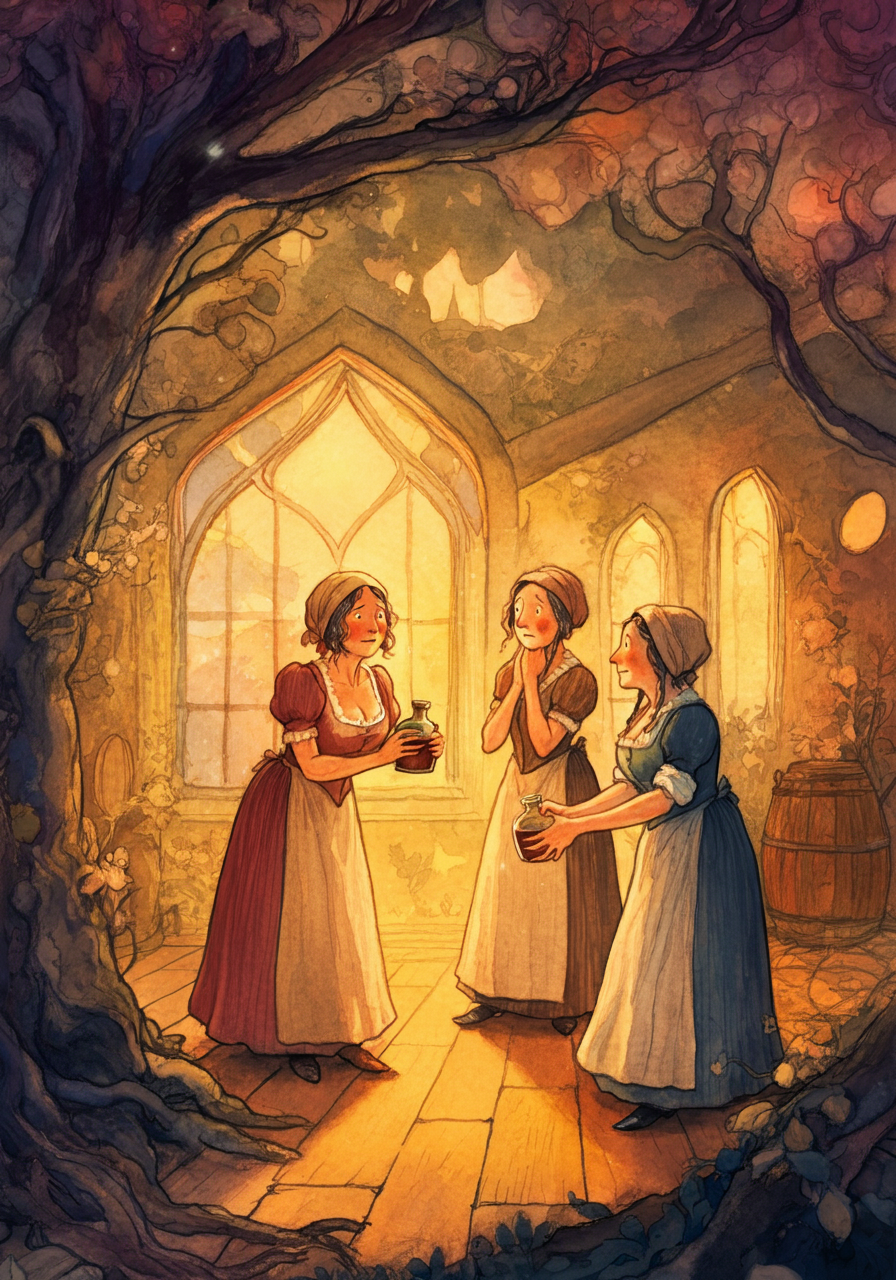
Once, three friends liked to meet. Anna, Maja, and Sofia were friends. They met every week. They talked and drank juice. They liked to talk. "Your husband is silly," said Anna. "No, your husband is silly!" said Maja. "No, yours!" said Sofia. They laughed and laughed.
One day, juice cost more. They needed more coins. They did not want to pay. "I have a game," said Anna. "We trick our husbands. The best trick wins. The winner gets free juice." "Yes!" said Maja. "Yes!" said Sofia.
The next day, Anna talked to Erik. "I need help," she said. "Be our dog tonight. Bark at the boys. Keep them away." Erik was not sure. "Please," said Anna. "Okay," said Erik. That night, Erik wore a big coat. Anna tied him with a rope. "Bark, bark!" said Erik. He barked at everyone. Anna laughed and laughed.
The next day, Maja talked to Lars. "Oh no!" she said. "You look sick. You are very sick. You must go to bed." Lars felt fine. But he listened to Maja. She put him in a box. She gave him a bottle of juice. "You are dead now," she said. Lars believed her. He lay still. He drank the juice. He had happy dreams.
The next day, Sofia talked to Kai. "Wake up!" she said. "You are late for the party!" Kai was sleepy. He looked at himself. He was all black! Sofia had put paint on him. "Run to the party!" she said. Kai ran very fast. He saw people with a box. "Wait for me!" he shouted. "I can help carry!"
The people saw Kai. He was all black. They were scared! They dropped the box. They ran away. The box opened. Lars sat up. He saw Kai. He laughed and laughed. "Kai, you are so funny!" he said. "If I was not dead, I would laugh more!"
Anna, Maja, and Sofia watched. They all laughed. "Maja wins!" said Anna. "Her trick was the best." "Yes!" said Sofia. Maja got free juice every week. Being clever is fun. But be kind to friends. And they all laughed and had fun.
Original Story
The Merry Wives
From the Danish
There lay three houses in a row, in one of which there lived a tailor,
in another a carpenter, and in the third a smith. All three were
married, and their wives were very good friends. They often talked about
how stupid their husbands were, but they could never agree as to which
of them had the most stupid one; each one stuck up for her own husband,
and maintained that it was he.
The three wives went to church together every Sunday, and had a regular
good gossip on the way, and when they were coming home from church they
always turned into the tavern which lay by the wayside and drank half
a pint together. This was at the time when half a pint of brandy cost
threepence, so that was just a penny from each of them.
But the brandy went up in price, and the taverner said that he must have
fourpence for the half-pint.
They were greatly annoyed at this, for there were only the three of them
to share it, and none of them was willing to pay the extra penny.
As they went home from the church that day they decided to wager with
each other as to whose husband was the most stupid, and the one who, on
the following Sunday, should be judged to have played her husband the
greatest trick should thereafter go free from paying, and each of the
two others would give twopence for their Sunday’s half-pint.
Next day the tailor’s wife said to her husband, ‘I have some girls
coming to-day to help to card my wool there is a great deal to do, and
we must be very busy. I am so annoyed that our watchdog is dead, for in
the evening the young fellows will come about to get fun with the girls,
and they will get nothing done. If we had only had a fierce watchdog he
would have kept them away.’
‘Yes,’ said the man, ‘that would have been a good thing.’
‘Listen, good man,’ said the wife, ‘you must just be the watchdog
yourself, and scare the fellows away from the house.’
The husband was not very sure about this, although otherwise he was
always ready to give in to her.
‘Oh yes, you will see it will work all right,’ said the wife.
And so towards evening she got the tailor dressed up in a shaggy fur
coat, tied a black woollen cloth round his head, and chained him up
beside the dog’s kennel.’
There he stood and barked and growled at everyone that moved in his
neighbourhood. The neighbour wives knew all about this, and were greatly
amused at it.
On the day after this the carpenter had been out at work, and came home
quite merry; but as soon as he entered the house his wife clapped her
hands together and cried, ‘My dear, what makes you look like that? You
are ill.’
The carpenter knew nothing about being ill; he only thought that he
wanted something to eat, so he sat down at the table and began his
dinner.
His wife sat straight in front of him, with her hands folded, and shook
her head, and looked at him with an anxious air.
‘You are getting worse, my dear,’ she said; ‘you are quite pale now; you
have a serious illness about you; I can see it by your looks.’
The husband now began to grow anxious, and thought that perhaps he was
not quite well.
‘No, indeed,’ said she; ‘it’s high time that you were in bed.’
She then got him to lie down, and piled above him all the bedclothes
she could find, and gave him various medicines, while he grew worse and
worse.
‘You will never get over it,’ said she; ‘I am afraid you are going to
die.’
‘Do you think so?’ said the carpenter; ‘I can well believe it, for I am
indeed very poorly.’
In a little while she said again, ‘Ah, now I must part with you. Here
comes Death. Now I must close your eyes.’ And she did so.
The carpenter believed everything that his wife said, and so he believed
now that he was dead, and lay still and let her do as she pleased.
She got her neighbours summoned, and they helped to lay him in the
coffin--it was one of those he himself had made; but his wife had bored
holes in it to let him get some air. She made a soft bed under him, and
put a coverlet over him, and she folded his hands over his breast;
but instead of a flower or a psalm-book, she gave him a pint-bottle of
brandy in his hands. After he had lain for a little he took a little
pull at this, and then another and another, and he thought this did
him good, and soon he was sleeping sweetly, and dreaming that he was in
heaven.
Meanwhile word had gone round the village that the carpenter was dead,
and was to be buried next day.
It was now the turn of the smith’s wife. Her husband was lying sleeping
off the effects of a drinking bout, so she pulled off all his clothes
and made him black as coal from head to foot, and then let him sleep
till far on in the day.
The funeral party had already met at the carpenter’s, and marched oft
towards the church with the coffin, when the smith’s wife came rushing
in to her husband.
‘Gracious, man,’ said she, ‘you are lying there yet? You are sleeping
too long. You know you are going to the funeral.’
The smith was quite confused; he knew nothing about any funeral.
‘It’s our neighbour the carpenter,’ said his wife, ‘who is to be buried
to-day. They are already half-way to church with him.’
‘All right,’ said the smith, ‘make haste to help me on with my black
clothes.’
‘What nonsense!’ said his wife, ‘you have them on already. Be off with
you now.’
The smith looked down at his person and saw that he was a good deal
blacker than he usually was, so he caught up his hat and ran out after
the funeral. This was already close to the church, and the smith wanted
to take part in carrying the coffin, like a good neighbour. So he ran
with all his might, and shouted after them, ‘Hey! wait a little; let me
get a hold of him!’
The people turned round and saw the black figure coming, and thought it
was the devil himself, who wanted to get hold of the carpenter, so they
threw down the coffin and took to their heels.
The lid sprang off the coffin with the shock, and the carpenter woke up
and looked out. He remembered the whole affair; he knew that he was dead
and was going to be buried, and recognising the smith, he said to him,
in a low voice, ‘My good neighbour, if I hadn’t been dead already, I
should have laughed myself to death now to see you coming like this to
my funeral.’
From that time forth the carpenter’s wife drank free of expense every
Sunday, for the others had to admit that she had fooled her husband the
best.
Story DNA
Moral
Sometimes, the most elaborate deceptions are the most effective, especially when targeting the naive.
Plot Summary
Three wives, who regularly meet for brandy and debate whose husband is the most foolish, decide to hold a contest when their drink price increases. The winner, who plays the greatest trick on her husband, will drink for free. The tailor's wife makes her husband act as a watchdog, the carpenter's wife convinces hers he's dead and puts him in a coffin with brandy, and the smith's wife covers her husband in soot, telling him he's late for the carpenter's funeral. The soot-covered smith chases the funeral, terrifying mourners who drop the coffin, revealing the 'dead' carpenter. The wives declare the carpenter's wife the winner, securing her free drinks.
Themes
Emotional Arc
amusement to triumph
Writing Style
Narrative Elements
Cultural Context
The specific price of brandy (threepence, fourpence) grounds the story in a historical economic reality, though the exact era is less important than the social customs.
Plot Beats (15)
- Three wives of a tailor, carpenter, and smith are friends who regularly gossip and drink brandy after church.
- They often argue about whose husband is the most stupid, each defending her own.
- The price of their Sunday brandy increases from three to fourpence, causing a dilemma as none wants to pay the extra penny.
- They decide to hold a contest: whoever plays the greatest trick on her husband will drink for free, paid for by the other two.
- The tailor's wife makes her husband dress in a fur coat and act as a watchdog, chained by the kennel, barking at passersby.
- The carpenter's wife convinces her husband he is deathly ill, then dead, and lays him in a coffin he made himself, with air holes and a bottle of brandy.
- The carpenter believes he is dead and drinks the brandy, dreaming he is in heaven.
- The smith's wife, while her husband sleeps off a drinking bout, covers him in soot, making him black.
- She wakes him, tells him he's late for the carpenter's funeral, and that he's already dressed in his black clothes.
- The smith, confused but seeing his black skin, rushes to join the funeral procession.
- He runs after the mourners, shouting to help carry the coffin.
- The mourners see the black figure and, thinking it's the devil, drop the coffin and flee.
- The coffin lid opens, and the carpenter wakes up, seeing the smith.
- The carpenter tells the smith he would have laughed himself to death if he hadn't already been dead.
- The wives declare the carpenter's wife the winner, and she drinks for free from then on.
Characters
Tailor's Wife ◆ supporting
Not described, but likely a sturdy, practical woman.
Attire: Simple, practical Danish peasant dress of the period, with an apron.
Clever, mischievous, dominant
Image Prompt & Upload
A middle-aged woman with kind, crinkled eyes and a gentle smile, her brown hair neatly pinned up beneath a simple linen coif. She wears a practical dress of undyed wool with a full, flour-dusted apron. Her posture is slightly bent, hands busy mending a tear in a large bolt of vibrant red fabric. She stands in a cozy, cluttered tailor's workshop filled with colorful threads and patterns. Plain white background, full body visible head to toe, single figure, no watermark, no text, no signature
Tailor ◆ supporting
Likely thin and wiry from his trade.
Attire: Shaggy fur coat, black woollen cloth tied around his head, chained up.
Gullible, obedient, easily manipulated
Image Prompt & Upload
A middle-aged man with a kind, weathered face and a thin mustache, wearing a leather apron over a simple tunic with the sleeves rolled up. His hair is neatly combed, and he has a focused, thoughtful expression. He stands with a slight stoop, one hand holding a measuring tape around his neck and the other resting on a pair of large scissors tucked into his belt. Plain white background, full body visible head to toe, single figure, no watermark, no text, no signature.
Carpenter's Wife ◆ supporting
Not described, but likely a strong woman.
Attire: Simple, practical Danish peasant dress of the period, with an apron.
Deceptive, cunning, resourceful
Image Prompt & Upload
A middle-aged woman with a kind, gentle face and faint smile. She has warm brown hair neatly pinned up beneath a white linen cap. She wears a practical, long-sleeved dress of faded blue wool with a clean, white apron tied around her waist. Her hands are slightly rough but held clasped gently before her. She stands in a relaxed, welcoming posture, her head tilted slightly. Plain white background, full body visible head to toe, single figure, no watermark, no text, no signature.
Carpenter ◆ supporting
Likely of average build from his trade.
Attire: Burial clothes, pint-bottle of brandy in his hands.
Gullible, suggestible, easily convinced
Image Prompt & Upload
A sturdy middle-aged man with a kind, weathered face, deep smile lines, and warm brown eyes. He has short, salt-and-pepper hair and a neatly trimmed beard. He wears a heavy leather apron over a simple linen shirt with the sleeves rolled up to his elbows, revealing strong, tanned forearms. His posture is slightly bent forward, focused on his work, holding a wooden mallet in one hand and a chisel in the other. Plain white background, full body visible head to toe, single figure, no watermark, no text, no signature.
Smith's Wife ◆ supporting
Not described, but likely a robust woman.
Attire: Simple, practical Danish peasant dress of the period, with an apron.
Mischievous, impulsive, quick-thinking
Image Prompt & Upload
A sturdy middle-aged woman with kind, tired eyes and warm brown hair pinned up in a practical bun. She wears a simple, faded blue linen dress with a flour-dusted brown apron over it. Her sleeves are rolled to the elbows, revealing strong arms, and she holds a wooden spoon. She stands in a humble kitchen with a hearth, looking directly at the viewer with a gentle, welcoming smile. Her posture is solid and dependable. Plain white background, full body visible head to toe, single figure, no watermark, no text, no signature.
Smith ◆ supporting
Large and muscular from his trade, covered in soot.
Attire: Naked and covered in soot, looking like the devil.
Oblivious, easily confused, well-meaning
Image Prompt & Upload
A middle-aged man with a kind, weathered face and warm brown eyes. He has short, salt-and-pepper hair and a neatly trimmed beard. He wears a simple, earthy-toned tunic over dark trousers, sturdy leather boots, and a leather apron. He stands in a helpful pose, holding out a freshly baked loaf of bread with a gentle, welcoming smile. Plain white background, full body visible head to toe, single figure, no watermark, no text, no signature.
Locations
Tailor's House Yard
Beside the dog's kennel, where the tailor is chained up dressed in a shaggy fur coat and black woollen cloth.
Mood: humorous, absurd
The tailor is tricked into acting as a watchdog.
Image Prompt & Upload
Dusk settles over a cramped, neglected yard behind a crooked timber cottage. A heavy iron chain lies coiled in the mud beside a splintered, roofless dog kennel. Scattered patches of withered grass push through the damp, dark earth. The air is cold and still, under a sky of bruised purple and grey clouds. A single, bare-branched tree casts long, skeletal shadows. Tattered scraps of black wool and coarse fur are snagged on the rough wooden fence and the kennel's splintered edges, fluttering weakly. The fading light is flat and grey, leaching color from the scene, highlighting the textures of rust, damp wood, and sodden fabric. no border, no frame, no watermark, no text, no signature, edge-to-edge illustration.
Carpenter's House
Inside the carpenter's house, where his wife convinces him he is deathly ill and puts him to bed.
Mood: anxious, deceptive
The carpenter is tricked into believing he is dying.
Image Prompt & Upload
Late afternoon light slants through a small, dusty window, illuminating a cluttered carpenter's workshop interior. Wooden shavings curl on the floor around a half-finished rocking horse. Tools—handsaws, chisels, a worn mallet—hang neatly on pegboard walls. A single, narrow bed with a rumpled quilt is pushed into a corner, its pillow indented. The air is still, heavy with the scent of pine and linseed oil. Golden sunbeams catch floating dust motes, casting long shadows from a workbench laden with wood blocks. A sense of quiet interruption hangs in the warm, woody space. no border, no frame, no watermark, no text, no signature, edge-to-edge illustration.
Road to the Church
The road leading to the church, where the funeral procession is underway.
Mood: solemn, chaotic
The smith, covered in soot, interrupts the funeral, causing chaos.
Image Prompt & Upload
A winding dirt road stretches toward a distant medieval stone church with a tall steeple, under a heavy overcast sky of gray and lavender. The road is lined with ancient, gnarled oaks, their leaves a deep autumnal green and brown. A low mist clings to the ground, softening the edges of the weathered stone walls and the iron gate of the churchyard. The light is flat and somber, casting long, subtle shadows. The atmosphere is solemn and quiet, with a palette of muted grays, deep greens, and earthy browns. no border, no frame, no watermark, no text, no signature, edge-to-edge illustration
Tavern by the Wayside
A tavern on the road, where the wives regularly stop for a half-pint of brandy.
Mood: social, gossipy
The wives discuss their husbands' stupidity and make a wager.
Image Prompt & Upload
Late afternoon sunlight filters through soft clouds, casting a warm golden glow over a timber-framed tavern nestled beside a winding country road. The thatched roof is neatly kept, with smoke curling from a stone chimney. Flower boxes with red geraniums adorn the mullioned windows, from which a soft, inviting light spills onto the cobblestone path. A wooden sign, painted with a half-pint glass, hangs above the sturdy oak door. Surrounding the tavern are lush green hedges, a small herb garden, and a few ancient oak trees. The road is quiet, lined with wildflowers and leading into rolling hills in the distance. The atmosphere is peaceful, welcoming, and serene, with a sense of timeless charm. no border, no frame, no watermark, no text, no signature, edge-to-edge illustration