The Thanksgiving of the Wazir
by Andrew Lang · from The Olive Fairy Book
Adapted Version
Once, there were two kings. They were not friends.
They made a rule. Going to the other's land means getting caught. This rule was very big. Both kings follow this rule each day. No one can break this rule.
One day, the King is writing. He cuts his finger by mistake. It hurts a lot. He sees blood. The blood is red. The King is worried. The King is in pain. He calls for help.
The Wise Man says thanks. The King is angry. He does not get it. He shouts, 'Why?' The Wise Man stays calm. The King is very mad. He does not like thanks for bad things. He puts the Wise Man in a room.
The King is sad. He goes for a walk to think. He walks and walks. He thinks about his finger. He thinks about the Wise Man. The sun is hot. The King is tired. He goes too far. He enters the Other King's land.
The Other King's men catch him. They hold him tight. They take him away. The King is scared. He does not know what will happen. The Other King's men are strong. They do not let go.
The Other King talks to his priests. They say it is a bad day. They need a perfect person for good luck. The priests are worried. The fairy spirit likes perfect things. We must find one. They talk and talk. They need good luck now.
The head priest says the King is the one. He points at the King. This is perfect, he says. He is sure. The King is the one.
They get ready for the event. They clean the place. They sing songs. They bring flowers. They make a special place. All are quiet. They wait for good luck. The King is brought out.
The event starts. The priest sees the hurt finger. The priest looks close. He sees the finger is not all there. He says the King is not perfect. The fairy spirit will not like this. The priest is sad. The event cannot go on.
The Other King is happy. He lets the King go. He gives him presents. He gives gold and food. The Other King says, "I am sorry. Let us be friends." The Other King is kind. He gives many gifts. They become friends. They agree to be nice.
The King goes home. He is glad to be home. He asks for the Wise Man to come. The Wise Man comes out of the room. The Wise Man smiles. He is happy to see the King. The King is happy. He hugs the Wise Man.
The King tells his story. He asks, "Why did you say thank you?"
The Wise Man says, "Your hurt finger saved you. My being in the room saved me. Your finger was hurt, so you were not perfect. I was in the room, so I was not there." The Wise Man is wise. He knows all things.
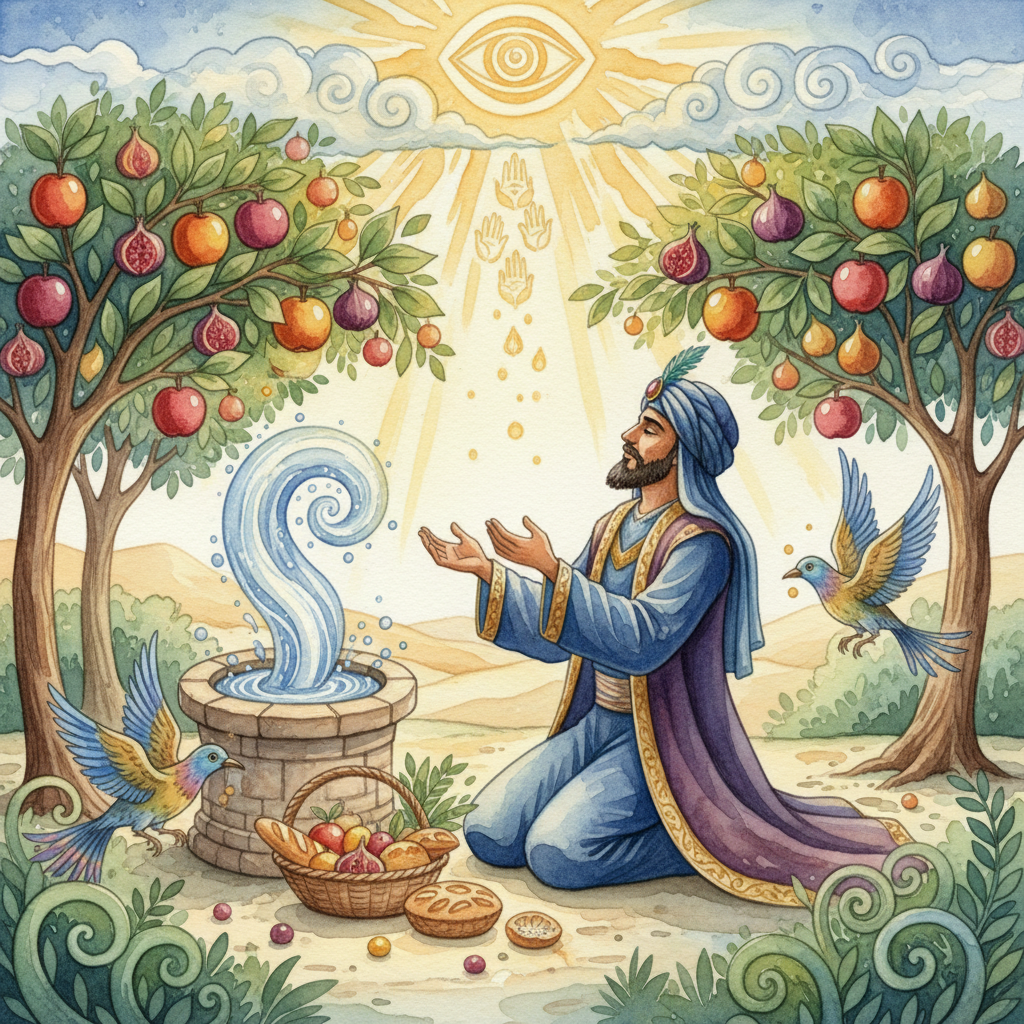
The King gets it. He says thank you too. "At times bad things help us," says the Wise Man. "Always say thank you."
And so, they learned to be thankful. Don't forget, even bad things can be good. Always be thankful. They smile as one. They say thank you again. Thank you, thank you. They are friends now. They are always thankful.
Original Story
THE THANKSGIVING OF THE WAZIR
Once upon a time there lived in Hindustan two kings whose countries
bordered upon each other; but, as they were rivals in wealth and
power, and one was a Hindu rajah and the other a Mohammedan bâdshah,
they were not good friends at all. In order, however, to escape
continual quarrels, the rajah and the bâdshah had drawn up an
agreement, stamped and signed, declaring that if any of their
subjects, from the least to the greatest, crossed the boundary between
the two kingdoms, he might be seized and punished.
One morning the bâdshah and his chief wazir, or prime minister, were
just about to begin their morning's work over the affairs of the
kingdom, and the bâdshah had taken up a pen and was cutting it to his
liking with a sharp knife, when the knife slipped and cut off the tip
of his finger.
'Oh-he, wazir!' cried the king, 'I've cut the tip of my finger off!'
'That is good hearing!' said the wazir in answer.
'Insolent one,' exclaimed the king. 'Do you take pleasure in the
misfortunes of others, and in mine also? Take him away, my guards, and
put him in the court prison until I have time to punish him as he
deserves!'
Instantly the officers in attendance seized upon the luckless wazir,
and dragged him out of the king's presence towards the narrow doorway,
through which unhappy criminals were wont to be led to prison or
execution. As the door opened to receive him, the wazir muttered
something into his great white beard which the soldiers could not
hear.
'What said the rascal?' shouted the angry king.
He says, 'he thanks your majesty,' replied one of the gaolers. And at
his words, the king stared at the closing door, in anger and
amazement.
'He must be mad,' he cried, 'for he is grateful, not only for the
misfortunes of others, but for his own; surely something has turned
his head!'
Now the king was very fond of his old wazir, and although the court
physician came and bound up his injured finger with cool and healing
ointment, and soothed the pain, he could not soothe the soreness of
the king's heart, nor could any of all his ministers and courtiers,
who found his majesty very cross all the day long.
Early next morning the king ordered his horse and declared that he
would go hunting. Instantly all was bustle and preparation in stable
and hall, and by the time he was ready a score of ministers and
huntsmen stood ready to mount and accompany him; but to their
astonishment the king would have none of them. Indeed, he glared at
them so fiercely that they were glad to leave him. So away and away he
wandered, over field and through forest, so moody and thoughtful that
many a fat buck and gaudy pheasant escaped without notice, and so
careless was he whither he was going that he strayed without
perceiving it over into the rajah's territory, and only discovered the
fact when, suddenly, men stepped from all sides out of a thicket, and
there was nothing left but surrender. Then the poor bâdshah was seized
and bound and taken to the rajah's prison, thinking most of the time
of his wazir, who was suffering a similar fate, and wishing that, like
the wazir, he could feel that there was something to give thanks for.
That night the rajah held a special council to consider what should
be done to his rival who had thus given himself into his hands. All
the Brahmans were sent for--fat priests who understood all about
everything, and what days were lucky and what unlucky--and, whilst all
the rest of the rajah's councillors were offering him different advice
until he was nearly crazy with anger and indecision, the chief Brahman
was squatting in a corner figuring out sums and signs to himself with
an admiring group of lesser priests around him. At last he arose, and
advanced towards the throne.
'Well,' said the rajah anxiously, 'what have you to advise?'
'A very unlucky day!' exclaimed the chief Brahman. 'Oh, a very unlucky
day! The god Devi is full of wrath, and commands that to-morrow you
must chop off this bâdshah's head and offer it in to him in
sacrifice.'
'Ah, well,' said the rajah, 'let it be done. I leave it to you to
carry out the sentence.' And he bowed to the priests and left the
room.
Before dawn great preparations were being made for a grand festival in
honour of the great idol Devi. Hundreds of banners waved, hundreds of
drummers drummed, hundreds of singers chanted chants, hundreds of
priests, well washed and anointed, performed their sacred rites,
whilst the rajah sat, nervous and ill at ease, amongst hundreds of
courtiers and servants, wishing it were all well over. At last the
time came for the sacrifice to be offered, and the poor bâdshah was
led out bound, to have his head chopped off.
The chief Brahman came along with a smile on his face, and a big sword
in his hand, when, suddenly, he noticed that the bâdshah's finger was
tied up in a bit of rag. Instantly he dropped the sword, and, with his
eyes starting out of his head with excitement, pounced upon the rag
and tore it off, and there he saw that the tip of his victim's finger
was missing. At this he got very red and angry indeed, and he led the
bâdshah up to where the rajah sat wondering.
'Behold! O rajah,' he said, 'this sacrifice is useless, the tip of his
finger is gone! A sacrifice is no sacrifice unless it is complete.'
And he began to weep with rage and mortification.
But of instead of wailing likewise, the rajah gave a sigh of relief,
and answered: 'Well, that settles the matter. If it had been anyone
else I should not have minded; but, somehow--a king and all--well, it
doesn't seem quite right to sacrifice a king.' And with that he jumped
up and with his jewelled dagger cut the bâdshah's cords, and marched
with him out of the temple back to the palace.
After having bathed and refreshed his guest, the rajah loaded him with
gifts, and himself accompanied him with a large escort as far as the
frontier between their kingdoms, where, amidst salutes and great
rejoicings, they tore up the old agreement and drew up another in
which each king promised welcome and safe conduct to any of the
other's people, from the least to the greatest, who came over the
border on any errand whatever. And so they embraced, and each went his
own way.
When the bâdshah got home that very evening he sent for his imprisoned
wazir.
'Well, O wazir!' he said, when the old man had been brought before
him, 'what think you has been happening to me?'
'How can a man in prison know what is happening outside it?' answered
the wazir.
Then the bâdshah told him all his adventures. And when he had reached
the end he added:
'I have made up my mind, as a token of gratitude for my escape, to
pardon you freely, if you will tell me why you gave thanks when I cut
off the tip of my finger.'
'Sire,' replied the old wazir, 'am I not right in thinking that it
was a very lucky thing for you that you did cut off the tip of your
finger, for otherwise you would certainly have lost your head. And to
lose a scrap of one's finger is surely the least of the two evils.'
'Very true,' answered the king, touching his head as he spoke, as if
to make quite certain that it was still there, 'but yet--why did you
likewise give thanks when I put you into prison?'
'I gave thanks,' said the wazir, 'because it is good always to give
thanks. And had I known that my being in prison was to prevent the god
Devi claiming me instead of your majesty, as a perfect offering, I
should have given greater thanks still.'
(Punjâbi story.)
Story DNA
Moral
Even in misfortune, there can be hidden blessings, and it is always good to give thanks.
Plot Summary
A Badshah accidentally cuts off his fingertip, and his Wazir's unexpected gratitude leads to the Wazir's imprisonment. Later, the Badshah, while hunting alone, unknowingly crosses into a rival Rajah's territory and is captured. The Rajah's Brahmans decree the Badshah must be sacrificed to the god Devi, but just as the ritual is to occur, the missing fingertip renders the Badshah an imperfect offering, saving his life. The Rajah, relieved, frees the Badshah, and they forge a new, friendly alliance. Upon returning home, the Badshah releases his Wazir, who reveals that his earlier gratitude stemmed from an understanding that all events, even misfortunes, serve a greater, protective purpose.
Themes
Emotional Arc
anger to understanding
Writing Style
Narrative Elements
Cultural Context
The story reflects the historical coexistence and occasional conflict between Hindu and Muslim rulers in India, and incorporates elements of traditional Indian religious practices and court structures.
Plot Beats (15)
- Two rival kings, a Badshah and a Rajah, have a border agreement: trespassers are seized.
- The Badshah accidentally cuts off his fingertip while sharpening a pen.
- His Wazir expresses gratitude for the injury, infuriating the Badshah, who imprisons him.
- The Badshah, still angry and thoughtful, goes hunting alone and inadvertently crosses into the Rajah's land.
- The Badshah is captured by the Rajah's men and imprisoned.
- The Rajah consults his Brahmans, who declare it an unlucky day requiring a human sacrifice to the god Devi.
- The chief Brahman decrees the captured Badshah as the sacrifice.
- Elaborate preparations are made for the sacrifice, and the Badshah is led out, bound.
- Just as the sacrifice is to occur, the chief Brahman notices the Badshah's bandaged finger.
- Upon removing the bandage, the Brahman discovers the missing fingertip, rendering the sacrifice imperfect and unacceptable to Devi.
- The Rajah, relieved, releases the Badshah, loads him with gifts, and they establish a new, friendly border agreement.
- The Badshah returns home and immediately sends for his imprisoned Wazir.
- The Badshah recounts his adventures and asks the Wazir why he was grateful for the finger injury and imprisonment.
- The Wazir explains that the missing fingertip saved the Badshah's life, and his own imprisonment prevented him from being an alternate, perfect sacrifice.
- The Badshah understands and acknowledges the Wazir's wisdom and gratitude.
Characters
bâdshah ★ protagonist
No specific details given
Attire: Richly decorated robes and turban befitting a king of Hindustan
Initially quick-tempered and impulsive, but ultimately grateful and forgiving
Image Prompt & Upload
A young adult male emperor with a determined expression, standing tall in a confident posture. He has short, dark hair neatly styled and a clean-shaven face. He wears an ornate, deep crimson tunic with intricate gold embroidery along the collar and sleeves, paired with dark leather trousers and polished black boots. A simple gold circlet rests on his head. One hand rests on the pommel of a sheathed sword at his hip, while the other hangs at his side. A heavy, dark blue cloak with a fur-lined collar drapes over his shoulders. Plain white background, full body visible head to toe, single figure, no watermark, no text, no signature.
Wazir ◆ supporting
No specific details given
Attire: Simple but dignified robes, reflecting his position as prime minister
Wise, philosophical, and loyal
Image Prompt & Upload
A wise middle-aged man with a neatly trimmed black beard and kind, discerning eyes. He wears layered robes of deep blue and burgundy silk, embroidered with gold thread at the hems and cuffs. A large, ornate turban of white linen sits atop his head, secured with a single emerald. He stands tall in a dignified posture, one hand resting on a carved wooden staff and the other holding an unrolled parchment scroll. His expression is calm and contemplative. Plain white background, full body visible head to toe, single figure, no watermark, no text, no signature.
rajah ⚔ antagonist
No specific details given
Attire: Richly decorated robes and turban befitting a king of Hindustan
Initially vengeful and indecisive, but ultimately relieved and willing to reconcile
Image Prompt & Upload
A tall, powerfully built man in his late 30s with a sharp, cruel face, a neatly trimmed black beard, and cold, calculating dark eyes. He has a thin scar across his left cheek. He wears opulent, dark crimson and gold robes over black armor, with a high collar and intricate metallic embroidery. His posture is arrogant and commanding, one hand resting on the hilt of a jeweled dagger at his belt. He stands in a dynamic, slightly forward-leaning pose, his expression a smirk of cruel amusement. The lighting is dramatic, casting sharp shadows across his features. Plain white background, full body visible head to toe, single figure, no watermark, no text, no signature.
chief Brahman ◆ supporting
Fat
Attire: Traditional priestly robes, possibly with sacred threads
Superstitious, excitable, and easily frustrated
Image Prompt & Upload
An elderly tribal chief with deep brown skin, wise dark eyes, and a long white beard. He wears a richly embroidered red and gold robe over simple linen garments, a tall feathered headdress with intricate beadwork, and holds a carved wooden staff. His expression is calm and authoritative, standing tall with a dignified posture. Plain white background, full body visible head to toe, single figure, no watermark, no text, no signature.
Devi ○ minor
Not described
Attire: Not described
wrathful
Image Prompt & Upload
A young girl around 8 years old with warm brown skin and large dark expressive eyes. She has long black hair in two braids adorned with small golden flowers and tiny bells. She wears a flowing saffron and magenta lehenga choli with intricate gold embroidery along the hem and sleeves, a sheer dupatta draped loosely over one shoulder. Small gold bangles on her wrists and delicate anklets on bare feet. Her expression is one of wonder and gentle curiosity, head tilted slightly with a soft smile. She stands in a graceful pose with one hand holding a glowing lotus flower that emits soft golden light, the other hand reaching out as if offering it to someone. She has a small bindi on her forehead and tiny gold earrings. Her posture is upright yet relaxed, embodying youthful innocence and quiet confidence. Plain white background, full body visible head to toe, single figure, no watermark, no text, no signature
Locations
Bâdshah's Palace
A grand hall where the bâdshah conducts affairs of state, complete with a narrow doorway leading to the prison.
Mood: formal, tense, prone to sudden shifts in mood
The bâdshah accidentally cuts his finger, leading to the wazir's imprisonment.
Image Prompt & Upload
A grand ceremonial hall in a vast, opulent palace, late afternoon light streaming through high arched windows, casting long dramatic shadows across intricate geometric tile floors. The space is defined by towering marble columns, gilded archways, and walls adorned with elaborate, faded frescoes depicting ancient triumphs. In the distance, a single, narrow, iron-bound doorway is set into a dark stone wall, its shadowed passage hinting at a cold, damp prison beyond. The air is still and heavy with the scent of old incense and dust. Rich jewel tones of deep crimson and sapphire blue in the tapestries contrast with the stark, grey stone of the ominous doorway. Dust motes drift in the golden shafts of light. no border, no frame, no watermark, no text, no signature, edge-to-edge illustration.
Forest Border
A dense forest area marking the boundary between the two kingdoms, with thickets suitable for hiding.
Mood: treacherous, uncertain, dangerous
The bâdshah unknowingly crosses the border and is captured.
Image Prompt & Upload
A dense, ancient forest at twilight, marking the boundary between two kingdoms. Thick, gnarled oaks and pines form an impenetrable wall of deep green and brown, their branches interlaced overhead to block the fading indigo sky. A low, creeping mist clings to the forest floor, weaving between thickets of thorny brambles and shadowy ferns. The only light is a dim, diffuse glow from the setting sun, casting long, soft shadows and highlighting the damp moss on twisted roots. The atmosphere is quiet, mysterious, and slightly ominous, with a sense of hidden depth within the tangled woods. no border, no frame, no watermark, no text, no signature, edge-to-edge illustration
Rajâh's Temple of Devi
A large open-air temple adorned with hundreds of banners, drummers, singers, and priests, centered around a large idol of Devi.
Mood: ceremonial, tense, chaotic
The bâdshah is about to be sacrificed when the missing fingertip is discovered.
Image Prompt & Upload
Golden hour bathes an ancient open-air temple in warm, amber light. Hundreds of vibrant silk banners in crimson, saffron, and deep blue flutter from carved stone pillars, surrounding a central courtyard. At its heart stands a towering, serene stone idol of Devi, draped with marigold garlands. The temple's sandstone architecture features intricate carvings of lotus flowers and divine motifs, set against a backdrop of lush, tropical foliage and distant misty mountains. The air is still, filled with the silent promise of ceremony, the stone floor scattered with fallen flower petals.

no border, no frame, no watermark, no text, no signature, edge-to-edge illustration
Court Prison
A place of confinement, presumably dark and unpleasant, where the wazir is held.
Mood: desolate, reflective, uncertain
The wazir contemplates his situation and gives thanks.
Image Prompt & Upload
A dimly lit stone dungeon beneath a grand palace, with rough-hewn gray walls slick with dampness and patches of dark moss. A single narrow window high on the wall lets in a sliver of pale moonlight, casting long shadows across the cold, uneven floor. Heavy iron chains hang from the walls, and a sturdy wooden door with iron bindings stands slightly ajar. The air feels thick and cold, with a faint mist swirling near the ground. The scene is set at midnight during a light rainstorm, with the distant sound of thunder echoing through the chamber. Colors are muted: charcoal grays, deep blues, and black shadows, with the moonlight providing a cool, silvery highlight. no border, no frame, no watermark, no text, no signature, edge-to-edge illustration