He Wins Who Waits
by Andrew Lang · from The Olive Fairy Book
Adapted Version
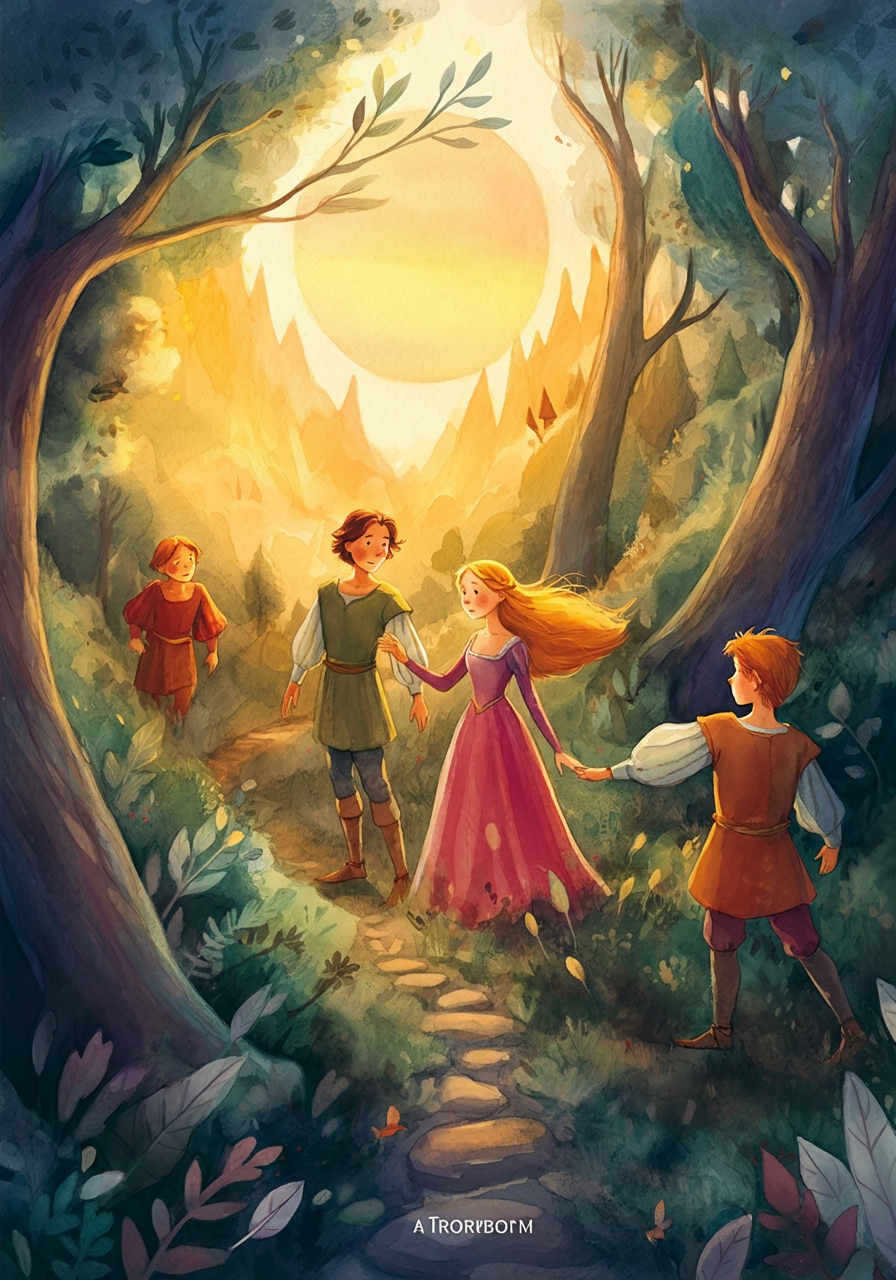
Once upon a time, there was a princess. She lived in a big castle. She was kind and brave. She wanted to choose her own husband. One day, she held a golden apple. She looked all around. She gave the apple to a kind young man. He was poor but good. The king, her father, was not happy. "You must go away," he said. So they left the castle. They were sad but hopeful.
They got married in a small church. They went to live with the young man's mother. Her house was very small. It had only one room. They had little food to eat. "I will find work," said the young man. He wanted to help his new family. He loved his wife very much.
His wife was sad to see him go. "Ask the wise man at the well," she said. "He gives good advice. He can help you." The young man nodded. He kissed his wife goodbye.
The young man walked to the well. The wise old man was sitting there. He smiled at the young man. "I have three pieces of advice for you," he said. "First, love sees good. Second, be patient for joy. Third, waiting wins." The young man thought of these words. He said them over and over. "Love sees good. Be patient for joy. Waiting wins." He wanted to remember them always.
The young man joined a group of people. They were traveling to find water. They needed water for their animals. A special well had water. But it was deep and hard to get. "I will go down," said the young man. He was brave and strong. The people were happy for his help.
In the well, he met a helper. The helper was a friendly spirit. He had two sons. They were both young and strong. "Who is more handsome?" the helper asked. The young man thought of the first advice. "Love sees good," he said. "Both are pretty to you." The helper smiled. He was happy with the answer. He gave the young man many shiny stones. The stones were red and blue. They sparkled in the light.
Later, a child came to him. The child had a toy. "Leave your work," the child said. "Come play with me." The young man thought of the second advice. "Be patient for joy," he said. He stayed and worked hard. The child was impressed. The child gave him more shiny stones. The young man was glad he waited.
The young man worked for many years. He worked every day. He sent the shiny stones home. He missed his wife. His wife had a baby boy. She took care of him with love. She told the boy about his father. She said he was a good man.
The wife used the shiny stones. She sold them for money. She built a big house by their small one. The new house had many rooms. It was happy and bright. The king, her father, came to visit. He was very proud of his daughter. He liked the boy. "You can help me," the king said to the boy. The boy smiled.
After many years, the young man came home. He was old now. He saw his wife with a young man. He felt surprised and sad. He wanted to be angry. Then he thought of the third advice. "Waiting wins," he thought. He stayed calm. He did not say anything.
He listened quietly. He heard the boy speak. "Mother, tell me about my father," the boy said. The wife told their story. She said how he went away to work. She said he sent shiny stones. She said he was patient and wise. The young man listened. He learned the boy was his son. He was so happy.
He came to them. "I am here!" he said. They looked at him. They recognized him. They hugged tightly. They were so happy and joyful. They cried tears of joy. They had waited for this moment.
They went to see the king. The king was very happy. "My daughter is home!" he cried. "You are my kin. You will be king one day." He meant the young man. The king was proud of them all.
The young man had waited. And he had won. They lived in joy ever after, because they were patient and wise. Love sees good. Be patient for joy. Waiting wins. These three advices helped them always. They were a happy family.
Original Story
HE WINS WHO WAITS
Once upon a time there reigned a king who had an only daughter. The
girl had been spoiled by everybody from her birth, and, besides being
beautiful, was clever and wilful, and when she grew old enough to be
married she refused to have anything to say to the prince whom her
father favoured, but declared she would choose a husband for herself.
By long experience the king knew that when once she had made up her
mind, there was no use expecting her to change it, so he inquired
meekly what she wished him to do.
'Summon all the young men in the kingdom to appear before me a month
from to-day,' answered the princess; 'and the one to whom I shall give
this golden apple shall be my husband.'
'But, my dear--' began the king, in tones of dismay.
'The one to whom I shall give this golden apple shall be my husband,'
repeated the princess, in a louder voice than before. And the king
understood the signal, and with a sigh proceeded to do her bidding.
* * * * *
The young men arrived--tall and short, dark and fair, rich and poor.
They stood in rows in the great courtyard in front of the palace, and
the princess, clad in robes of green, with a golden veil flowing
behind her, passed before them all, holding the apple. Once or twice
she stopped and hesitated, but in the end she always passed on, till
she came to a youth near the end of the last row. There was nothing
specially remarkable about him, the bystanders thought; nothing that
was likely to take a girl's fancy. A hundred others were handsomer,
and all wore finer clothes; but he met the princess's eyes frankly and
with a smile, and she smiled too, and held out the apple.
'There is some mistake,' cried the king, who had anxiously watched her
progress, and hoped that none of the candidates would please her. 'It
is impossible that she can wish to marry the son of a poor widow, who
has not a farthing in the world! Tell her that I will not hear of it,
and that she must go through the rows again and fix upon someone
else'; and the princess went through the rows a second and a third
time, and on each occasion she gave the apple to the widow's son.
'Well, marry him if you will,' exclaimed the angry king; 'but at least
you shall not stay here.' And the princess answered nothing, but threw
up her head, and taking the widow's son by the hand, they left the
castle.
That evening they were married, and after the ceremony went back to
the house of the bridegroom's mother, which, in the eyes of the
princess, did not look much bigger than a hen-coop.
The old woman was not at all pleased when her son entered bringing his
bride with him.
'As if we were not poor enough before,' grumbled she. 'I dare say this
is some fine lady who can do nothing to earn her living.' But the
princess stroked her arm, and said softly:
'Do not be vexed, dear mother; I am a famous spinner, and can sit at
my wheel all day without breaking a thread.'
[Illustration: THE PRINCESS CHOOSES]
And she kept her word; but in spite of the efforts of all three, they
became poorer and poorer; and at the end of six months it was agreed
that the husband should go to the neighbouring town to get work. Here
he met a merchant who was about to start on a long journey with a
train of camels laden with goods of all sorts, and needed a man to
help him. The widow's son begged that he would take him as a servant,
and to this the merchant assented, giving him his whole year's salary
beforehand. The young man returned home with the news, and next day
bade farewell to his mother and his wife, who were very sad at parting
from him.
'Do not forget me while you are absent,' whispered the princess as she
flung her arms round his neck; 'and as you pass by the well which lies
near the city gate, stop and greet the old man you will find sitting
there. Kiss his hand, and then ask him what counsel he can give you
for your journey.'
Then the youth set out, and when he reached the well where the old man
was sitting he asked the questions as his wife had bidden him.
'My son,' replied the old man, 'you have done well to come to me, and
in return remember three things: "She whom the heart loves, is ever
the most beautiful." "Patience is the first step on the road to
happiness." "He wins who waits."'
The young man thanked him and went on his way. Next morning early the
caravan set out, and before sunset it had arrived at the first halting
place, round some wells, where another company of merchants had
already encamped. But no rain had fallen for a long while in that
rocky country, and both men and beasts were parched with thirst. To be
sure, there was another well about half a mile away, where there was
always water; but to get it you had to be lowered deep down, and,
besides, no one who had ever descended that well had been known to
come back.
However, till they could store some water in their bags of goat-skin,
the caravans dared not go further into the desert, and on the night of
the arrival of the widow's son and his master, the merchants had
decided to offer a large reward to anyone who was brave enough to go
down into the enchanted well and bring some up. Thus it happened that
at sunrise the young man was aroused from his sleep by a herald making
his round of the camp, proclaiming that every merchant present would
give a thousand piastres to the man who would risk his life to bring
water for themselves and their camels.
The youth hesitated for a little while when he heard the proclamation.
The story of the well had spread far and wide, and long ago had
reached his ears. The danger was great, he knew; but then, if he came
back alive, he would be the possessor of eighty thousand piastres. He
turned to the herald who was passing the tent:
'I will go,' said he.
'What madness!' cried his master, who happened to be standing near.
'You are too young to throw away your life like that. Run after the
herald and tell him you take back your offer.' But the young man shook
his head, and the merchant saw that it was useless to try and persuade
him.
'Well, it is your own affair,' he observed at last. 'If you must go,
you must. Only, if you ever return, I will give you a camel's load of
goods and my best mule besides.' And touching his turban in token of
farewell, he entered the tent.
Hardly had he done so than a crowd of men were seen pouring out of the
camp.
'How can we thank you!' they exclaimed, pressing round the youth. 'Our
camels as well as ourselves are almost dead of thirst. See! here is
the rope we have brought to let you down.'
'Come, then,' answered the youth. And they all set out.
On reaching the well, the rope was knotted securely under his arms, a
big goat-skin bottle was given him, and he was gently lowered to the
bottom of the pit. Here a clear stream was bubbling over the rocks,
and, stooping down, he was about to drink, when a huge Arab appeared
before him, saying in a loud voice:
'Come with me!'
The young man rose, never doubting that his last hour had come; but as
he could do nothing, he followed the Arab into a brilliantly lighted
hall, on the further side of the little river. There his guide sat
down, and drawing towards him two boys, one black and the other white,
he said to the stranger:
'I have a question to ask you. If you answer it right, your life shall
be spared. If not, your head will be forfeit, as the head of many
another has been before you. Tell me: which of my two children do I
think the handsomer.'
The question did not seem a hard one, for while the white boy was as
beautiful a child as ever was seen, his brother was ugly even for a
negro. But, just as the youth was going to speak, the old man's
counsel flashed into the youth's mind, and he replied hastily: 'The
one whom we love best is always the handsomest.'
'You have saved me!' cried the Arab, rising quickly from his seat, and
pressing the young man in his arms. 'Ah! if you could only guess what
I have suffered from the stupidity of all the people to whom I have
put that question, and I was condemned by a wicked genius to remain
here until it was answered! But what brought you to this place, and
how can I reward you for what you have done for me?'
'By helping me to draw enough water for my caravan of eighty merchants
and their camels, who are dying for want of it,' replied the youth.
'That is easily done,' said the Arab. 'Take these three apples, and
when you have filled your skin, and are ready to be drawn up, lay one
of them on the ground. Half-way to the earth, let fall another, and at
the top, drop the third. If you follow my directions no harm will
happen to you. And take, besides, these three pomegranates, green,
red and white. One day you will find a use for them!'
The young man did as he was told, and stepped out on the rocky waste,
where the merchants were anxiously awaiting him. Oh, how thirsty they
all were! But even after the camels had drunk, the skin seemed as full
as ever.
Full of gratitude for their deliverance, the merchants pressed the
money into his hands, while his own master bade him choose what goods
he liked, and a mule to carry them.
So the widow's son was rich at last, and when the merchant had sold
his merchandise, and returned home to his native city, his servant
hired a man by whom he sent the money and the mule back to his wife.
'I will send the pomegranates also,' thought he 'for if I leave them
in my turban they may some day fall out,' and he drew them out of his
turban. But the fruit had vanished, and in their places were three
precious stones, green, white and red.
For a long time he remained with the merchant, who gradually trusted
him with all his business, and gave him a large share of the money he
made. When his master died, the young man wished to return home, but
the widow begged him to stay and help her; and one day he awoke with a
start, to remember that twenty years had passed since he had gone
away.
'I want to see my wife,' he said next morning to his mistress. 'If at
any time I can be of use to you, send a messenger to me; meanwhile, I
have told Hassan what to do.' And mounting a camel he set out.
* * * * *
Now, soon after he had taken service with the merchant a little boy
had been born to him, and both the princess and the old woman toiled
hard all day to get the baby food and clothing. When the money and the
pomegranates arrived there was no need for them to work any more, and
the princess saw at once that they were not fruit at all, but precious
stones of great value. The old woman, however, not being accustomed,
like her daughter-in-law, to the sight of jewels, took them only for
common fruit, and wished to give them to the child to eat. She was
very angry when the princess hastily took them from her and hid them
in her dress, while she went to the market and bought the three finest
pomegranates she could find, which she handed the old woman for the
little boy.
Then she bought beautiful new clothes for all of them, and when they
were dressed they looked as fine as could be. Next, she took out one
of the precious stones which her husband had sent her, and placed it
in a small silver box. This she wrapped up in a handkerchief
embroidered in gold, and filled the old woman's pockets with gold and
silver pieces.
'Go, dear mother,' she said, 'to the palace, and present the jewel to
the king, and if he asks you what he can give you in return, tell him
that you want a paper, with his seal attached, proclaiming that no one
is to meddle with anything you may choose to do. Before you leave the
palace distribute the money amongst the servants.'
The old woman took the box and started for the palace. No one there
had ever seen a ruby of such beauty, and the most famous jeweller in
the town was summoned to declare its value. But all he could say was:
'If a boy threw a stone into the air with all his might, and you could
pile up gold as high as the flight of the stone, it would not be
sufficient to pay for this ruby.'
At these words the king's face fell. Having once seen the ruby he
could not bear to part with it, yet all the money in his treasury
would not be enough to buy it. So for a little while he remained
silent, wondering what offer he could make the old woman, and at last
he said:
'If I cannot give you its worth in money, is there anything you will
take in exchange?'
'A paper signed by your hand, and sealed with your seal, proclaiming
that I may do what I will, without let or hindrance,' answered she
promptly. And the king, delighted to have obtained what he coveted at
so small a cost, gave her the paper without delay. Then the old woman
took her leave and returned home.
The fame of this wonderful ruby soon spread far and wide, and envoys
arrived at the little house to know if there were more stones to sell.
Each king was so anxious to gain possession of the treasure that he
bade his messenger outbid all the rest, and so the princess sold the
two remaining stones for a sum of money so large that if the gold
pieces had been spread out they would have reached from here to the
moon. The first thing she did was to build a palace by the side of the
cottage, and it was raised on pillars of gold, in which were set great
diamonds, which blazed night and day. Of course the news of this
palace was the first thing that reached the king her father, on his
return from the wars, and he hurried to see it. In the doorway stood a
young man of twenty, who was his grandson, though neither of them knew
it, and so pleased was the king with the appearance of the youth, that
he carried him back to his own palace, and made him commander of the
whole army.
Not long after this, the widow's son returned to his native land.
There, sure enough, was the tiny cottage where he had lived with his
mother, but the gorgeous building beside it was quite new to him. What
had become of his wife and his mother, and who could be dwelling in
that other wonderful place. These were the first thoughts that flashed
through his mind; but not wishing to betray himself by asking
questions of passing strangers, he climbed up into a tree that stood
opposite the palace and watched.
[Illustration: BLIND RAGE FILLED THE HEART OF THE WATCHER]
By-and-by a lady came out, and began to gather some of the roses and
jessamine that hung about the porch. The twenty years that had passed
since he had last beheld her vanished in an instant, and he knew her
to be his own wife, looking almost as young and beautiful as on the
day of their parting. He was about to jump down from the tree and
hasten to her side, when she was joined by a young man who placed his
arm affectionately round her neck. At this sight the angry husband
drew his bow, but before he could let fly the arrow, the counsel of
the wise man came back to him: 'Patience is the first step on the road
to happiness.' And he laid it down again.
At this moment the princess turned, and drawing her companion's head
down to hers, kissed him on each cheek. A second time blind rage
filled the heart of the watcher, and he snatched up his bow from the
branch where it hung, when words, heard long since, seemed to sound in
his ears:
'He wins who waits.' And the bow dropped to his side. Then, through
the silent air came the sound of the youth's voice:
'Mother, can you tell me nothing about my father? Does he still live,
and will he never return to us?'
'Alas! my son, how can I answer you?' replied the lady. 'Twenty years
have passed since he left us to make his fortune, and, in that time,
only once have I heard aught of him. But what has brought him to your
mind just now?'
'Because last night I dreamed that he was here,' said the youth, 'and
then I remembered what I have so long forgotten, that I had a
father, though even his very history was strange to me. And now, tell
me, I pray you, all you can concerning him.'
And standing under the jessamine, the son learnt his father's history,
and the man in the tree listened also.
'Oh,' exclaimed the youth, when it was ended, while he twisted his
hands in pain, 'I am general-in-chief, you are the king's daughter,
and we have the most splendid palace in the whole world, yet my father
lives we know not where, and for all we can guess, may be poor and
miserable. To-morrow I will ask the king to give me soldiers, and I
will seek him over the whole earth till I find him.'
Then the man came down from the tree, and clasped his wife and son in
his arms. All that night they talked, and when the sun rose it still
found them talking. But as soon as it was proper, he went up to the
palace to pay his homage to the king, and to inform him of all that
had happened and who they all really were. The king was overjoyed to
think that his daughter, whom he had long since forgiven and sorely
missed, was living at his gates, and was, besides, the mother of the
youth who was so dear to him. 'It was written beforehand,' cried the
monarch. 'You are my son-in-law before the world, and shall be king
after me.'
And the man bowed his head.
He had waited; and he had won.
(From Contes Arméniens. Par Frédéric Macler.)
Story DNA
Moral
Patience and wisdom, especially in the face of adversity and temptation, ultimately lead to happiness and success.
Plot Summary
A headstrong princess chooses a poor widow's son, leading to their banishment and poverty. The husband embarks on a long journey, guided by three pieces of wisdom from an old man. He faces two magical tests, using the advice to gain wealth and resist temptation. After twenty years, he returns to find his wife and a grown son living in a grand palace. Overcoming a moment of jealous rage by remembering the final piece of advice, he reunites with his family and is ultimately recognized and named heir by the king, proving that patience leads to triumph.
Themes
Emotional Arc
suffering to triumph
Writing Style
Narrative Elements
Cultural Context
Collected by Frédéric Macler from Armenian sources, suggesting a blend of Middle Eastern and European fairy tale motifs. The emphasis on wisdom, patience, and the journey reflects common themes in many ancient cultures.
Plot Beats (15)
- A wilful princess insists on choosing her own husband and selects a poor widow's son, leading to their banishment.
- The couple marries and lives in poverty with the husband's mother, prompting the husband to seek work.
- The princess advises her husband to seek counsel from an old man at a well before his journey.
- The old man gives the husband three pieces of advice: "She whom the heart loves, is ever the most beautiful," "Patience is the first step on the road to happiness," and "He wins who waits."
- The husband joins a merchant's caravan and volunteers to descend a dangerous, enchanted well for water.
- Inside the well, he encounters an Arab who tests him by asking which of his two sons is handsomer; the husband uses the first piece of advice to answer correctly and receives jewels.
- Later, he is tempted by a beautiful woman who tries to lure him away from his master; he uses the second piece of advice to resist and receives more jewels.
- He works for the merchant for twenty years, accumulating wealth, while his wife and mother raise their son, born after his departure.
- The wife uses the jewels sent by her husband to build a magnificent palace next to their humble cottage and reconnects with her father, the king, who makes their son commander of the army.
- The husband returns home after twenty years, sees his wife embracing a young man, and almost attacks them in a fit of jealousy.
- He remembers the third piece of advice, "He wins who waits," and restrains himself.
- He overhears his wife and son discussing his long absence, realizing the young man is his son.
- The husband reveals himself, and the family is joyfully reunited.
- He presents himself to the king, who is overjoyed to welcome his daughter, son-in-law, and grandson, declaring the husband his heir.
- The story concludes with the husband's triumph, having won through patience.
Characters
Princess ★ protagonist
Beautiful and clever
Attire: Robes of green, golden veil
Wilful, determined
Image Prompt & Upload
A young princess in her late teens with long flowing blonde hair adorned with a delicate silver tiara. She has bright blue eyes and a gentle yet determined expression. She wears an elegant floor-length gown of soft blue silk with intricate gold embroidery along the bodice and sleeves. The gown has a full skirt and is complemented by a sheer cape that drapes over her shoulders. She stands tall with a graceful posture, one hand lightly holding a single red rose. Her appearance is regal and kind, embodying the classic fairy tale heroine. Plain white background, full body visible head to toe, single figure, no watermark, no text, no signature.
Widow's son ★ protagonist
Nothing specially remarkable
Attire: Wore finer clothes than others
Patient, obedient, brave
Image Prompt & Upload
A teenage boy around fourteen years old, with messy auburn hair and a determined, hopeful expression. He wears a simple, slightly tattered cream-colored tunic over brown trousers, with worn leather boots. He stands tall, leaning slightly on a wooden walking staff, his posture conveying quiet resilience. Plain white background, full body visible head to toe, single figure, no watermark, no text, no signature.
King ◆ supporting
Not described
Attire: Royal robes
Anxious, easily swayed
Image Prompt & Upload
A mature male monarch with a neatly trimmed grey beard and kind, wise eyes, wearing an ornate golden crown set with rubies and sapphires. He is dressed in deep crimson velvet robes with ermine fur trim, a white ruffled collar, and polished black boots. He stands tall with a regal posture, one hand resting on the pommel of a jeweled sword at his hip, the other holding a royal scepter topped with a glowing crystal. His expression is calm and benevolent. Plain white background, full body visible head to toe, single figure, no watermark, no text, no signature.
Widow ◆ supporting
Poor
Attire: Simple, poor clothing
Grumbling, initially unwelcoming
Image Prompt & Upload
A middle-aged woman with kind, weary eyes and streaks of grey in her neatly pulled-back dark hair. She wears a simple, high-collared dress of faded black wool, covered by a dark grey knitted shawl. Her hands are clasped gently in front of her, and her posture is straight but relaxed, with a soft, supportive smile. Plain white background, full body visible head to toe, single figure, no watermark, no text, no signature.
Old Man at the Well ◆ supporting
Wise
Attire: Not described
Wise, helpful
Image Prompt & Upload
An elderly man with a long, flowing white beard and deeply lined, kindly face. He wears a simple, earth-toned tunic and a hooded cloak of rough-spun fabric. His posture is slightly stooped, leaning on a gnarled wooden staff with one hand, the other resting on the weathered stone rim of a well. A wooden bucket sits at his feet. His expression is gentle and weary. Plain white background, full body visible head to toe, single figure, no watermark, no text, no signature.
Son ◆ supporting
Not described
Attire: General-in-chief uniform
Respectful, loyal
Image Prompt & Upload
A young boy of about ten years old with a warm, encouraging smile and bright curious eyes. He has tousled chestnut brown hair and a smattering of freckles across his nose. He wears a simple but well-kept cream-colored linen tunic with a leather belt, brown trousers, and sturdy boots. He stands with a confident, open posture, one hand resting on his hip and the other holding a small, intricately carved wooden bird. Plain white background, full body visible head to toe, single figure, no watermark, no text, no signature.
Locations
Palace Courtyard
A large open space in front of the palace where young men gather in rows.
Mood: Formal, expectant, competitive
The princess chooses her husband by giving him the golden apple.
Image Prompt & Upload
A grand palace courtyard at dusk, viewed from the center. Imposing sandstone palace facade with arched colonnades and tall, narrow windows glows warmly in the fading light. The geometric courtyard is paved with large, pale limestone slabs. In the center, a serene marble fountain with a bronze sculpture catches the last golden rays. Manicured boxwood hedges line the perimeter, and terracotta pots with blooming crimson geraniums add color. Long shadows stretch across the empty space. The sky transitions from soft peach to deep lavender, with the first stars appearing. Atmosphere is serene and majestic. no border, no frame, no watermark, no text, no signature, edge-to-edge illustration.
Widow's Small House
A small dwelling, described as not much bigger than a hen-coop.
Mood: Poor, cramped, initially unwelcoming
The princess and her new husband begin their married life in poverty.
Image Prompt & Upload
At dusk, a tiny, weathered cottage sits in an overgrown meadow, barely larger than a hen-coop. Its crooked, moss-covered thatched roof sags, and the single small window glows with a warm, flickering candlelight. The rough-hewn wooden door is slightly ajar. Surrounding the dwelling are tall, swaying grasses and wildflowers, fading into the purple twilight. A winding dirt path leads to its doorstep. The air is still, with a soft mist gathering at the edges of the scene, under a deep indigo sky with the first stars appearing. no border, no frame, no watermark, no text, no signature, edge-to-edge illustration
Enchanted Well
A deep well in a rocky, arid landscape where no one who descends ever returns.
Mood: Dangerous, mysterious, potentially rewarding
The husband risks his life to retrieve water and earn a fortune.
Image Prompt & Upload
At twilight under a vast, clear sky, a deep, circular well of ancient, moss-covered stone sits in the center of a cracked, arid plateau. The crumbling rim is surrounded by sparse, thorny brush and twisted, petrified trees. The air is still and heavy. Long shadows stretch from jagged rock formations in the distance. The well's opening is a void of absolute black, reflecting no light, hinting at an unfathomable depth. The color palette is dominated by dusty ochres, deep umbers, and the cool, purple hues of fading daylight, with the well as the central, ominous focal point. no border, no frame, no watermark, no text, no signature, edge-to-edge illustration.
Palace with Golden Pillars
A magnificent palace built next to the cottage, featuring pillars of gold and diamonds.
Mood: Opulent, dazzling, a symbol of success
The princess reveals her success and attracts the attention of her father.
Image Prompt & Upload
A magnificent fairy tale palace at sunset, with towering pillars of gleaming gold and sparkling diamonds, adjacent to a quaint thatched-roof cottage. The palace features intricate carvings, domed roofs, and large arched windows. Surrounding the palace are lush gardens with blooming roses and a tranquil reflecting pool. The sky is painted in shades of orange and purple, with soft clouds. Warm golden light illuminates the scene, casting long shadows. In the background, rolling hills and a distant forest. Magical atmosphere with a gentle breeze rustling the leaves. no border, no frame, no watermark, no text, no signature, edge-to-edge illustration
Tree Opposite the Palace
A tree across from the palace, providing a vantage point for observation.
Mood: Suspenseful, emotional, filled with doubt and revelation
The husband observes his wife and son, struggling with jealousy and ultimately choosing patience.
Image Prompt & Upload
Ancient gnarled oak tree with sprawling roots and thick canopy, standing in a dew-kissed meadow at dawn. Opposite across the field, a grand fairy tale palace of white stone and blue-tiled spires, its windows glowing warmly in the soft morning mist. Golden hour light filters through the oak's leaves, casting long shadows over wildflowers and tall grass. A cobblestone path winds from the tree towards the palace gates. Atmospheric, serene, with a soft focus on the distant palace architecture and detailed bark textures on the tree. no border, no frame, no watermark, no text, no signature, edge-to-edge illustration