Fairy Gifts
by Andrew Lang · from The Green Fairy Book
Adapted Version
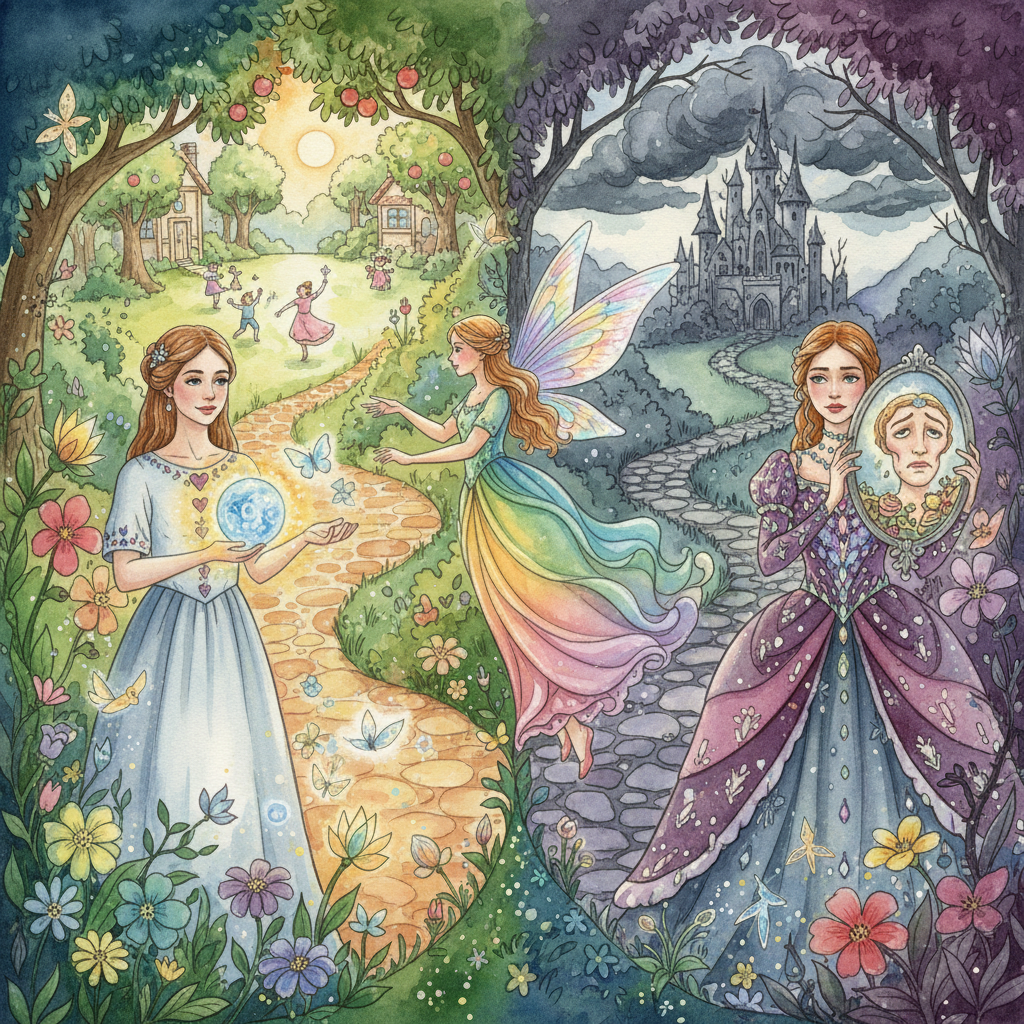
Once, there was a kind fairy. She loved flowers very much. She lived in a palace with a garden. The garden had many colorful flowers. The fairy was very kind to everyone. Young royals came to live with her. When they left, she gave each a special gift.
The fairy loved Princess Sylvia the most. She wanted Sylvia to learn from others. So, she sent Sylvia to visit friends. Sylvia flew in a cart to see them.
First, Sylvia visited Princess Iris. Iris had asked for pretty looks. She was very pretty. But then she got sick. She lost her pretty looks. Iris was very sad. She did not like her face now. She wanted her pretty looks back. Iris cried and said, "I am so unhappy. I used to be pretty, but now I am not." Sylvia felt sorry for her.
Sylvia went home and told the fairy about Iris. The fairy looked sorry. "I cannot help," she said. "My gift is given only once. I cannot take it back."
Next, Sylvia visited Princess Daphne. Daphne had asked to speak well. She talked all the time, even when no one listened. Sylvia did not like it. Daphne talked too much about herself. It was not nice to hear.
Sylvia went home again. She told the fairy about Daphne. "She talks and talks," said Sylvia. "She never stops. I was glad to leave because it was too noisy."
Sylvia thought about the gifts she saw. Pretty looks were not enough. Talking well was not enough. She did not want those gifts for herself. She wanted something better.
It was time for Sylvia to get her gift. The fairy smiled and asked her, "What gift do you want, Sylvia?"
Sylvia thought slowly. She remembered Iris and Daphne. "I want a quiet spirit," she said.
The fairy smiled. She gave Sylvia the gift. A quiet spirit is calm and kind inside. Sylvia felt very happy. She was always kind to others. People near her felt happy too. The fairy smiled and said, "Being kind inside is the best gift of all."
Original Story
FAIRY GIFTS
It generally happens that people's surroundings reflect more or less
accurately their minds and dispositions, so perhaps that is why the
Flower Fairy lived in a lovely palace, with the most delightful garden
you can imagine, full of flowers, and trees, and fountains, and
fish-ponds, and everything nice. For the Fairy herself was so kind and
charming that everybody loved her, and all the young princes and
princesses who formed her court, were as happy as the day was long,
simply because they were near her. They came to her when they were quite
tiny, and never left her until they were grown up and had to go away
into the great world; and when that time came she gave to each whatever
gift he asked of her. But it is chiefly of the Princess Sylvia that you
are going to hear now. The Fairy loved her with all her heart, for she
was at once original and gentle, and she had nearly reached the age at
which the gifts were generally bestowed. However, the Fairy had a great
wish to know how the other princesses who had grown up and left her,
were prospering, and before the time came for Sylvia to go herself, she
resolved to send her to some of them. So one day her chariot, drawn by
butterflies, was made ready, and the Fairy said: 'Sylvia, I am going to
send you to the court of Iris; she will receive you with pleasure for my
sake as well as for your own. In two months you may come back to me
again, and I shall expect you to tell me what you think of her.'
Sylvia was very unwilling to go away, but as the Fairy wished it she
said nothing--only when the two months were over she stepped joyfully
into the butterfly chariot, and could not get back quickly enough to the
Flower-Fairy, who, for her part, was equally delighted to see her again.
[Illustration]
'Now, child,' said she, 'tell me what impression you have received.'
'You sent me, madam,' answered Sylvia, 'to the Court of Iris, on whom
you had bestowed the gift of beauty. She never tells anyone, however,
that it was your gift, though she often speaks of your kindness in
general. It seemed to me that her loveliness, which fairly dazzled me at
first, had absolutely deprived her of the use of any of her other gifts
or graces. In allowing herself to be seen, she appeared to think that
she was doing all that could possibly be required of her. But,
unfortunately, while I was still with her she became seriously ill, and
though she presently recovered, her beauty is entirely gone, so that she
hates the very sight of herself, and is in despair. She entreated me to
tell you what had happened, and to beg you, in pity, to give her beauty
back to her. And, indeed, she does need it terribly, for all the things
in her that were tolerable, and even agreeable, when she was so pretty,
seem quite different now she is ugly, and it is so long since she
thought of using her mind or her natural cleverness, that I really don't
think she has any left now. She is quite aware of all this herself, so
you may imagine how unhappy she is, and how earnestly she begs for your
aid.'
'You have told me what I wanted to know,' cried the Fairy, 'but alas! I
cannot help her; my gifts can be given but once.'
Some time passed in all the usual delights of the Flower-Fairy's palace,
and then she sent for Sylvia again, and told her she was to stay for a
little while with the Princess Daphne, and accordingly the butterflies
whisked her off, and set her down in quite a strange kingdom. But she
had only been there a very little time before a wandering butterfly
brought a message from her to the Fairy, begging that she might be sent
for as soon as possible, and before very long she was allowed to return.
'Ah! madam,' cried she, 'what a place you sent me to that time!'
'Why, what was the matter?' asked the Fairy. 'Daphne was one of the
princesses who asked for the gift of eloquence, if I remember rightly.'
'And very ill the gift of eloquence becomes a woman,' replied Sylvia,
with an air of conviction. 'It is true that she speaks well, and her
expressions are well chosen; but then she never leaves off talking, and
though at first one may be amused, one ends by being wearied to death.
Above all things she loves any assembly for settling the affairs of her
kingdom, for on those occasions she can talk and talk without fear of
interruption; but, even then, the moment it is over she is ready to
begin again about anything or nothing, as the case may be. Oh! how glad
I was to come away I cannot tell you.'
The Fairy smiled at Sylvia's unfeigned disgust at her late experience;
but after allowing her a little time to recover she sent her to the
Court of the Princess Cynthia, where she left her for three months. At
the end of that time Sylvia came back to her with all the joy and
contentment that one feels at being once more beside a dear friend. The
Fairy, as usual, was anxious to hear what she thought of Cynthia, who
had always been amiable, and to whom she had given the gift of pleasing.
'I thought at first,' said Sylvia, 'that she must be the happiest
Princess in the world; she had a thousand lovers who vied with one
another in their efforts to please and gratify her. Indeed, I had nearly
decided that I would ask a similar gift.'
'Have you altered your mind, then?' interrupted the Fairy.
'Yes, indeed, madam,' replied Sylvia; 'and I will tell you why. The
longer I stayed the more I saw that Cynthia was not really happy. In her
desire to please everyone she ceased to be sincere, and degenerated
into a mere coquette; and even her lovers felt that the charms and
fascinations which were exercised upon all who approached her without
distinction were valueless, so that in the end they ceased to care for
them, and went away disdainfully.'
'I am pleased with you, child,' said the Fairy; 'enjoy yourself here for
awhile and presently you shall go to Phyllida.'
Sylvia was glad to have leisure to think, for she could not make up her
mind at all what she should ask for herself, and the time was drawing
very near. However, before very long the Fairy sent her to Phyllida, and
waited for her report with unabated interest.
'I reached her court safely,' said Sylvia, 'and she received me with
much kindness, and immediately began to exercise upon me that brilliant
wit which you had bestowed upon her. I confess that I was fascinated by
it, and for a week thought that nothing could be more desirable; the
time passed like magic, so great was the charm of her society. But I
ended by ceasing to covet that gift more than any of the others I have
seen, for, like the gift of pleasing, it cannot really give
satisfaction. By degrees I wearied of what had so delighted me at first,
especially as I perceived more and more plainly that it is impossible to
be constantly smart and amusing without being frequently ill-natured,
and too apt to turn all things, even the most serious, into mere
occasions for a brilliant jest.'
The Fairy in her heart agreed with Sylvia's conclusions, and felt
pleased with herself for having brought her up so well.
But now the time was come for Sylvia to receive her gift, and all her
companions were assembled; the Fairy stood in the midst and in the usual
manner asked what she would take with her into the great world.
Sylvia paused for a moment, and then answered: 'A quiet spirit.' And the
Fairy granted her request.
This lovely gift makes life a constant happiness to its possessor, and
to all who are brought into contact with her. She has all the beauty of
gentleness and contentment in her sweet face; and if at times it seems
less lovely through some chance grief or disquietude, the hardest thing
that one ever hears said is:
'Sylvia's dear face is pale to-day. It grieves one to see her so.'
And when, on the contrary, she is gay and joyful, the sunshine of her
presence rejoices all who have the happiness of being near her.
By the Comte de Caylus.
Story DNA
Moral
True and lasting happiness comes from inner virtues like a quiet spirit, not from superficial gifts or external validation.
Plot Summary
The kind Flower Fairy raises young royals, granting each a special gift upon leaving her court. She sends her favorite, Princess Sylvia, to observe former princesses who chose gifts like beauty, eloquence, pleasing, and wit. Sylvia learns that these superficial traits lead to unhappiness, insincerity, or weariness. Upon her return, having gained wisdom from these experiences, Sylvia chooses 'a quiet spirit' as her gift, which brings her lasting happiness and radiates joy to all around her.
Themes
Emotional Arc
innocence to wisdom
Writing Style
Narrative Elements
Cultural Context
Andrew Lang was a Scottish poet and folklorist who collected and retold fairy tales from various cultures. The original author, Comte de Caylus, was an 18th-century French antiquarian and writer, suggesting an Enlightenment-era influence on the story's moralizing tone.
Plot Beats (13)
- The Flower Fairy, known for her kindness, raises young royals in her palace and grants each a gift upon their departure.
- The Fairy sends her favorite, Princess Sylvia, to visit four former princesses to observe the outcomes of their chosen gifts.
- Sylvia first visits Princess Iris, who chose beauty, and witnesses her despair after losing her beauty and realizing its emptiness.
- Sylvia reports back to the Fairy about Iris's plight, and the Fairy explains her gifts cannot be taken back.
- Sylvia then visits Princess Daphne, who chose eloquence, and finds her constant, self-serving talking to be tiresome.
- Sylvia reports her negative experience with Daphne's gift to the Fairy.
- Next, Sylvia visits Princess Cynthia, who chose the gift of pleasing, and observes her insincerity and the eventual loss of her admirers.
- Sylvia reports her findings about Cynthia's gift, noting her change of mind about wanting a similar gift.
- Finally, Sylvia visits Princess Phyllida, who chose wit, and initially enjoys it but later realizes its potential for ill-nature and superficiality.
- Sylvia returns to the Fairy, having reflected on all the gifts she witnessed.
- The Fairy asks Sylvia what gift she desires for herself.
- Sylvia, having learned from the experiences of others, requests 'a quiet spirit.'
- The Fairy grants Sylvia's wish, and Sylvia lives a life of constant happiness, radiating contentment to all around her.
Characters
Flower Fairy ◆ supporting
Kind and charming, reflecting the beauty of her surroundings.
Attire: Ethereal gowns of silk and gossamer, interwoven with flower petals and leaves.
Kind, wise, observant
Image Prompt & Upload
A young woman with a gentle, nurturing expression, appearing to be in her early twenties. She has long, flowing hair the color of pale dandelion yellow, woven with tiny white daisy chains. Her skin has a soft, luminous quality. She wears a dress crafted from layered, translucent petals in shades of soft pink and lavender, cinched at the waist with a braided green vine. Delicate, iridescent wings, like a dragonfly's, sprout from her back. She stands in a welcoming pose, one hand extended forward as if offering a glowing seed, her posture relaxed and kind. The scene is set in a sun-dappled forest clearing with soft bokeh lights. Plain white background, full body visible head to toe, single figure, no watermark, no text, no signature.
Sylvia ★ protagonist
Gentle and original, with a sweet face.
Attire: Simple but elegant gowns of fine linen or silk, suitable for a princess in training.
Observant, thoughtful, gentle
Image Prompt & Upload
A young woman in her late teens with long, flowing chestnut hair and bright, determined green eyes. She wears a simple but elegant deep blue dress with a subtle floral pattern, cinched at the waist with a leather belt. A worn, forest-green cloak is clasped at her throat. She stands confidently, one hand resting on her hip, the other holding a small, intricately carved wooden lantern that emits a soft, warm glow. Her posture is poised and alert, her expression a mix of curiosity and resolve. She is surrounded by faint, floating motes of golden light in a softly lit, ancient forest clearing. Plain white background, full body visible head to toe, single figure, no watermark, no text, no signature.
Iris ◆ supporting
Dazzlingly beautiful, but loses her beauty through illness.
Attire: Luxurious gowns of velvet and brocade, adorned with jewels and lace.
Vain, shallow, dependent on beauty
Image Prompt & Upload
A young woman with a kind and gentle expression, appearing to be in her late teens or early twenties. She has soft, wavy lavender hair that falls to her shoulders, adorned with small, fresh iris flowers. Her eyes are a warm, golden-amber color. She wears a flowing dress in shades of deep purple and soft green, reminiscent of iris petals, with delicate leaf-like embroidery on the bodice and sleeves. The dress has a modest neckline and a full skirt. She stands in a relaxed, welcoming posture, slightly turned, with one hand gently holding a small bouquet of purple irises. Her smile is soft and encouraging. Plain white background, full body visible head to toe, single figure, no watermark, no text, no signature.
Daphne ◆ supporting
Eloquent but tiresome.
Attire: Formal gowns suitable for court, perhaps with quill and parchment visible.
Talkative, verbose, self-important
Image Prompt & Upload
A young woman in her early twenties with flowing auburn hair woven with small green leaves and delicate vines. She wears a simple dress of layered moss-green and earth-brown linen, with bare feet. Her expression is gentle and serene, with a slight smile. She stands in a graceful, welcoming pose, one hand slightly extended as if offering support. Soft, dappled sunlight filters through an unseen canopy. Plain white background, full body visible head to toe, single figure, no watermark, no text, no signature.
Cynthia ◆ supporting
Amiable but insincere.
Attire: Flattering gowns designed to attract attention, adorned with ribbons and lace.
Coquettish, insincere, people-pleasing
Image Prompt & Upload
A young woman in her early twenties with kind, hazel eyes and a gentle smile. Her long, wavy chestnut hair is partially tied back with a simple ribbon. She wears a modest, soft blue linen dress with puffed sleeves and a white apron. Her posture is open and welcoming, with one hand slightly extended as if offering help. Plain white background, full body visible head to toe, single figure, no watermark, no text, no signature.
Phyllida ◆ supporting
Witty but ill-natured.
Attire: Elegant gowns with a touch of extravagance, perhaps with a jeweled fan.
Witty, sarcastic, sharp-tongued
Image Prompt & Upload
A kindly middle-aged woman with soft wrinkles around her warm brown eyes and a gentle, encouraging smile. Her silver-streaked auburn hair is neatly braided and coiled at the nape of her neck. She wears a practical, long-sleeved dress of undyed linen with a leather apron tied at her waist, her sleeves rolled to the elbows. She stands with a slightly forward-leaning, attentive posture, one hand extended as if offering help or a small object. Plain white background, full body visible head to toe, single figure, no watermark, no text, no signature.
Locations
Flower Fairy's Palace Garden
A delightful garden full of flowers, trees, fountains, and fish-ponds.
Mood: Lovely, happy, charming, idyllic.
Sylvia departs and returns from her visits to the other princesses.
Image Prompt & Upload
At sunrise, a magical garden bathed in soft golden light. A central ornate marble fountain sprays crystalline water into a large, clear pond where golden koi swim among water lilies. Winding gravel paths lead through lush flower beds overflowing with giant, luminous roses, foxgloves, and forget-me-nots in pinks, purples, and blues. Ancient, gnarled willow trees with hanging moss frame the scene. Delicate, vine-covered stone arches and tiny, glowing lanterns dot the landscape. Mist gently rises from the pond, creating a dreamy, ethereal atmosphere. The air feels serene and enchanted. no border, no frame, no watermark, no text, no signature, edge-to-edge illustration.
Princess Iris's Court
Implied to be luxurious and focused on visual beauty, but details are not given.
Mood: Initially dazzling and impressive, but later becomes despairing and ugly.
Sylvia observes Iris's dependence on her beauty and her subsequent despair when it is lost.
Image Prompt & Upload
A grand palace courtyard at golden hour, bathed in warm, soft light. Ornate marble archways and pillars with intricate floral carvings frame the space. A central fountain with crystal-clear water reflects the sunset sky of peach, lavender, and gold. Lush, meticulously pruned rose gardens in full bloom line the polished stone pathways. Delicate topiaries shaped like mythical creatures stand at attention. The air is still and serene, with a gentle mist rising from the fountain. The architecture features elegant spires and stained-glass windows catching the last light, casting colorful patterns on the ground. no border, no frame, no watermark, no text, no signature, edge-to-edge illustration.
Princess Daphne's Assembly Hall
A place for settling the affairs of her kingdom.
Mood: Wearying, talkative, overwhelming.
Sylvia is overwhelmed by Daphne's constant talking and desire to be heard.
Image Prompt & Upload
Late afternoon sunlight streams through towering arched windows of clear glass, illuminating a vast assembly hall. The high, vaulted ceiling is supported by polished marble columns with gold-veined accents. A long, central aisle of cream-colored marble leads to a raised dais holding a single ornate throne of dark, carved wood and blue velvet. Sunlight casts long, dramatic shadows across the floor. Along the walls, tall bookshelves hold leather-bound tomes and rolled parchments. A large, detailed map table stands in the center. The air is still and quiet, filled with golden light and a sense of solemn grandeur. no border, no frame, no watermark, no text, no signature, edge-to-edge illustration.