The Colony of Cats
by Andrew Lang · from The Crimson Fairy Book
Adapted Version
Once, many cats lived in a big house. The house was old and quiet. The cats could talk. They were magic cats. They had shiny fur and bright eyes. They were happy with each other. But they needed help with the work. They could not clean or cook alone. So they looked for a helper.
A girl named Lizina lived nearby. Her mother and sister were not kind to her. They made her do all the work. Lizina cleaned and cooked all day. She felt sad and alone. One day, she decided to go and live with the cats. She thought they might be kinder.
The cats were happy to see Lizina. She worked hard for them. She was very kind. She helped the little kittens. She cleaned their house and cooked their food. She played with them too. The cats liked her very much. They gave her soft beds and tasty food. Lizina was happy with the cats.
An old cat named Father Gatto came to visit. He had wise eyes and soft fur. He saw Lizina looked sad. “Why are you sad?” he asked kindly. “I miss my home,” said Lizina. “I miss my family.” Father Gatto wanted to help her. He had a magic gift.
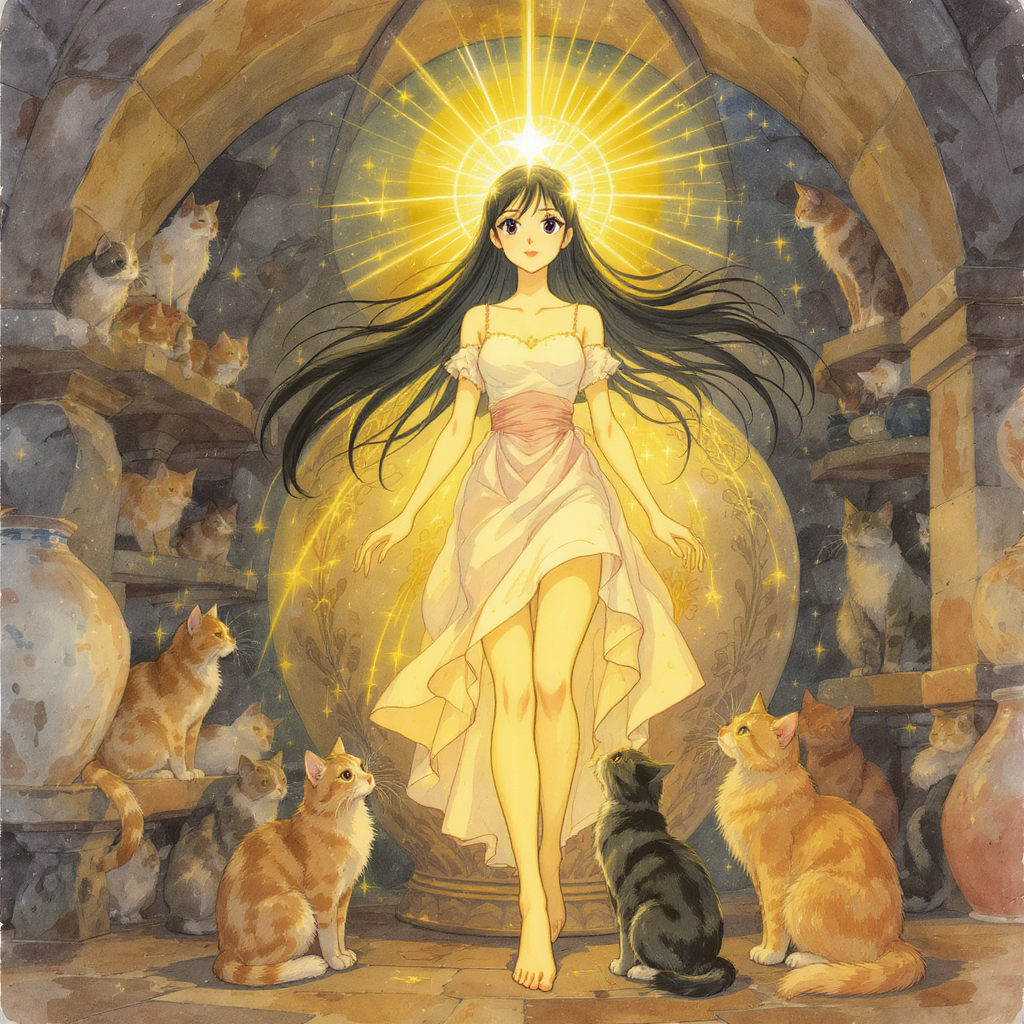
Father Gatto took her to a special room. The room was dark and quiet. There were two big pots. One pot had oil. The other pot had shiny gold. “I will give you a gift,” he said. He put her in the gold. It was magic! The gold covered her softly. Now she was shiny and bright. She could make gold too. “Listen for a rooster and a donkey,” he said. “When you hear them, do this.” Lizina listened carefully. She heard a rooster crow and a donkey bray. A golden star appeared on her head. It sparkled in the light.
Lizina went home. She wanted to share her joy. She shared her gold with her mother and sister. They were surprised to see her shiny. They were also jealous. They wanted gold too. They asked Lizina how she got it.
Her sister, Peppina, went to the cats’ house. She wanted gold too. But Peppina was not kind. She was not careful with the cats. She did not help them. She was rough and lazy. The cats did not like her.
Father Gatto was not happy with Peppina. He took her to the pots. He put her in the oil. Then he rolled her in ashes. The oil and ashes made her look different. Now she looked very changed. A donkey’s tail was on her head. It was because she was not kind.
Peppina went home. Her mother was very upset. She saw the donkey’s tail. The mother was angry at Lizina. She thought Lizina caused this. In her anger, Lizina fell into a well by chance. It was an accident.
A Prince wanted to marry Lizina. He had seen her before and liked her. He came to her house to ask for her. The mother tricked him. She put a veil on Peppina. The Prince thought Peppina was Lizina. He agreed to marry her.
The Prince’s carriage passed the cats’ house. The cats saw the carriage. They sang a song to help. “Look in the well! Lizina is there! You have Peppina!” the song said. The words were clear and loud.
The Prince heard the song. He was surprised. He looked under the veil. He saw the donkey’s tail. He knew it was not Lizina. He was angry at the trick. He asked for Lizina.
They pulled Lizina from the well. She was safe and sound. The Prince was happy to see her. He married Lizina in a big wedding. They were very happy together. All the cats came to the wedding. They danced and sang. Kindness is rewarded. Being kind brings happiness.
Original Story
The Colony Of Cats
Long, long ago, as far back as the time when animals spoke, there lived
a community of cats in a deserted house they had taken possession of
not far from a large town. They had everything they could possibly
desire for their comfort, they were well fed and well lodged, and if by
any chance an unlucky mouse was stupid enough to venture in their way,
they caught it, not to eat it, but for the pure pleasure of catching
it. The old people of the town related how they had heard their parents
speak of a time when the whole country was so overrun with rats and
mice that there was not so much as a grain of corn nor an ear of maize
to be gathered in the fields; and it might be out of gratitude to the
cats who had rid the country of these plagues that their descendants
were allowed to live in peace. No one knows where they got the money to
pay for everything, nor who paid it, for all this happened so very long
ago. But one thing is certain, they were rich enough to keep a servant;
for though they lived very happily together, and did not scratch nor
fight more than human beings would have done, they were not clever
enough to do the housework themselves, and preferred at all events to
have some one to cook their meat, which they would have scorned to eat
raw. Not only were they very difficult to please about the housework,
but most women quickly tired of living alone with only cats for
companions, consequently they never kept a servant long; and it had
become a saying in the town, when anyone found herself reduced to her
last penny: “I will go and live with the cats,” and so many a poor
woman actually did.
Now Lizina was not happy at home, for her mother, who was a widow, was
much fonder of her elder daughter; so that often the younger one fared
very badly, and had not enough to eat, while the elder could have
everything she desired, and if Lizina dared to complain she was certain
to have a good beating.
At last the day came when she was at the end of her courage and
patience, and exclaimed to her mother and sister:
“As you hate me so much you will be glad to be rid of me, so I am going
to live with the cats!”
“Be off with you!” cried her mother, seizing an old broom-handle from
behind the door. Poor Lizina did not wait to be told twice, but ran off
at once and never stopped till she reached the door of the cats’ house.
Their cook had left them that very morning, with her face all
scratched, the result of such a quarrel with the head of the house that
he had very nearly scratched out her eyes. Lizina therefore was warmly
welcomed, and she set to work at once to prepare the dinner, not
without many misgivings as to the tastes of the cats, and whether she
would be able to satisfy them.
Going to and fro about her work, she found herself frequently hindered
by a constant succession of cats who appeared one after another in the
kitchen to inspect the new servant; she had one in front of her feet,
another perched on the back of her chair while she peeled the
vegetables, a third sat on the table beside her, and five or six others
prowled about among the pots and pans on the shelves against the wall.
The air resounded with their purring, which meant that they were
pleased with their new maid, but Lizina had not yet learned to
understand their language, and often she did not know what they wanted
her to do. However, as she was a good, kindhearted girl, she set to
work to pick up the little kittens which tumbled about on the floor,
she patched up quarrels, and nursed on her lap a big tabby—the oldest
of the community—which had a lame paw. All these kindnesses could
hardly fail to make a favourable impression on the cats, and it was
even better after a while, when she had had time to grow accustomed to
their strange ways. Never had the house been kept so clean, the meats
so well served, nor the sick cats so well cared for. After a time they
had a visit from an old cat, whom they called their father, who lived
by himself in a barn at the top of the hill, and came down from time to
time to inspect the little colony. He too was much taken with Lizina,
and inquired, on first seeing her: “Are you well served by this nice,
black-eyed little person?” and the cats answered with one voice: “Oh,
yes, Father Gatto, we have never had so good a servant!”
At each of his visits the answer was always the same; but after a time
the old cat, who was very observant, noticed that the little maid had
grown to look sadder and sadder. “What is the matter, my child has any
one been unkind to you?” he asked one day, when he found her crying in
her kitchen. She burst into tears and answered between her sobs: “Oh,
no! they are all very good to me; but I long for news from home, and I
pine to see my mother and my sister.”
Old Gatto, being a sensible old cat, understood the little servant’s
feelings. “You shall go home,” he said, “and you shall not come back
here unless you please. But first you must be rewarded for all your
kind services to my children. Follow me down into the inner cellar,
where you have never yet been, for I always keep it locked and carry
the key away with me.”
Lizina looked round her in astonishment as they went down into the
great vaulted cellar underneath the kitchen. Before her stood the big
earthenware water jars, one of which contained oil, the other a liquid
shining like gold. “In which of these jars shall I dip you?” asked
Father Gatto, with a grin that showed all his sharp white teeth, while
his moustaches stood out straight on either side of his face. The
little maid looked at the two jars from under her long dark lashes: “In
the oil jar,” she answered timidly, thinking to herself: “I could not
ask to be bathed in gold.”
But Father Gatto replied: “No, no; you have deserved something better
than that.” And seizing her in his strong paws he plunged her into the
liquid gold. Wonder of wonders! when Lizina came out of the jar she
shone from head to foot like the sun in the heavens on a fine summer’s
day. Her pretty pink cheeks and long black hair alone kept their
natural colour, otherwise she had become like a statue of pure gold.
Father Gatto purred loudly with satisfaction. “Go home,” he said, “and
see your mother and sisters; but take care if you hear the cock crow to
turn towards it; if on the contrary the ass brays, you must look the
other way.”
The little maid, having gratefully kissed the white paw of the old cat,
set off for home; but just as she got near her mother’s house the cock
crowed, and quickly she turned towards it. Immediately a beautiful
golden star appeared on her forehead, crowning her glossy black hair.
At the same time the ass began to bray, but Lizina took care not to
look over the fence into the field where the donkey was feeding. Her
mother and sister, who were in front of their house, uttered cries of
admiration and astonishment when they saw her, and their cries became
still louder when Lizina, taking her handkerchief from her pocket, drew
out also a handful of gold.
For some days the mother and her two daughters lived very happily
together, for Lizina had given them everything she had brought away
except her golden clothing, for that would not come off, in spite of
all the efforts of her sister, who was madly jealous of her good
fortune. The golden star, too, could not be removed from her forehead.
But all the gold pieces she drew from her pockets had found their way
to her mother and sister.
“I will go now and see what I can get out of the pussies,” said
Peppina, the elder girl, one morning, as she took Lizina’s basket and
fastened her pockets into her own skirt. “I should like some of the
cats’ gold for myself,” she thought, as she left her mother’s house
before the sun rose.
The cat colony had not yet taken another servant, for they knew they
could never get one to replace Lizina, whose loss they had not yet
ceased to mourn. When they heard that Peppina was her sister, they all
ran to meet her. “She is not the least like her,” the kittens whispered
among themselves.
“Hush, be quiet!” the older cats said; “all servants cannot be pretty.”
No, decidedly she was not at all like Lizina. Even the most reasonable
and large-minded of the cats soon acknowledged that.
The very first day she shut the kitchen door in the face of the
tom-cats who used to enjoy watching Lizina at her work, and a young and
mischievous cat who jumped in by the open kitchen window and alighted
on the table got such a blow with the rolling-pin that he squalled for
an hour.
With every day that passed the household became more and more aware of
its misfortune.
The work was as badly done as the servant was surly and disagreeable;
in the corners of the rooms there were collected heaps of dust;
spiders’ webs hung from the ceilings and in front of the window-panes;
the beds were hardly ever made, and the feather beds, so beloved by the
old and feeble cats, had never once been shaken since Lizina left the
house. At Father Gatto’s next visit he found the whole colony in a
state of uproar.
“Caesar has one paw so badly swollen that it looks as if it were
broken,” said one. “Peppina kicked him with her great wooden shoes on.
Hector has an abscess in his back where a wooden chair was flung at
him; and Agrippina’s three little kittens have died of hunger beside
their mother, because Peppina forgot them in their basket up in the
attic. There is no putting up with the creature—do send her away,
Father Gatto! Lizina herself would not be angry with us; she must know
very well what her sister is like.”
“Come here,” said Father Gatto, in his most severe tones to Peppina.
And he took her down into the cellar and showed her the same two great
jars that he had showed Lizina. “In which of these shall I dip you?” he
asked; and she made haste to answer: “In the liquid gold,” for she was
no more modest than she was good and kind.
Father Gatto’s yellow eyes darted fire. “You have not deserved it,” he
uttered, in a voice like thunder, and seizing her he flung her into the
jar of oil, where she was nearly suffocated. When she came to the
surface screaming and struggling, the vengeful cat seized her again and
rolled her in the ash-heap on the floor; then when she rose, dirty,
blinded, and disgusting to behold, he thrust her from the door, saying:
“Begone, and when you meet a braying ass be careful to turn your head
towards it.”
Stumbling and raging, Peppina set off for home, thinking herself
fortunate to find a stick by the wayside with which to support herself.
She was within sight of her mother’s house when she heard in the meadow
on the right, the voice of a donkey loudly braying. Quickly she turned
her head towards it, and at the same time put her hand up to her
forehead, where, waving like a plume, was a donkey’s tail. She ran home
to her mother at the top of her speed, yelling with rage and despair;
and it took Lizina two hours with a big basin of hot water and two
cakes of soap to get rid of the layer of ashes with which Father Gatto
had adorned her. As for the donkey’s tail, it was impossible to get rid
of that; it was as firmly fixed on her forehead as was the golden star
on Lizina’s. Their mother was furious. She first beat Lizina
unmercifully with the broom, then she took her to the mouth of the well
and lowered her into it, leaving her at the bottom weeping and crying
for help.
Before this happened, however, the king’s son in passing the mother’s
house had seen Lizina sitting sewing in the parlour, and had been
dazzled by her beauty. After coming back two or three times, he at last
ventured to approach the window and to whisper in the softest voice:
“Lovely maiden, will you be my bride?” and she had answered: “I will.”
Next morning, when the prince arrived to claim his bride, he found her
wrapped in a large white veil. “It is so that maidens are received from
their parents’ hands,” said the mother, who hoped to make the king’s
son marry Peppina in place of her sister, and had fastened the donkey’s
tail round her head like a lock of hair under the veil. The prince was
young and a little timid, so he made no objections, and seated Peppina
in the carriage beside him.
Their way led past the old house inhabited by the cats, who were all at
the window, for the report had got about that the prince was going to
marry the most beautiful maiden in the world, on whose forehead shone a
golden star, and they knew that this could only be their adored Lizina.
As the carriage slowly passed in front of the old house, where cats
from all parts of world seemed to be gathered a song burst from every
throat:
Mew, mew, mew!
Prince, look quick behind you!
In the well is fair Lizina,
And you’ve got nothing but Peppina.
When he heard this the coachman, who understood the cat’s language
better than the prince, his master, stopped his horses and asked:
“Does your highness know what the grimalkins are saying?” and the song
broke forth again louder than ever.
With a turn of his hand the prince threw back the veil, and discovered
the puffed-up, swollen face of Peppina, with the donkey’s tail twisted
round her head. “Ah, traitress!” he exclaimed, and ordering the horses
to be turned round, he drove the elder daughter, quivering with rage,
to the old woman who had sought to deceive him. With his hand on the
hilt of his sword he demanded Lizina in so terrific a voice that the
mother hastened to the well to draw her prisoner out. Lizina’s clothing
and her star shone so brilliantly that when the prince led her home to
the king, his father, the whole palace was lit up. Next day they were
married, and lived happy ever after; and all the cats, headed by old
Father Gatto, were present at the wedding.
Story DNA
Moral
Kindness and good deeds are rewarded, while cruelty and selfishness are punished.
Plot Summary
Lizina, an ill-treated girl, leaves her cruel family to become a servant for a community of wealthy, talking cats. Her kindness and diligence earn her a magical reward from Father Gatto, the elder cat, who transforms her into a golden, star-adorned maiden capable of producing gold. Her jealous sister, Peppina, attempts to replicate Lizina's fortune but is cruel to the cats and is magically punished with oil, ashes, and a donkey's tail. Lizina's mother then throws Lizina into a well, but the cats intervene, revealing the deception to a Prince who was tricked into marrying Peppina. Lizina is rescued and marries the Prince, while Peppina and her mother face their deserved fate.
Themes
Emotional Arc
suffering to triumph
Writing Style
Narrative Elements
Cultural Context
Andrew Lang was a Scottish poet, novelist, literary critic, and folklorist, known for collecting and publishing fairy tales from various cultures in his 'Fairy Books' series in the late 19th and early 20th centuries. This story fits the European folk tale tradition of moral justice and magical realism.
Plot Beats (15)
- A community of wealthy, anthropomorphic cats lives in a deserted house, known for their difficulty with human servants.
- Lizina, an ill-treated younger daughter, is driven from her home by her cruel mother and sister.
- Lizina finds employment with the cats, who have just lost a servant, and proves to be an exceptionally kind and diligent maid.
- Father Gatto, the wise elder cat, notices Lizina's longing for home and offers her a reward.
- Lizina, despite her modesty, is dipped in liquid gold by Father Gatto, emerging radiant and able to produce gold.
- Father Gatto gives Lizina instructions about a cock crowing and an ass braying, which she follows, gaining a golden star on her forehead.
- Lizina returns home, sharing her gold with her mother and sister, who are astonished and jealous.
- Peppina, Lizina's elder sister, goes to the cat colony, intending to get rich, but is cruel and neglectful towards the cats.
- Father Gatto punishes Peppina by dipping her in oil, rolling her in ashes, and giving her a donkey's tail on her forehead for ignoring his instructions.
- Peppina returns home, covered in ashes and with a donkey's tail, infuriating her mother.
- The mother beats Lizina and throws her into a well.
- The Prince, having previously seen Lizina and fallen in love, comes to marry her, but is tricked into taking the veiled Peppina.
- As the Prince's carriage passes the cat colony, the cats sing a song revealing the deception and Lizina's location in the well.
- The Prince unveils Peppina, discovers the donkey's tail, and demands Lizina from the mother.
- Lizina is rescued from the well, marries the Prince, and lives happily ever after, with the cats present at the wedding.
Characters
Lizina ★ protagonist
Pretty, black-eyed
Attire: Simple peasant dress, later radiant clothing befitting a princess
Kind, patient, longs for affection
Image Prompt & Upload
A young woman in her late teens with warm brown skin and determined dark eyes stands in a sun-dappled forest clearing. She wears a practical, deep green tunic over brown leggings and sturdy leather boots. A simple silver pendant rests at her throat. Her long, black hair is braided with a few small, white flowers woven in. She holds a weathered leather satchel in one hand and rests the other on the trunk of an ancient, mossy tree, her posture poised and alert, gazing forward with quiet resolve. Plain white background, full body visible head to toe, single figure, no watermark, no text, no signature.
Father Gatto ◆ supporting
Observant
Wise, just, protective
Image Prompt & Upload
An elderly anthropomorphic cat with kind, wise eyes and a gentle smile, wearing a simple black cassock with a white clerical collar. A small silver crucifix hangs around his neck. His fur is a soft gray, and he holds an ancient leather-bound book in his paws. He stands with a welcoming, slightly bowed posture, exuding a calm and supportive presence. Plain white background, full body visible head to toe, single figure, no watermark, no text, no signature.
Peppina ⚔ antagonist
Not pretty, puffed-up, swollen face
Attire: Simple peasant dress, later a veil
Surly, disagreeable, not modest
Image Prompt & Upload
A severe-looking woman in her late 40s with sharp, aristocratic features, a pointed chin, and high cheekbones. Her jet-black hair is pulled back into a tight, intricate bun. She has cold, pale green eyes and a thin, unsmiling mouth. She wears a high-collared, floor-length gown of deep plum velvet with black lace trim at the cuffs and collar. Her posture is rigid and imperious, standing tall with her hands clasped tightly before her. Plain white background, full body visible head to toe, single figure, no watermark, no text, no signature.
The Mother ⚔ antagonist
None specified
Attire: Typical peasant clothing
Unfair, abusive, deceitful
Image Prompt & Upload
A stern middle-aged woman with sharp angular features, cold piercing eyes, and a cruel thin-lipped smile. Her jet-black hair is pulled back into a severe tight bun with not a strand out of place. She wears a high-collared dark crimson velvet gown with black lace trim and intricate gold embroidery. Her pale bony fingers are adorned with heavy jeweled rings. She stands tall with rigid posture, chin raised haughtily, looking down her sharp nose with an expression of cold contempt and calculating malice. A dark fur-trimmed cloak drapes over her shoulders. Her skin is unnaturally pale, almost porcelain-like, with high cheekbones casting harsh shadows. She exudes an aura of menace and authority, one hand resting on her hip while the other holds a gleaming black scepter. Dark dramatic lighting emphasizes her sinister presence. Plain white background, full body visible head to toe, single figure, no watermark, no text, no signature
The Prince ◆ supporting
None specified
Attire: Princely attire
Timid, easily deceived, but ultimately just
Image Prompt & Upload
A young adult male prince with short, neatly styled dark hair and kind hazel eyes. He wears a tailored doublet of deep blue velvet with gold embroidery at the collar and cuffs, dark trousers, and polished black boots. A simple silver crown rests on his head, and a sheathed sword hangs at his hip. He stands in a relaxed, confident pose with a gentle, reassuring smile, one hand resting casually on the pommel of his sword. Plain white background, full body visible head to toe, single figure, no watermark, no text, no signature.
Locations
Deserted House
A large, old, but comfortable house taken over by a colony of cats. Well-fed and well-lodged.
Mood: peaceful, comfortable, peculiar
Lizina works as a servant, is rewarded with gold, and Peppina is punished.
Image Prompt & Upload
A large, two-story Victorian house at twilight, its weathered gray paint peeling to reveal aged wood beneath. Warm, golden light glows invitingly from several multi-paned windows, casting long shadows across a slightly overgrown garden. The front porch sags gently, with a worn but clean welcome mat and a small, discreet cat flap in the sturdy oak door. Ivy climbs one side of the structure, and a well-trodden dirt path leads to the steps. The air is still and peaceful, with the last hints of sunset painting the sky in soft purples and oranges. no border, no frame, no watermark, no text, no signature, edge-to-edge illustration.
Kitchen
The heart of the cats' house, where Lizina prepares meals, surrounded by curious cats.
Mood: busy, warm, domestic
Lizina proves her kindness and skill, earning the cats' affection.
Image Prompt & Upload
Late afternoon golden light streams through a small, leaded glass window into a cozy, rustic kitchen. Warm, honey-colored wood beams crisscross the low ceiling, and a large, stone hearth with a gently glowing fire dominates one wall. Shelves lined with mismatched, colorful pottery and jars of dried herbs surround a sturdy wooden table. A cushioned window seat overlooks a wildflower garden. Scattered about are whimsical, cat-sized details: a tiny rocking chair, a miniature ladder leaning against a shelf, and a saucer of milk on the floor. The atmosphere is warm, inviting, and slightly magical. no border, no frame, no watermark, no text, no signature, edge-to-edge illustration
Inner Cellar
A locked, vaulted cellar beneath the kitchen, containing large earthenware jars filled with oil and a liquid that shines like gold.
Mood: mysterious, magical, hidden
Lizina is tested and rewarded with a bath in liquid gold.
Image Prompt & Upload
A subterranean vaulted cellar beneath a stone kitchen floor, ancient brick arches curving overhead, damp and cool. A single beam of dusty light from a high grate illuminates rows of large, rounded earthenware jars on a packed earth floor. The jars are sealed with wax, their surfaces rough and clay-colored. From within, a soft, internal luminescence glows, a warm golden light seeping through the porous ceramic, casting long, gentle shadows. The air is still and thick with the scent of oil and earth. Cobwebs drape in the shadowy corners. The atmosphere is quiet, secret, and timeless, the golden glow the only warmth in the cool, silent dark. no border, no frame, no watermark, no text, no signature, edge-to-edge illustration
The Well
A deep well near Lizina's mother's house.
Mood: desolate, hopeless
Lizina is thrown into the well by her mother.
Image Prompt & Upload
A deep stone well in a quiet, overgrown garden at twilight, its moss-covered rim worn smooth with age. A weathered wooden bucket rests on a crumbling stone ledge beside it, attached to a rusty iron crank. Thick, ancient vines climb the well's circular structure, disappearing into the dark, still water far below that reflects the deepening violet sky. The surrounding garden is lush with ferns, wildflowers, and twisted roots. Soft, ethereal twilight bathes the scene in shades of indigo and dusty rose, with a single, early star glimmering above the silhouette of a distant, crooked cottage roof. no border, no frame, no watermark, no text, no signature, edge-to-edge illustration.
Roadside
A road leading past the cats' house and Lizina's home, with a meadow nearby where a donkey brays.
Mood: public, exposed
The prince discovers Peppina's deception, and the cats reveal Lizina's plight.
Image Prompt & Upload
A winding dirt road at dawn, bathed in soft golden morning light. To the left stands a cozy, crooked cottage with a mossy thatched roof and round windows, the cats' house. Further down, Lizina's whimsical home with a purple door and flower boxes sits beneath a large oak tree. A lush meadow dotted with white and yellow wildflowers rolls gently to the right, where the distant silhouette of a donkey is seen against the rising sun. The air is cool with a hint of morning mist, dew glistening on the grass. The color palette is soft greens, warm browns, and gentle purples. No border, no frame, no watermark, no text, no signature, edge-to-edge illustration.