The Princess on the Glass Hill
by Andrew Lang · from The Blue Fairy Book
Adapted Version
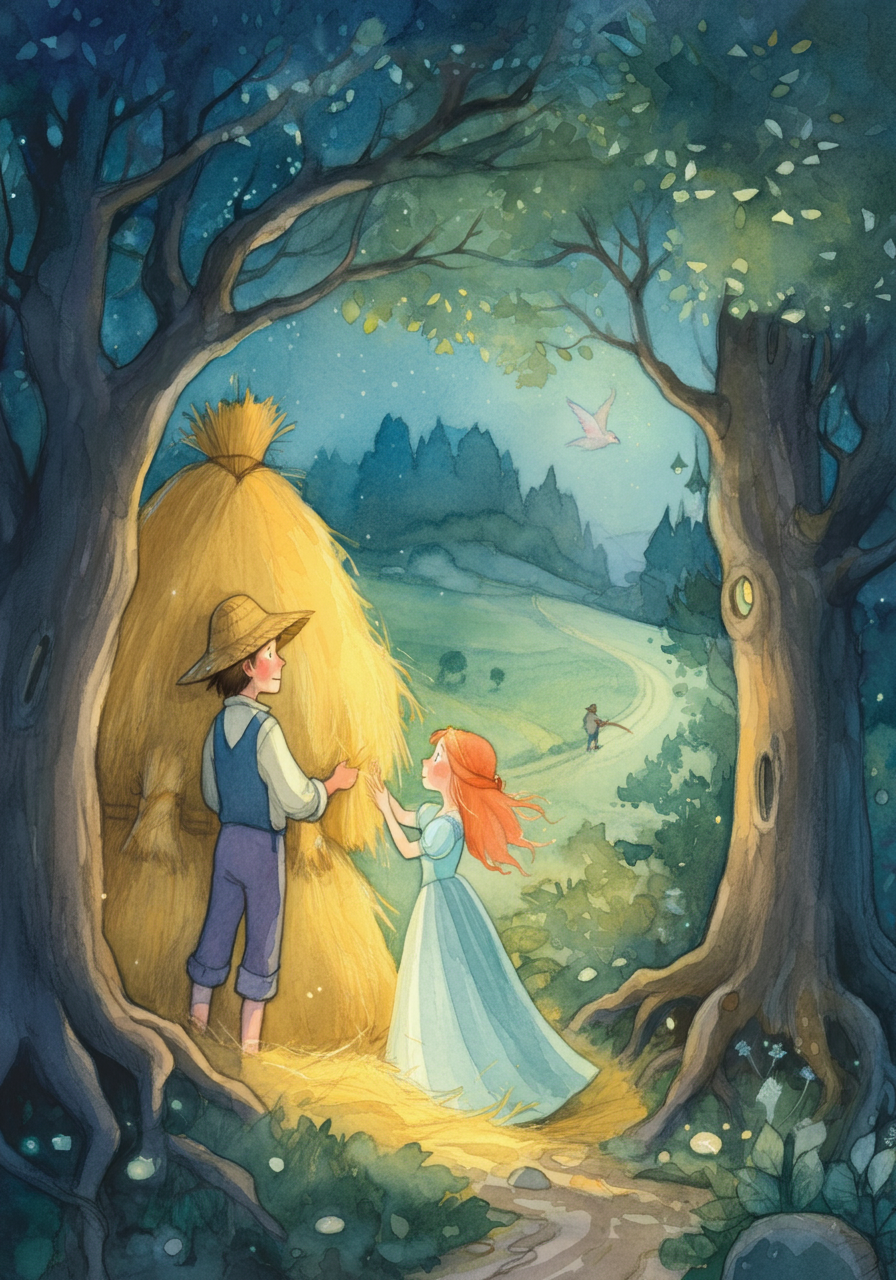
Once, there was a boy called Cinder boy. He lived on a farm. The farm had a meadow. Each year, the hay in the meadow went away. It happened on the same night. The brothers were very surprised. They wanted to know why. It was a big secret. Cinder boy worked hard on the farm. He was kind and helpful.
The first brother went to watch. He was very strong. He thought he was brave. At night, the barn made a noise. The ground shook a little. The brother was scared. He ran away fast. He did not stay long. He did not see anything. He was too afraid.
The next year, the second brother went. He was also strong. At night, the barn made a louder noise. The ground shook more. The brother was also scared. He ran away too. He was not brave enough. He told his brothers he tried.
Then it was Cinder boy's turn. His brothers laughed at him. "You cannot do it," they said. But Cinder boy was brave. He went to the barn. He was not scared at all. The ground shook three times. Each time, it shook more. But Cinder boy stayed. Then it was quiet. Cinder boy heard a chewing sound. He looked outside. A big horse stood there. It had shiny copper armor. The armor gleamed in the moonlight. Cinder boy threw his steel over it. The horse became very calm. Cinder boy climbed on its back. He rode the horse away. He hid the horse in a secret place. In the morning, the hay was still there. His brothers were surprised. They could not believe it. They asked Cinder boy how he did it. But Cinder boy just smiled. He kept his secret.
The next year, Cinder boy watched again. The ground shook more than before. He found a bigger horse. It had shiny silver armor. Cinder boy threw his steel over it. The horse became calm. He hid the silver horse. The hay was safe again. Cinder boy was happy. He now had two horses.
The third year, Cinder boy watched again. The ground shook the most. He found the biggest horse. It had shiny gold armor. The gold shone brightly. Cinder boy threw his steel over it. The horse became calm. He hid the golden horse. He was very happy. He now had three horses. Cinder boy took care of the three horses. He loved them very much. They were strong and pretty. He fed them and brushed them.
One day, the King gave news. He sent helpers everywhere. The whole kingdom talked about it. All people wanted to try. The King had a daughter. He made a new rule. "Who can ride the glass hill?" he asked. "Who can take the golden apple? The winner can marry my daughter." The King announced a contest to marry his daughter. All people were excited. The glass hill was tall and steep. The golden apple was at the top. Many knights tried. They all fell down. No one could do it. It was very hard.
Cinder boy's brothers went to watch. They did not let Cinder boy come. The first day, a copper knight came. He rode up a little. The Princess gave him an apple. He rode away fast. The brothers told Cinder boy. "He was very shiny," they said. They talked about the knight. They thought he was great.
The second day, a silver knight came. He rode up more. The Princess gave him an apple. He rode away fast. The brothers told Cinder boy. "He was very shiny," they said. They were amazed. They wanted to know who it was.
The third day, a gold knight came. He rode to the top. The Princess gave him an apple. He rode away very fast. The brothers told Cinder boy. "He was the shiniest," they said. They wondered who it was. They talked about it all day.
The King wanted to find the knight. "Bring me the apple!" he said. Many people came. No one had the apple. The brothers went too. They did not have the apple. "Is anyone else left?" asked the King. "We have a brother," they said. "But he is always dirty." The King said, 'Bring the dirty brother too.'
Cinder boy came. He was clean now. He wore golden armor. "Here are the apples," he said. He gave all three to the King. "I have the apples," he said. "I am the knight." The King smiled. "You are brave and kind," he said. "You can marry my daughter." Everyone cheered.
Cinder boy married the princess. They were all very happy. Cinder boy was brave and kind. He never gave up, and he won. They lived happily ever after.
Original Story
THE PRINCESS ON THE GLASS HILL
Once upon a time there was a man who had a meadow which lay on the side
of a mountain, and in the meadow there was a barn in which he stored
hay. But there had not been much hay in the barn for the last two years,
for every St. John’s eve, when the grass was in the height of its vigor,
it was all eaten clean up, just as if a whole flock of sheep had gnawed
it down to the ground during the night. This happened once, and it
happened twice, but then the man got tired of losing his crop, and
said to his sons--he had three of them, and the third was called
Cinderlad--that one of them must go and sleep in the barn on St. John’s
night, for it was absurd to let the grass be eaten up again, blade and
stalk, as it had been the last two years, and the one who went to watch
must keep a sharp look-out, the man said.
The eldest was quite willing to go to the meadow; he would watch the
grass, he said, and he would do it so well that neither man, nor beast,
nor even the devil himself should have any of it. So when evening came
he went to the barn, and lay down to sleep, but when night was drawing
near there was such a rumbling and such an earthquake that the walls and
roof shook again, and the lad jumped up and took to his heels as fast as
he could, and never even looked back, and the barn remained empty that
year just as it had been for the last two.
Next St. John’s eve the man again said that he could not go on in this
way, losing all the grass in the outlying field year after year, and
that one of his sons must just go there and watch it, and watch well
too. So the next oldest son was willing to show what he could do. He
went to the barn and lay down to sleep, as his brother had done; but
when night was drawing near there was a great rumbling, and then an
earthquake, which was even worse than that on the former St. John’s
night, and when the youth heard it he was terrified, and went off,
running as if for a wager.
The year after, it was Cinderlad’s turn, but when he made ready to go
the others laughed at him, and mocked him. “Well, you are just the right
one to watch the hay, you who have never learned anything but how to sit
among the ashes and bake yourself!” said they. Cinderlad, however, did
not trouble himself about what they said, but when evening drew near
rambled away to the outlying field. When he got there he went into the
barn and lay down, but in about an hour’s time the rumbling and creaking
began, and it was frightful to hear it. “Well, if it gets no worse than
that, I can manage to stand it,” thought Cinderlad. In a little time
the creaking began again, and the earth quaked so that all the hay flew
about the boy. “Oh! if it gets no worse than that I can manage to stand
it,” thought Cinderlad. But then came a third rumbling, and a third
earthquake, so violent that the boy thought the walls and roof had
fallen down, but when that was over everything suddenly grew as still
as death around him. “I am pretty sure that it will come again,” thought
Cinderlad; but no, it did not. Everything was quiet, and everything
stayed quiet, and when he had lain still a short time he heard something
that sounded as if a horse were standing chewing just outside the barn
door. He stole away to the door, which was ajar, to see what was there,
and a horse was standing eating. It was so big, and fat, and fine a
horse that Cinderlad had never seen one like it before, and a saddle
and bridle lay upon it, and a complete suit of armor for a knight, and
everything was of copper, and so bright that it shone again. “Ha, ha! it
is thou who eatest up our hay then,” thought the boy; “but I will stop
that.” So he made haste, and took out his steel for striking fire, and
threw it over the horse, and then it had no power to stir from the spot,
and became so tame that the boy could do what he liked with it. So he
mounted it and rode away to a place which no one knew of but himself,
and there he tied it up. When he went home again his brothers laughed
and asked how he had got on.
“You didn’t lie long in the barn, if even you have been so far as the
field!” said they.
“I lay in the barn till the sun rose, but I saw nothing and heard
nothing, not I,” said the boy. “God knows what there was to make you two
so frightened.”
“Well, we shall soon see whether you have watched the meadow or not,”
answered the brothers, but when they got there the grass was all
standing just as long and as thick as it had been the night before.
The next St. John’s eve it was the same thing, once again: neither of
the two brothers dared to go to the outlying field to watch the crop,
but Cinderlad went, and everything happened exactly the same as on the
previous St. John’s eve: first there was a rumbling and an earthquake,
and then there was another, and then a third: but all three earthquakes
were much, very much more violent than they had been the year before.
Then everything became still as death again, and the boy heard something
chewing outside the barn door, so he stole as softly as he could to
the door, which was slightly ajar, and again there was a horse standing
close by the wall of the house, eating and chewing, and it was far
larger and fatter than the first horse, and it had a saddle on its back,
and a bridle was on it too, and a full suit of armor for a knight, all
of bright silver, and as beautiful as anyone could wish to see. “Ho,
ho!” thought the boy, “is it thou who eatest up our hay in the night?
but I will put a stop to that.” So he took out his steel for striking
fire, and threw it over the horse’s mane, and the beast stood there as
quiet as a lamb. Then the boy rode this horse, too, away to the place
where he kept the other, and then went home again.
“I suppose you will tell us that you have watched well again this time,”
said the brothers.
“Well, so I have,” said Cinderlad. So they went there again, and there
the grass was, standing as high and as thick as it had been before, but
that did not make them any kinder to Cinderlad.
When the third St. John’s night came neither of the two elder brothers
dared to lie in the outlying barn to watch the grass, for they had been
so heartily frightened the night that they had slept there that they
could not get over it, but Cinderlad dared to go, and everything
happened just the same as on the two former nights. There were three
earthquakes, each worse than the other, and the last flung the boy from
one wall of the barn to the other, but then everything suddenly
became still as death. When he had lain quietly a short time, he heard
something chewing outside the barn door; then he once more stole to the
door, which was slightly ajar, and behold, a horse was standing just
outside it, which was much larger and fatter than the two others he had
caught. “Ho, ho! it is thou, then, who art eating up our hay this time,”
thought the boy; “but I will put a stop to that.” So he pulled out his
steel for striking fire, and threw it over the horse, and it stood as
still as if it had been nailed to the field, and the boy could do just
what he liked with it. Then he mounted it and rode away to the place
where he had the two others, and then he went home again. Then the two
brothers mocked him just as they had done before, and told him that they
could see that he must have watched the grass very carefully that night,
for he looked just as if he were walking in his sleep; but Cinderlad did
not trouble himself about that, but just bade them go to the field and
see. They did go, and this time too the grass was standing, looking as
fine and as thick as ever.
The King of the country in which Cinderlad’s father dwelt had a daughter
whom he would give to no one who could not ride up to the top of the
glass hill, for there was a high, high hill of glass, slippery as ice,
and it was close to the King’s palace. Upon the very top of this the
King’s daughter was to sit with three gold apples in her lap, and the
man who could ride up and take the three golden apples should marry her,
and have half the kingdom. The King had this proclaimed in every church
in the whole kingdom, and in many other kingdoms too. The Princess was
very beautiful, and all who saw her fell violently in love with her,
even in spite of themselves. So it is needless to say that all the
princes and knights were eager to win her, and half the kingdom besides,
and that for this cause they came riding thither from the very end of
the world, dressed so splendidly that their raiments gleamed in the
sunshine, and riding on horses which seemed to dance as they went, and
there was not one of these princes who did not think that he was sure to
win the Princess.
When the day appointed by the King had come, there was such a host of
knights and princes under the glass hill that they seemed to swarm, and
everyone who could walk or even creep was there too, to see who won the
King’s daughter. Cinderlad’s two brothers were there too, but they would
not hear of letting him go with them, for he was so dirty and black
with sleeping and grubbing among the ashes that they said everyone would
laugh at them if they were seen in the company of such an oaf.
“Well, then, I will go all alone by myself,” said Cinderlad.
When the two brothers got to the glass hill, all the princes and knights
were trying to ride up it, and their horses were in a foam; but it was
all in vain, for no sooner did the horses set foot upon the hill than
down they slipped, and there was not one which could get even so much as
a couple of yards up. Nor was that strange, for the hill was as smooth
as a glass window-pane, and as steep as the side of a house. But they
were all eager to win the King’s daughter and half the kingdom, so they
rode and they slipped, and thus it went on. At length all the horses
were so tired that they could do no more, and so hot that the foam
dropped from them and the riders were forced to give up the attempt. The
King was just thinking that he would cause it to be proclaimed that the
riding should begin afresh on the following day, when perhaps it might
go better, when suddenly a knight came riding up on so fine a horse that
no one had ever seen the like of it before, and the knight had armor of
copper, and his bridle was of copper too, and all his accoutrements were
so bright that they shone again. The other knights all called out to him
that he might just as well spare himself the trouble of trying to ride
up the glass hill, for it was of no use to try; but he did not heed
them, and rode straight off to it, and went up as if it were nothing at
all. Thus he rode for a long way--it may have been a third part of the
way up--but when he had got so far he turned his horse round and rode
down again. But the Princess thought that she had never yet seen so
handsome a knight, and while he was riding up she was sitting thinking,
“Oh! how I hope he may be able to come up to the top!” And when she saw
that he was turning his horse back she threw one of the golden apples
down after him, and it rolled into his shoe. But when he had come down
from off the hill he rode away, and that so fast that no one knew what
had become of him.
So all the princes and knights were bidden to present themselves before
the King that night, so that he who had ridden so far up the glass hill
might show the golden apple which the King’s daughter had thrown down.
But no one had anything to show. One knight presented himself after the
other, and none could show the apple.
At night, too, Cinderlad’s brothers came home again and had a long story
to tell about riding up the glass hill. At first, they said, there was
not one who was able to get even so much as one step up, but then came
a knight who had armor of copper, and a bridle of copper, and his armor
and trappings were so bright that they shone to a great distance, and it
was something like a sight to see him riding. He rode one-third of the
way up the glass hill, and he could easily have ridden the whole of it
if he had liked; but he had turned back, for he had made up his mind
that that was enough for once. “Oh! I should have liked to see him too,
that I should,” said Cinderlad, who was as usual sitting by the chimney
among the cinders. “You, indeed!” said the brothers, “you look as if you
were fit to be among such great lords, nasty beast that you are to sit
there!”
Next day the brothers were for setting out again, and this time too
Cinderlad begged them to let him go with them and see who rode; but no,
they said he was not fit to do that, for he was much too ugly and dirty.
“Well, well, then I will go all alone by myself,” said Cinderlad. So the
brothers went to the glass hill, and all the princes and knights began
to ride again, and this time they had taken care to roughen the shoes of
their horses; but that did not help them: they rode and they slipped as
they had done the day before, and not one of them could get even so far
as a yard up the hill. When they had tired out their horses, so that
they could do no more, they again had to stop altogether. But just as
the King was thinking that it would be well to proclaim that the riding
should take place next day for the last time, so that they might have
one more chance, he suddenly bethought himself that it would be well to
wait a little longer to see if the knight in copper armor would come on
this day too. But nothing was to be seen of him. Just as they were still
looking for him, however, came a knight riding on a steed that was much,
much finer than that which the knight in copper armor had ridden, and
this knight had silver armor and a silver saddle and bridle, and all
were so bright that they shone and glistened when he was a long way off.
Again the other knights called to him, and said that he might just as
well give up the attempt to ride up the glass hill, for it was useless
to try; but the knight paid no heed to that, but rode straight away
to the glass hill, and went still farther up than the knight in copper
armor had gone; but when he had ridden two-thirds of the way up he
turned his horse around, and rode down again. The Princess liked this
knight still better than she had liked the other, and sat longing that
he might be able to get up above, and when she saw him turning back she
threw the second apple after him, and it rolled into his shoe, and as
soon as he had got down the glass hill he rode away so fast that no one
could see what had become of him.
In the evening, when everyone was to appear before the King and
Princess, in order that he who had the golden apple might show it, one
knight went in after the other, but none of them had a golden apple to
show.
At night the two brothers went home as they had done the night before,
and told how things had gone, and how everyone had ridden, but no one
had been able to get up the hill. “But last of all,” they said, “came
one in silver armor, and he had a silver bridle on his horse, and a
silver saddle, and oh, but he could ride! He took his horse two-thirds
of the way up the hill, but then he turned back. He was a fine fellow,”
said the brothers, “and the Princess threw the second golden apple to
him!”
“Oh, how I should have liked to see him too!” said Cinderlad.
“Oh, indeed! He was a little brighter than the ashes that you sit
grubbing among, you dirty black creature!” said the brothers.
On the third day everything went just as on the former days. Cinderlad
wanted to go with them to look at the riding, but the two brothers would
not have him in their company, and when they got to the glass hill there
was no one who could ride even so far as a yard up it, and everyone
waited for the knight in silver armor, but he was neither to be seen nor
heard of. At last, after a long time, came a knight riding upon a horse
that was such a fine one, its equal had never yet been seen. The knight
had golden armor, and the horse a golden saddle and bridle, and these
were all so bright that they shone and dazzled everyone, even while the
knight was still at a great distance. The other princes and knights were
not able even to call to tell him how useless it was to try to ascend
the hill, so amazed were they at sight of his magnificence. He rode
straight away to the glass hill, and galloped up it as if it were no
hill at all, so that the Princess had not even time to wish that he
might get up the whole way. As soon as he had ridden to the top, he took
the third golden apple from the lap of the Princess and then turned his
horse about and rode down again, and vanished from their sight before
anyone was able to say a word to him.
When the two brothers came home again at night they had much to tell of
how the riding had gone off that day, and at last they told about the
knight in the golden armor too. “He was a fine fellow, that was! Such
another splendid knight is not to be found on earth!” said the brothers.
“Oh, how I should have liked to see him too!” said Cinderlad.
“Well, he shone nearly as brightly as the coal-heaps that thou art
always lying raking among, dirty black creature that thou art!” said the
brothers.
Next day all the knights and princes were to appear before the King and
Princess--it had been too late for them to do it the night before--in
order that he who had the golden apple might produce it. They all went
in turn, first princes, and then knights, but none of them had a golden
apple.
“But somebody must have it,” said the King, “for with our own eyes we
all saw a man ride up and take it.” So he commanded that everyone in the
kingdom should come to the palace, and see if he could show the apple.
And one after the other they all came, but no one had the golden apple,
and after a long, long time Cinderlad’s two brothers came likewise. They
were the last of all, so the King inquired of them if there was no one
else in the kingdom left to come.
“Oh! yes, we have a brother,” said the two, “but he never got the golden
apple! He never left the cinder-heap on any of the three days.”
“Never mind that,” said the King; “as everyone else has come to the
palace, let him come too.”
So Cinderlad was forced to go to the King’s palace.
“Hast thou the golden apple?” asked the King.
“Yes, here is the first, and here is the second, and here is the third,
too,” said Cinderlad, and he took all three apples out of his pocket,
and with that drew off his sooty rags, and appeared there before them in
his bright golden armor, which gleamed as he stood.
“Thou shalt have my daughter, and the half of my kingdom, and thou hast
well earned both!” said the King. So there was a wedding, and Cinderlad
got the King’s daughter, and everyone made merry at the wedding, for all
of them could make merry, though they could not ride up the glass hill,
and if they have not left off their merry-making they must be at it
still.(1)
(1) Asbjornsen and Moe.
Story DNA
Moral
True worth and courage may be hidden beneath a humble exterior, and perseverance in the face of adversity leads to ultimate triumph.
Plot Summary
A farmer's hay is mysteriously consumed each St. John's eve. His two arrogant elder sons fail to guard it, but the youngest, Cinderlad, endures terrifying tremors over three nights, secretly capturing three magnificent horses and suits of armor (copper, silver, gold). The King announces a competition for his daughter's hand: whoever can ride up an impossible glass hill and take a golden apple will marry her. Cinderlad's brothers and other knights fail, but Cinderlad, in his hidden armor, rides further up the hill each day, collecting all three golden apples from the Princess. Finally, he reveals his true identity and accomplishments to the King, marries the Princess, and inherits half the kingdom.
Themes
Emotional Arc
underestimation to recognition and triumph
Writing Style
Narrative Elements
Cultural Context
This story is a variant of the 'Ash-lad' or 'Cinderella' archetype, common in European folklore, where a humble, often underestimated youngest sibling proves their worth through courage and resourcefulness.
Plot Beats (15)
- A farmer's hay is mysteriously eaten every St. John's eve for two years.
- The eldest son attempts to guard the hay but is scared away by a rumbling and earthquake.
- The second son attempts to guard the hay but is also scared away by a more violent rumbling and earthquake.
- Cinderlad, mocked by his brothers, guards the hay, endures three escalating tremors, and captures a magnificent horse with copper armor by throwing his steel over it.
- Cinderlad hides the copper horse and armor, and his brothers are surprised the hay is intact.
- The next St. John's eve, Cinderlad again guards the hay, endures even stronger tremors, and captures a second, larger horse with silver armor.
- Cinderlad hides the silver horse and armor, and his brothers remain unaware of his deeds.
- On the third St. John's eve, Cinderlad endures the most violent tremors, captures a third, largest horse with golden armor, and hides it.
- The King announces a competition for his daughter's hand: ride up a glass hill and take a golden apple from her.
- Cinderlad's brothers and other knights fail to ascend the glass hill, while Cinderlad, in secret, rides his copper horse one-third of the way up, receiving the first apple.
- The next day, Cinderlad, in secret, rides his silver horse two-thirds of the way up, receiving the second apple.
- On the third day, Cinderlad, in secret, rides his golden horse to the very top, takes the third golden apple, and rides away before anyone can stop him.
- The King demands the apple-holder come forward; Cinderlad's brothers mock his suggestion of having seen the knights.
- All princes and knights fail to produce an apple; the King commands everyone in the kingdom to come forward.
- Cinderlad's brothers reluctantly mention him; Cinderlad is brought before the King, produces all three apples, and reveals himself in golden armor, marrying the Princess and receiving half the kingdom.
Characters
Cinderlad ★ protagonist
Covered in soot and ashes until revealed in golden armor
Attire: Ragged, sooty clothes; later revealed to have copper, silver, and finally golden armor
Humble, persistent, brave
Image Prompt & Upload
A young man in his late teens with a strong jaw and determined expression, wearing a simple rough-spun tunic, patched trousers, and worn leather boots. His dark hair is slightly tousled, and he stands in a confident, heroic pose with one hand resting on his hip. He has a kind but resolute look in his eyes. Plain white background, full body visible head to toe, single figure, no watermark, no text, no signature.
Princess ◆ supporting
Beautiful, desired by many knights
Attire: Royal gowns befitting a princess, likely adorned with jewels; holds golden apples in her lap
Observant, discerning (chooses the most skilled knight)
Image Prompt & Upload
A young woman in her late teens with a kind and gentle expression, offering a warm, supportive smile. She has long, flowing golden hair adorned with a delicate silver tiara. She wears an elegant, floor-length gown of soft blue silk with intricate silver embroidery along the neckline and sleeves. Her posture is poised yet approachable, standing with her hands gently clasped before her. Plain white background, full body visible head to toe, single figure, no watermark, no text, no signature
King ◆ supporting
Royal bearing
Attire: Royal robes and crown
Just, eager to find a worthy husband for his daughter
Image Prompt & Upload
An elderly king in his late 70s with a long, flowing white beard and kind, weathered eyes. He wears a simple, deep blue velvet robe trimmed with modest silver thread, over a plain white tunic. A small, unadorned golden crown rests upon his bald head. He stands with a straight but gentle posture, one hand resting on the head of a tall, wooden staff, his expression calm and wise. Plain white background, full body visible head to toe, single figure, no watermark, no text, no signature.
Eldest Brother ⚔ antagonist
Strong, but easily frightened
Attire: Ordinary clothing suitable for farm work
Arrogant, boastful, cowardly
Image Prompt & Upload
A tall, gaunt man in his late thirties with a severe, angular face and a sharp, pointed nose. He has slicked-back, dark hair and cold, calculating eyes that glint with malice. He wears a high-collared, black wool coat over a dark grey tunic, with polished black boots. His posture is rigid and imposing, standing with his hands clasped behind his back, a faint, cruel smirk playing on his thin lips. Plain white background, full body visible head to toe, single figure, no watermark, no text, no signature.
Second Brother ⚔ antagonist
Strong, but easily frightened
Attire: Ordinary clothing suitable for farm work
Arrogant, boastful, cowardly
Image Prompt & Upload
A man in his late thirties with a sharp, angular face, cold grey eyes, and a cruel smirk. His black hair is slicked back severely. He wears a tailored, dark velvet doublet with silver embroidery, black leather gloves, and polished boots. He stands tall with a predatory posture, one hand resting on the pommel of a sheathed sword at his hip. His expression is one of arrogant disdain. Plain white background, full body visible head to toe, single figure, no watermark, no text, no signature.
Locations
Meadow Barn
A barn in a meadow on the side of a mountain, used for storing hay. Walls and roof shake during St. John's Eve.
Mood: eerie, frightening, mysterious
Cinderlad discovers the magical horses.
Image Prompt & Upload
A rustic weathered wooden barn sits in a vast, lush mountain meadow under a deep twilight sky on St. John's Eve. The sky is a gradient of dusky purple and indigo, with the first stars appearing. The air is thick with a magical, trembling energy, causing the tall grass and wildflowers to sway as if in a gentle earthquake. The barn's old wooden walls and roof appear to subtly vibrate, with wisps of golden hay glowing from within its cracks. A soft, ethereal mist clings to the ground, and countless tiny fireflies begin to rise, their lights flickering like earthbound stars. The scene is bathed in a cool, mystical light from the rising moon, contrasting with the warm glow from the barn. no border, no frame, no watermark, no text, no signature, edge-to-edge illustration.
Hidden Glade
A secret place where Cinderlad hides the magical horses.
Mood: secretive, safe
Cinderlad secures the magical horses after each encounter.
Image Prompt & Upload
A secluded, sun-dappled glade deep within an ancient forest, bathed in the soft, golden light of late afternoon. Towering, gnarled oaks and beeches with emerald moss on their bark form a protective canopy. The air is still and warm, with floating dust motes catching the light. A crystal-clear stream trickles over smooth, grey stones into a small, tranquil pool reflecting the sky. Lush ferns and wild bluebells carpet the forest floor. A hidden, moss-covered stone archway, half-consumed by ivy, marks the secret entrance. Ethereal, faintly glowing hoofprints shimmer in the soft earth near the water's edge. no border, no frame, no watermark, no text, no signature, edge-to-edge illustration
Glass Hill
A steep, slippery hill made of glass, impossible to climb on horseback. Overlooked by the King and Princess.
Mood: challenging, competitive, magical
The knights attempt to ride up the hill, and Cinderlad succeeds in golden armor.
Image Prompt & Upload
A steep, impossible hill of polished, transparent glass rises sharply, its surface catching the golden light of a setting sun. The glass reflects the sky in fractured, prismatic hues of orange, pink, and violet. The hill is utterly smooth and slick, with sharp, angular facets. At its base, a path of dark, wet stone leads to its sheer face. In the distance, overlooking the scene, sits a silhouette of a grand castle with tall spires against the dusky sky. The atmosphere is magical, silent, and still, with a sense of unattainable height and beauty. no border, no frame, no watermark, no text, no signature, edge-to-edge illustration.
King's Palace
A grand palace where the King and Princess reside, and where knights present themselves.
Mood: formal, expectant, celebratory
Cinderlad reveals his golden armor and claims the Princess.
Image Prompt & Upload
Sunrise bathes the grand palace in a soft golden glow, mist clinging to the vast, manicured gardens. The palace itself is a magnificent structure of white marble and pale stone, with soaring towers topped with blue-tiled roofs and fluttering royal banners. A wide marble staircase leads to massive, ornately carved wooden doors beneath a grand arch. Tall, arched windows with intricate stained glass catch the early light. The scene is framed by ancient, blossoming cherry trees and a reflective moat, with distant, misty mountains under a pastel pink and blue sky. no border, no frame, no watermark, no text, no signature, edge-to-edge illustration.