Si Pitung
by Rangkuman 100 Cerita Rakyat Indonesia · from Cerita Rakyat Indonesia
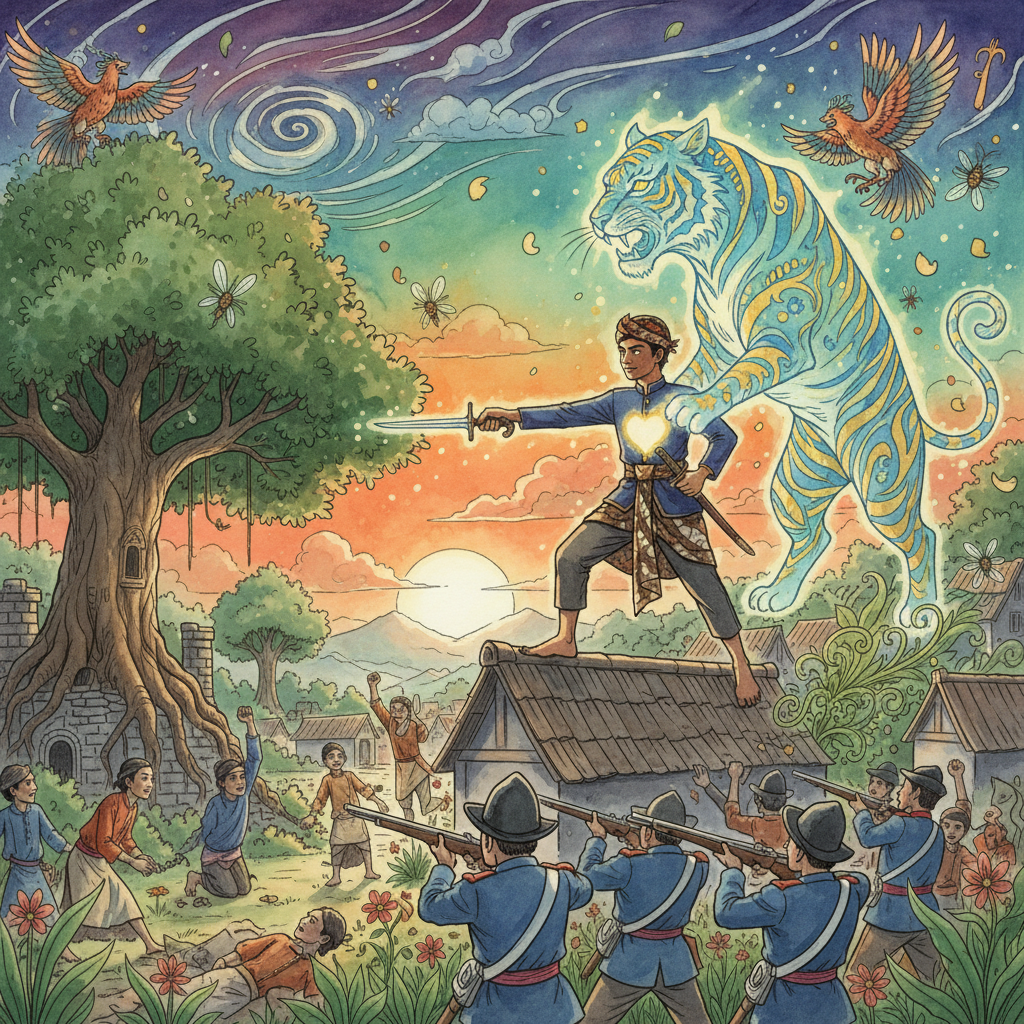
Adapted Version
Once lived a brave man named Si Pitung. He was very strong and kind. He saw some people had no food. Mean rich people had too much. So Si Pitung took from them. He was not afraid. He gave food and clothes to poor people. The people were very happy. They had food to eat. Si Pitung helped them each day.
But the mean rulers heard about Si Pitung. They did not like him. They wanted to stop him. They looked for him all around. They searched the villages and the forests. Si Pitung was clever. He helped many people in secret.
One day, the mean rulers found Si Pitung. They caught him. Si Pitung was brave. He did not run away. He let them catch him. This kept his Father and Teacher safe. He loved them very much. He wanted to protect them. It was a hard choice.
Si Pitung had to go away. But the people did not forget him. They kept his kindness in mind. They called him a hero. They told his story with love. They shared it with their children. His brave acts lived on in their hearts.
Si Pitung helped the poor and was brave. We should help others and be brave too.
Original Story
Si Pitung
Si Pitung adalah pencuri yang merampok tuan tanah kaya dan membagikan jarahan kepada rakyat miskin. Ia ditangkap Belanda demi melindungi ayah dan gurunya. Ia mati sebagai pahlawan rakyat[1][5][27].
Pesan Moral: Keadilan sosial dan pengorbanan untuk orang yang dicintai.
Story DNA
Moral
Keadilan sosial dan pengorbanan untuk orang yang dicintai.
Plot Summary
Si Pitung is a legendary Indonesian social bandit who steals from rich landlords and distributes his spoils to the poor. The Dutch colonial authorities seek to capture him. He is eventually apprehended after sacrificing himself to protect his father and teacher, dying as a revered folk hero.
Themes
Emotional Arc
struggle to tragic triumph
Writing Style
Narrative Elements
Cultural Context
The story reflects the social injustices and resistance against Dutch colonial rule in Indonesia, where figures like Si Pitung became symbols of defiance.
Plot Beats (6)
- Si Pitung establishes himself as a social bandit, robbing wealthy landlords.
- He distributes his stolen goods to the impoverished people.
- The Dutch colonial authorities become determined to capture him.
- Si Pitung is eventually apprehended by the Dutch.
- His capture is a result of his sacrifice to protect his father and teacher.
- Si Pitung dies, becoming a revered folk hero among the people.
Characters
Si Pitung ★ protagonist
A lean and agile young man of average height, typical of Betawi ethnicity, with a strong, wiry build honed by physical training and constant movement. His skin is a warm, medium brown, often tanned from being outdoors. He moves with a quiet confidence and quick reflexes.
Attire: He typically wears practical, dark-colored Betawi traditional attire suitable for stealth and movement: a dark blue or black 'pangsi' (loose-fitting shirt and trousers made of sturdy cotton), a 'sabuk' (wide cloth belt) wrapped around his waist, and a 'peci' (black velvet cap) on his head. Sometimes he wears a 'sarung' (a length of patterned cloth) draped over his shoulder or tied around his waist for disguise or utility.
Wants: To alleviate the suffering of the poor by redistributing wealth from the corrupt rich, and to protect his loved ones.
Flaw: His deep loyalty and love for his father and teacher, which the Dutch exploit to capture him.
He begins as a local hero, a 'thief with a cause,' and his arc culminates in his ultimate sacrifice, solidifying his status as a martyr and folk hero for his people.
Courageous, altruistic, cunning, determined, and protective. He is driven by a strong sense of justice for the poor.
Image Prompt & Upload
A young Betawi man, lean and agile, standing upright and facing forward, full body visible from head to toe. He has a warm, medium brown skin tone, an oval face with sharp, dark brown eyes, a straight nose, and firm lips. His hair is thick, black, and cut short. He wears a dark blue cotton pangsi (loose shirt and trousers), a wide dark cloth sabuk belt wrapped around his waist, and a black velvet peci cap on his head. His expression is determined and observant. Plain white background, full body visible head to toe, single figure, no watermark, no text, no signature.
Si Pitung's Father ◆ supporting
An older Betawi man, slightly stooped with age but still possessing a quiet strength. His build is slender, and his skin is weathered from years of labor under the sun. He has a gentle demeanor but a resilient spirit.
Attire: Simple, traditional Betawi peasant clothing: a light-colored cotton shirt, loose dark trousers, and perhaps a sarung wrapped around his waist or draped over his shoulder. His clothes are clean but worn.
Wants: To live a peaceful life and ensure the safety and well-being of his son.
Flaw: His vulnerability and love for Si Pitung, which makes him a target for the Dutch.
He remains a steadfast figure, a symbol of what Si Pitung is fighting to protect. His capture is the catalyst for Si Pitung's ultimate sacrifice.
Loving, wise, humble, and deeply concerned for his son's safety. He represents the moral compass and the family ties that ground Si Pitung.
Image Prompt & Upload
An elderly Betawi man, slender and slightly stooped, standing upright and facing forward, full body visible from head to toe. He has a weathered, medium brown skin, a face lined with age, kind dark eyes, and a short, graying mustache. His hair is thinning and gray, combed back. He wears a light-colored cotton shirt, loose dark trousers, and a simple patterned sarung wrapped around his waist. His expression is gentle but shows concern. Plain white background, full body visible head to toe, single figure, no watermark, no text, no signature.
Si Pitung's Guru ◆ supporting
An elderly Betawi man, often depicted as a spiritual and martial arts master. He has a lean, strong frame despite his age, suggesting years of discipline. His skin is deeply tanned and wrinkled.
Attire: Traditional, simple Islamic attire: a loose-fitting white or light-colored 'baju koko' (tunic shirt), dark trousers, and a 'kopiah' (skullcap) or a simple 'sorban' (turban) on his head. His clothes are modest but immaculately clean.
Wants: To guide his students towards righteousness and to uphold moral values in the community.
Flaw: His age and his commitment to his spiritual path make him less capable of physical escape, making him vulnerable to capture.
Like Si Pitung's father, he serves as a symbol of the values Si Pitung defends. His capture is a direct threat that forces Si Pitung's hand.
Wise, patient, disciplined, spiritual, and deeply committed to justice and moral principles. He is a mentor and a source of strength.
Image Prompt & Upload
An elderly Betawi man, lean and strong, standing upright and facing forward, full body visible from head to toe. He has deeply tanned and wrinkled skin, a serene and wise face with deep-set, piercing dark eyes. He has a long, flowing white beard and mustache, and his white hair is covered by a simple white kopiah. He wears a loose-fitting white baju koko tunic shirt and dark trousers. His expression is calm and knowing. Plain white background, full body visible head to toe, single figure, no watermark, no text, no signature.
Locations
Kampung Rawa Belong
A typical Betawi village setting, likely with traditional 'rumah panggung' (stilt houses) made of wood and bamboo, surrounded by lush tropical vegetation and possibly rice fields or coconut groves.
Mood: Humble, communal, and later, oppressed by colonial rule.
Si Pitung's home village, where he grew up and where the poor villagers he defended resided.
Image Prompt & Upload
A traditional Betawi village scene in Kampung Rawa Belong, with several 'rumah panggung' (stilt houses) constructed from dark tropical hardwood and woven bamboo, their steep roofs covered in red clay tiles. Lush green rice paddies stretch into the distance, interspersed with tall coconut palms swaying gently. A narrow, sun-baked dirt path winds between the houses, with chickens scratching in the dust. The air is humid and bright under a clear tropical sky. no border, no frame, no watermark, no text, no signature, edge-to-edge illustration.
Rumah Tuan Tanah (Rich Landowner's House)
A large, opulent residence belonging to a wealthy Dutch colonial-era landowner or a local 'tuan tanah' collaborating with the Dutch, likely a blend of European and local architectural styles, featuring solid construction, perhaps with a tiled roof, wide verandas, and well-kept grounds.
Mood: Opulent, guarded, a symbol of wealth and injustice.
The primary target of Si Pitung's robberies, where he takes the wealth to redistribute to the poor.
Image Prompt & Upload
An imposing colonial-era 'tuan tanah' residence, possibly a blend of Dutch and traditional Indonesian architecture, with whitewashed plastered walls and a dark, steeply pitched tiled roof. Wide, shaded verandas with turned wooden balustrades wrap around the front, overlooking a manicured tropical garden. Large, dark wooden double doors with brass knockers stand at the entrance. Inside, the rooms are spacious with high ceilings, polished dark wood floors, and heavy, ornate European-style furniture. The night is dark, with soft lamplight spilling from the windows. no border, no frame, no watermark, no text, no signature, edge-to-edge illustration.
Colonial Prison
A grim, sturdy colonial-era prison, likely built by the Dutch, characterized by thick stone or brick walls, iron bars, and a general sense of confinement and despair.
Mood: Oppressive, bleak, a place of punishment and despair.
Where Si Pitung is eventually captured and imprisoned by the Dutch colonial authorities.
Image Prompt & Upload
A stark, grim colonial-era prison interior, with rough-hewn, thick stone walls stained with damp and age. Narrow, high-set windows, barely visible, allow only slivers of dim, dusty light to penetrate the oppressive gloom. Heavy, rusted iron bars form the cell doors, leading to dark, cramped cells with rough, cold stone floors. The air is heavy and still, carrying a sense of despair. A single, flickering oil lamp casts long, dancing shadows on the textured walls. no border, no frame, no watermark, no text, no signature, edge-to-edge illustration.


