Legenda Sendang Tawun
by Balai Bahasa Surabaya · from Cerita Rakyat Jawa Timur
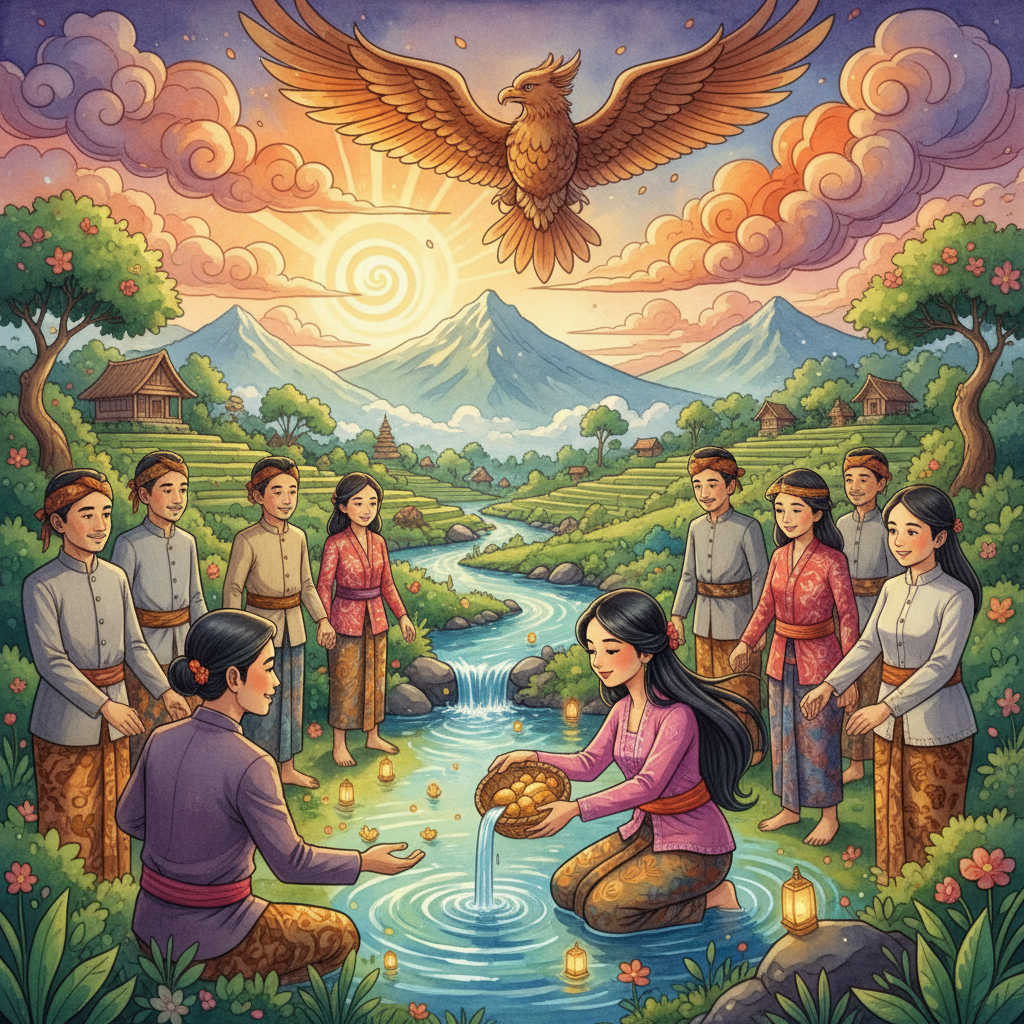
Adapted Version
Long, long ago, a kind old man lived. He found a pretty spring. The water was clean and bright. Old Father Tawun smiled. He built a home near it.
He had two sons. Lodrojoyo loved plants and people. Hascaryo loved to travel far away.
Lodrojoyo walked to the farms one day. He saw the plants. They were brown and dry. The farmers looked very sad. "We have no water," they said. Lodrojoyo felt sad too. He wanted to help them.
He looked at the spring. The water was down low. He looked at the farms. The farms were up high. The water could not go up. "How can I help?" he said.
Lodrojoyo went to his father. "Father, the farmers are sad," he said. "The water cannot reach them. Can I ask the spring?" He wanted to sit very still. He wanted to ask softly.
Old Father Tawun looked at his son. He smiled a big, warm smile. "Yes, my son. You are very kind."
That night, Lodrojoyo sat by the spring. The stars were very bright. The night was quiet and soft. He closed his eyes. He wished very, very hard. "Please help the farmers," he said.
Then a great thing happened. A bright, warm light shone. It was so bright and pretty. They all woke up. They all came to look.
The spring had moved up the hill! The water was up high now. It could reach the farms! But Lodrojoyo was not there. He had gone to a special place.
They looked for him. But he was gone. They missed him very much.
Then they saw the water. It flowed to all the farms. Lodrojoyo helped the water move. He gave the biggest gift he could. He was so kind and so brave.
Now water went to all the plants. The plants grew tall and green! The farmers smiled and laughed. They were so happy.
Each year, the people had a big party. They made good food. They sang happy songs. They said thank you to Lodrojoyo. They told his story to each child.
And each year, they say thank you. Lodrojoyo was very, very kind. When we help others, they never forget.
Original Story
Legenda Sendang Tawun
onon pada abad XV, seorang pengembara yang datang bersama rombongannya ke
Ss, daerah Padas menemukan sebuah sendang. Pengembara itu bemama Ki Ageng
Tawun. Karena yang menemukan sendang tersebut adalah Ki Ageng Tawun,
masyarakat setempat kemudian menamakan sendang itu sesuai dengan nama penemunya,
yakni Sendang Tawun.
Ki Ageng Tawun beserta keluarga dan rombongannya memutuskan tinggal di daerah itu
karena mudah mendapatkan air untuk kebutuhan sehari-hari. Setelah lama hidup di sekitar
sendang, Ki Ageng Tawun dan istrinya dikaruniai dua orang anak laki-laki yang bernama
Raden Lodrojoyo dan Raden Hascaryo. Mereka sangat bahagia mendapat karunia dua anak
laki-laki yang gagah dan tampan itu sehingga Ki Ageng Tawun selalu bersemangat dalam
menjalankan aktivitas kesehariannya, yaitu membangun daerah Padas.
Meskipun memiliki kemiripan fisik, kedua anak Ki Ageng Tawun itu mempunyai
kegemaran dan sifat yang berbeda, Raden Lodrojoyo suka bertani dan bercocok tanam,
sedangkan Raden Hascaryo suka belajar olah keprajuritan, olah perang, dan mendalami ilmu
ketatanegaraan. Kegemaran dan bakat mereka mendapat perhatian, salah satunya dari salah
seorang anggota kelompok yang turut mengembara bersama Ki Ageng Tawun, yaitu Raden
Sinorowito, putra Sultan Pajang. Dari kedua putra Ki Ageng Tawun, Raden Hascaryo yang
paling dia perhatikan karena bakat dan kegemarannya sesuai dengan keahlian dan
kemampuannya. Akhirnya, Raden Sinorowito memutuskan untuk mengangkat Raden
Hascaryo menjadi muridnya dan sejak saat itu dia terus melatih dan menggemblengnya, baik
dalam hal keprajuritan dan ilmu perang maupun dalam hal ketatanegaraan.
Setelah bertihun-tahun menjadi murid Raden Sinorowito, Raden Hascaryo menjelma
menjadi seorang pria dewasa yang sangat cakap. Dia cakap dalam hal keprajuritan dan
strategi perang, juga cakap dalam hal ketatanegaraan. Setelah dirasa cukup, Raden Hascaryo
diajak ikut mengabdi di kesultanan Pajang oleh Raden Sinorowito. Sebelum pergi, Raden
Hascaryo dibekali sebuah cinde pusaka oleh Ki Ageng Tawun. Sejak saat itulah, Raden
Hascaryo mengabdi di kesultanan Pajang.
Konon, pada waktu terjadi pertempuran antara kesultanan Pajang dan kerajaan
« Blambangan, Raden Hascaryo dipercaya oleh Sultan Pajang sebagai seorang senopati perang.
Sultan Pajang melihat kemampuan Raden Hascaryo untuk memimpin pasukan perang dan
percaya akan mampu melakukan tugasnya dengan baik. Terbukti akhirnya Pajang menuai
kemenangan melawan kerajaan Blambangan di bawah kepemimpinannya.
Lain cerita dengan Raden Lodrojoyo. Jika saudaranya, Raden Hascaryo sudah mengabdi
di kesultanan Pajang, dia malah memilih tinggal bersama dengan Ki Ageng Tawun. Karena
gemar bertani dan bercocok tanam, dia sering berkeliling melihat kehidupan para petani di
daerah tersebut. Sehari-hari dia sangat memerhatikan rakyat kecil, khususnya para petani. Dia
selalu menanyakan kesulitan-kesulitan yang dihadapi mereka. Banyak yang mengatakan
bahwa mereka tidak dapat menanam padi dengan sempuma karena kekurangan air. Raden
119
Lodrojoyo tak habis pikir, bagaimana mungkin petani di desa tersebut bisa kekurangan air
untuk tanaman padinya karena di daerah itu ada sendang yang selalu penuh atrnya: Ia terus
berusaha mencari cara agar petani bisa memanfaatkan air yang ada di sendang itu untuk
mengairi sawahnya. Dia yakin pasti ada jalan untuk mengalirkan air dari sendang menuju
persawahan warga.
Pada suatu hari, tepatnya hari Kamis Kliwon, Raden Lodrojoyo menghadap Ki Ageng
Tawun dan mengutarakan niat sucinya.
“Romo, jika romo mengizinkan, nanti malam Putranda hendak menjalani ulah tirakat di
Sendang Tawun.”
"Kamu hendak bertapa di Sendang Tawun malam ini?”
"Tya Romo, jika diperkenankan.”
“Lalu tapa apa yang hendak kamu lakukan?”
"Matirto, Romo."
”Matirto?”
"Iya Romo.”
"Jika memang niatmu untuk membantu petani dan rakyat kecil, Romo tidak bisa
mencegahmu.”
Matirto adalah lelaku tirakat atau bertapa dengan cara merendam diri di dalam air. Di
Pulau Jawa bertapa seperti ini juga dikenal dengan sebutan topo kungkum. Merendam seluruh
tubuh sampai sebatas leher atau bahu di dalam air. Dengan melakukan matirto ini, Raden
Lodrojoyo berharap cita-cita luhurnya akan dikabulkan oleh Tuhan pencipta alam semesta,
yaitu dapat membantu memecahkan masalah yang dihadapi oleh petani dan rakyat kecil.
Ki Ageng masih penasaran dengan apa yang dikehendaki sebenarnya oleh Raden
Lodrojoyo sehingga pembicaraan mereka berlanjut.
”Apa tujuanmu sebenarnya melakukan matirto, Lodrojoyo?”
“Putranda mengerti bagaimana warga sekitar sendang selalu mengalami gagal panen.
Hal itu terjadi karena sawah-sawah mereka kekurangan air meskipun ada sendang di sekitar
tempat itu. Namun, bagaimana cara mengalirkan airnya? Sawah mereka lebih tinggi letaknya
dibandingkan dengan letak Sendang Tawun."
"Lalu kamu ingin mengubah nasib mereka?”
”Putranda hendak mohon petunjuk dari Tuhan Yang Mahaagung dan Mahakuasa
bagaimana caranya mengalirkan air Sendang Tawun tersebut ke sawah-sawah mereka.”
“Baiklah, Romo merestui niat tulusmu, Lodrojoyo.”"
”Terima kasih Romo."
Setelah mendapat restu dari Ki Ageng Tawun, tepat pukul tujuh malam, bari Jumat Legi,
Raden Lodrojoyo pergi ke Sendang Tawun. Sambil berdoa memohon petunjuk Tuhan Yang
Mahaagung dia mulai melakukan lelaku matirto, yaitu dengan merendam dirinya di Sendang
Tawun. Suasana gelap dan air yang sangat dingin tidak dihiraukan karena tekadnya hanya
satu, yaitu ingin membantu petani dan rakyat kecil.
Malam langit cerah, bulan purnama tersenyum ramah. Di tengah-tengah sendang yang
rimbun oleh pepohonan yang ditanam memagari Sendang Tawun, Raden Lodrojoyo terus
melakukan /elaku matirto dan memanjatkan doanya kepada Yang Mahaagung.
Tepat pada pukul dua belas tengah malam, bulan yang semula terang tiba-tiba redup
tertutup awan tebal. Suasana menjadi sangat menyeramkan. Tak lama kemudian terdengar
suara ledakan yang amat dahsyat, "blaaarr!” Kerasnya suara ledakan tersebut sampai
120
membangunkan warga setempat. Mereka beramai-ramai menuju pusat suara ledakan yang
diduga berasal dari arah Sendang Tawun. Mereka ingin tahu apa yang terjadi.
Betapa terkejutnya mereka setelah melihat apa yang terjadi di Sendang Tawun. Sendang
tidak lagi berada di tempat semula, namun berpindah ke sebelah utara yang lokasinya lebih
tinggi jika dibandingkan dengan persawahan warga. Warga pun tak dapat menutupi
keheranannya.
"Ajaib!
“Sungguh aneh!”
"Luar biasa!”
"Bagaimana bisa? Apa ada hubungannya Gerai suara ledakan yang kita dengar tadi?”
“Tya, benar. Mungkin karena suara ledakan itu?”
"Tapi apanya yang meledak? Sendang itu masih utuh, hanya lokasinya saja yang
berpindah.”
"Ayo, coba kita lihat lebih dekat.”
”Benar...benar, siapa tahu ada yang berubah.”
Mereka berjalan mengitari sendang di tempat yang baru, tetapi tidak ada yang berbeda
dengan sendang sebelumnya. Airnya pun tetap tenang dan jernih, seperti tidak terjadi apa-apa.
Keheranan warga pun semekin menjadi. Akan tetapi, belum sempat mereka berkomentar,
terdengar suara Ki Ageng Tawun memanggil-manggil anaknya.
“Lodrojoyo...Lodrojoyo!”
"Bukankah itu suara Ki Ageng?”
“Benar, itu suara Ki Ageng!”
”Jangan...jangan...suara tadi ada hubungannya dengan Ki Ageng. Ayo, sebaiknya kita
beritahu Ki Ageng.”
”Aki...Ki Ageng, kami di sini. Sekarang sendangnya ada di atas!”
Sesaat kemudian mereka juga tersadar bahwa Raden Lodrojoyo yang menjalani /elaku
matirto di sendang itu juga turut lenyap secara misterius bersamaan dengan terdengarnya
suara ledakan itu.
”Ki, bukankah Raden Lodrojoyo tadi ada di sendang?” tanya seorang petani kepada Ki
Ageng Tawun setelah tiba di atas. Mereka berdiri sambil mengamati sekeliling sendang.
”Ta melakukan lelaku matirto sejak sore tadi, Tapi, di mana dia sekarang?”
“Sejak kami kemari, tidak ada orang lain selain kita di sini, Ki.”
”Coba kita berpencar mencari. Karyo dan...kau Sanapi, cari di lokasi sekitar sendang
lama. Kau...Mistam, Parmin, dan Paijo, ajak warga yang lain mencari di sekitar lokasi ini.”
"Baik, Ki!”
Mereka pun berpencar. Sambil memanggil-manggil nama Raden Lodrojoyo mereka
berusaha menyibak pepohonan di sekitar sendang. Usaha mereka malam itu tidak
membuahkan hasil.
Ki Ageng Tawun dengan dibantu oleh masyarakat setempat terus mencari keberadaan
Raden Lodrojoyo di dalam sendang tersebut sampai hari Selasa Kliwon, tetapi tidak berhasil.
Segala upaya telah dilakukan untuk menemukannya, bahkan air Sendang Tawun dikuras
sampai habis, tetapi Raden Lodrojoyo tetap tidak ditemukan. Akhirnya, mereka sadar bahwa
inilah pengorbanan Raden Lodrojoyo. Kegigihannya dalam memperjuangkan dan membantu
kepentingan petani dan rakyat kecil harus dibayar mahal dengan nyawanya. Pengorbanannya
tidak sia-sia karena berkat upaya gigih Raden Lodrojoyo, petani sudah dapat mengalirkan air
121
dari sendang ke lokasi persawahan mereka. Dengan demikian, petani tidak akan mengalami
gagal panen lagi akibat kekurangan air.
Sejak peristiwa itu, setahun sekali warga setempat mengadakan upacara adat untuk
mengenang pengorbanan Raden Lodrojoyo yang peduli terhadap nasib kaum miskin dan para
petani yang menderita karena kekurangan air. Upacara adat tersebut dinamakan "Bersih
Sendang” dan diadakan tepat pada hari Selasa Kliwon.
Mereka menyediakan sesaji berupa tiga puluh macam hasil bumi dan bunga-bunga segar
dan harum baunya. Dalam upacara adat itu juga disembelih dua belas ekor kambing yang
sebelumnya dimandikan dahulu sebanyak tiga kali di Sendang Tawun. Beberapa juru selam
dengan berpakaian kebesaran melakukan penyelaman sambil membersihkan sendang.
Setelah sendang bersih, sekelompok orang yang mewakili masyarakat setempat dengan
membawa tumpeng nasi lengkap dengan lauk pauknya dan berbagai peralatan makan
berjalan beriringan melintasi sendang dari arah timur ke barat. Kemudian diadakan selamatan
atau kenduri yang diakhiri dengan perebutan tumpeng berkah dan makan bersama. Acara
selanjutnya dengan permainan pecut-pecutan secara berpasang-pasangan sebagai ungkapan
latihan perang antara seorang prajurit dengan seorang senopati.
122
Story DNA
Moral
True compassion and self-sacrifice for the well-being of the community will be remembered and honored.
Plot Summary
In the 15th century, Ki Ageng Tawun settles near a spring, raising two sons: Raden Hascaryo, who becomes a respected warrior, and Raden Lodrojoyo, who dedicates himself to the local farmers. Witnessing the farmers' struggles with water scarcity, Raden Lodrojoyo performs a sacred water meditation ('matirto') at the spring, seeking a divine solution. During his ritual, a mysterious explosion occurs, and the spring miraculously moves to a higher elevation, allowing water to reach the fields, but Raden Lodrojoyo vanishes. The community, realizing his ultimate sacrifice, establishes an annual ceremony, 'Bersih Sendang,' to honor his memory and ensure the continued prosperity of their land.
Themes
Emotional Arc
hope to sacrifice to enduring legacy
Writing Style
Narrative Elements
Cultural Context
The story is set in the context of historical Javanese kingdoms (Pajang, Blambangan) and incorporates traditional Javanese spiritual practices and social structures, giving it a legendary quality rooted in local history and belief.
Plot Beats (15)
- Ki Ageng Tawun discovers Sendang Tawun in the 15th century and settles there with his family and followers.
- Ki Ageng Tawun and his wife have two sons, Raden Lodrojoyo (farmer) and Raden Hascaryo (soldier/statesman).
- Raden Hascaryo becomes a skilled warrior and statesman, serving the Sultanate of Pajang.
- Raden Lodrojoyo remains with his father, observing the local farmers' struggles with crop failure due to lack of water, despite the nearby spring.
- Raden Lodrojoyo realizes the problem is the spring's lower elevation compared to the rice fields.
- Raden Lodrojoyo seeks his father's permission to perform 'matirto' (water meditation) at Sendang Tawun to find a solution.
- Ki Ageng Tawun, after understanding his son's noble intention, grants his blessing.
- Raden Lodrojoyo begins his 'matirto' ritual at Sendang Tawun on a dark, cold night, praying for divine guidance.
- At midnight, a bright moon dims, and a massive explosion occurs, waking the villagers.
- Villagers rush to Sendang Tawun and discover it has miraculously moved to a higher elevation, but Raden Lodrojoyo is gone.
- Ki Ageng Tawun and the villagers search for Raden Lodrojoyo for days, even draining the spring, but he is never found.
- The community realizes Raden Lodrojoyo's disappearance is a sacrifice that enabled the spring to move, solving the farmers' water problem.
- Farmers can now irrigate their fields, preventing future crop failures.
- The community establishes an annual 'Bersih Sendang' ceremony on 'Selasa Kliwon' to honor Raden Lodrojoyo's sacrifice.
- The ceremony involves offerings, ritual bathing of goats, cleaning the spring, a communal meal, and a 'pecut-pecutan' (whip play) performance.
Characters
Ki Ageng Tawun ◆ supporting
None explicitly mentioned, but implied to be a capable leader and father.
Attire: Traditional Javanese attire, possibly a sarong and a batik shirt, suitable for a respected elder and leader of a group.
Caring, supportive, wise, and a good leader.
Image Prompt & Upload
An elderly man in his late seventies with deep-set wrinkles, a long flowing white beard, and gentle brown eyes that exude wisdom. He wears a traditional Javanese batik shirt with intricate geometric patterns in indigo and brown, paired with a matching sarong and a black blangkon headgear. His posture is steady and reassuring, standing with one hand lightly resting on a gnarled wooden staff, the other hand open in a welcoming gesture. Plain white background, full body visible head to toe, single figure, no watermark, no text, no signature.
Raden Lodrojoyo ★ protagonist
Described as 'gagah dan tampan' (strong and handsome).
Attire: Simple, practical clothing suitable for farming and a life close to the land, perhaps a sarong and a plain shirt.
Compassionate, determined, selfless, and persistent.
Image Prompt & Upload
A young nobleman in his early twenties with a determined gaze and strong jawline. He wears an elegant, deep blue batik-patterned tunic with gold embroidery at the collar and cuffs, paired with dark, fitted trousers and polished leather boots. His black hair is neatly tied back, and he stands tall with a confident posture, one hand resting on the hilt of a sheathed keris dagger at his waist. Plain white background, full body visible head to toe, single figure, no watermark, no text, no signature.
Raden Hascaryo ◆ supporting
Described as 'gagah dan tampan' (strong and handsome).
Attire: More formal attire befitting a warrior and statesman, possibly a traditional Javanese military uniform or fine batik clothing, and carrying a 'cinde pusaka'.
Ambitious, disciplined, intelligent, and skilled in warfare and statecraft.
Image Prompt & Upload
A middle-aged Javanese nobleman with a calm, wise expression and a neatly trimmed mustache. He wears a dark blue beskap jacket with intricate gold batik patterns, a batik sarong in deep indigo, and a traditional blangkon headcloth. A keris dagger is tucked at his waist. He stands with a dignified posture, one hand resting lightly on the hilt of his keris. Plain white background, full body visible head to toe, single figure, no watermark, no text, no signature.
Raden Sinorowito ◆ supporting
None explicitly mentioned, but as a prince, likely well-groomed and of noble bearing.
Attire: Regal Javanese attire, indicative of his status as the son of the Sultan of Pajang, possibly rich batik fabrics and noble accessories.
Perceptive, influential, and a skilled mentor.
Image Prompt & Upload
A young adult male of Javanese heritage, with a composed and dignified expression. He has short, neatly combed black hair and a clean-shaven face. He wears an elegant, dark blue velvet blazer with gold trim over a high-collared white shirt. A traditional batik sarong in deep indigo and brown geometric patterns is wrapped around his waist, secured with a wide, ornate belt. He stands straight in a formal posture, one hand resting lightly on the hilt of a traditional kris dagger at his side. Plain white background, full body visible head to toe, single figure, no watermark, no text, no signature.
Sultan Pajang ○ minor
None explicitly mentioned, but as a Sultan, would be expected to have a commanding presence.
Attire: Royal Javanese regalia, including a crown or elaborate headpiece, and richly embroidered garments.
Discerning, trusting, and a strong leader.
Image Prompt & Upload
A young male ruler, aged 10-12, with olive skin and dark, thoughtful eyes. He is dressed in luxurious silk robes of crimson and gold, embroidered with mythical creatures. A jeweled crown rests on his curly black hair. He stands confidently, arms crossed, with a slight smile. Plain white background, full body visible head to toe, single figure, no watermark, no text, no signature
Locations
Daerah Padas
An area where Ki Ageng Tawun and his group settled, known for having a spring (sendang).
Mood: initially promising, later facing agricultural challenges
Ki Ageng Tawun discovers the spring and decides to settle here; later, farmers face water scarcity for their rice fields.
Image Prompt & Upload
Early morning mist clings to a lush jungle clearing, where a sacred spring (sendang) emerges from moss-covered rocks. Soft, golden sunlight filters through the dense canopy, illuminating the clear, turquoise water that pools and trickles over smooth stones. Ancient, gnarled trees with hanging vines frame the scene. Simple, traditional wooden shelters with thatched roofs are nestled discreetly among the giant ferns and flowering tropical plants. The air feels cool, damp, and reverent, with a mystical glow highlighting the steam rising gently from the water's surface. no border, no frame, no watermark, no text, no signature, edge-to-edge illustration
Sendang Tawun (Original Location)
A spring discovered by Ki Ageng Tawun, full of water, later surrounded by lush trees planted to fence it.
Mood: serene, then eerie and mysterious
Raden Lodrojoyo performs 'matirto' (meditation by immersing in water) here; a massive explosion occurs, and the spring mysteriously relocates.
Image Prompt & Upload
At dawn, a hidden spring of crystal-clear water glistens in a sun-dappled clearing, surrounded by ancient, towering banyan trees with roots like gnarled fingers. Lush ferns and emerald moss carpet the ground, and vibrant tropical flowers bloom in clusters. Soft morning mist rises from the water's surface, catching the golden light that filters through the dense, layered canopy. The air feels still and sacred, with the gentle sound of trickling water. Colors are rich and saturated: deep greens, earthy browns, and the sparkling blue of the pool. no border, no frame, no watermark, no text, no signature, edge-to-edge illustration
Sendang Tawun (New Location)
The spring after it mysteriously moved to a higher location north of the farmlands, with calm and clear water, appearing unchanged despite its relocation.
Mood: awe-inspiring, miraculous, still serene
Discovered by the villagers after the explosion; Raden Lodrojoyo is missing from here; becomes the site of the annual 'Bersih Sendang' ceremony.
Image Prompt & Upload
A crystal-clear spring nestles in a mossy hillside north of rolling farmlands, its water perfectly calm and reflecting the late afternoon sky. Smooth, pale stones line the pool's edge, surrounded by lush ferns and clusters of tiny blue wildflowers. The water glows with a soft, ethereal light from within, subtle sparkles drifting in its depths. Gentle sunlight filters through the canopy of ancient, broad-leafed trees, casting dappled patterns on the grassy banks. In the distance, patchwork fields and a thatched-roof cottage are visible under a serene, cloud-dusted sky. The scene is peaceful, vibrant, and touched with quiet magic. no border, no frame, no watermark, no text, no signature, edge-to-edge illustration.
Pajang Sultanate
The royal court where Raden Hascaryo serves as a warrior and strategist.
Mood: formal, strategic, powerful
Raden Hascaryo serves as a senopati (commander) and leads Pajang to victory against Blambangan.
Image Prompt & Upload
Dusk settles over the grand courtyard of the Pajang Sultanate's royal palace. The sky is a deep indigo, transitioning to fiery orange at the horizon. Ornate, multi-tiered joglo roofs with dark, carved teak wood dominate the architecture, their sweeping eaves casting long shadows. Warm torchlight flickers from within open-air pavilions, reflecting off polished stone floors and intricate batik-patterned walls. A serene, rectangular reflecting pool mirrors the vibrant sky and the silhouette of a towering, ancient banyan tree. Lush tropical gardens with frangipani and jasmine line the gravel pathways. The atmosphere is still, strategic, and imposing, charged with the quiet power of a kingdom at its height. no border, no frame, no watermark, no text, no signature, edge-to-edge illustration.


