Legenda Sarip Tambak Oso
by Balai Bahasa Surabaya · from Cerita Rakyat Jawa Timur
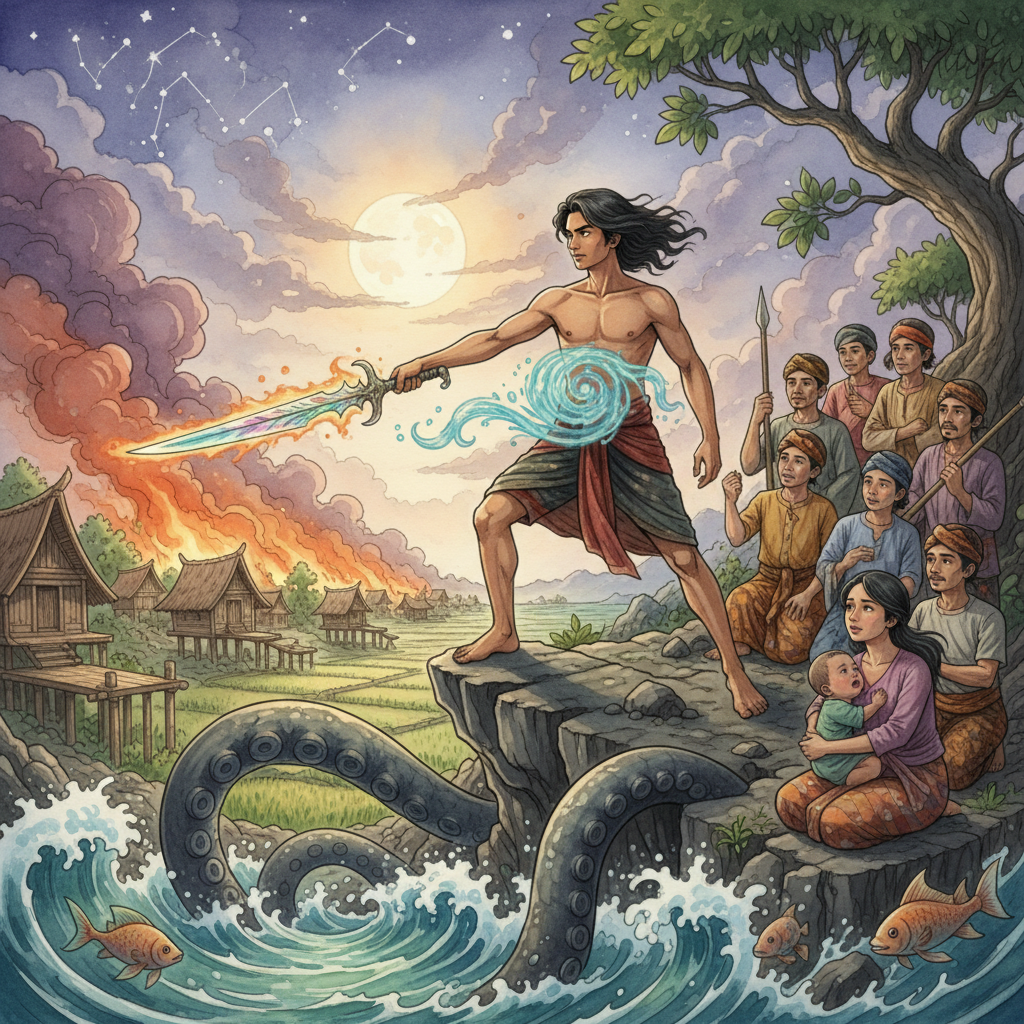
Adapted Version
Sarip was a kind boy. He lived in a small village. The village had bad bosses. The bosses were very mean. They were not good to the people.
Sarip wanted to help. He said, "I must help people." Mother said, "Be safe." She gave him her blessing.
Sarip took food from the bad bosses. He gave the food to the poor people. Sarip helps all. He helps each day.
The bad bosses caught Sarip. They let him go. But Sarip kept helping. He did not stop.
The bad bosses made Sarip sleep. Mother found him. She used her magic words. "Wake up, my son." Sarip woke up. This happened many times. Each time, Mother used her magic words.
The bad bosses were very upset. They wanted to stop Sarip for good. They made a plan.
A bad boss went to Salim. "Do you want a big toy?" he asked. Salim's eyes were big. "Yes! I want a toy!" "Tell me Sarip's secret," said the bad boss.
Salim was greedy. He told the secret. "Use a special gold thing. Then Sarip will sleep always."
The bad bosses got the special gold thing. They made a new plan.
Sarip went to help again. He did not know the secret. He did not know about Salim.
The bad bosses used the special gold thing. Sarip fell asleep. He did not wake up.
They took Sarip away. They put him in many places. They put him far away.
Mother looked for Sarip. She looked and looked. She could not find all of him. She could not use her magic words. Sarip stays asleep always.
Sarip helped many people. It is good to help others. But be safe with secrets. Sarip is gone, but people know how he helped.
Original Story
Legenda Sarip Tambak Oso
ada zaman penjajahan
Belanda, di sebuah
desa bernamna-
Tambak” Oso di Sidoarjo
hiduplah seorang ibu dan
anak lelakinya yang bernama
Sarip. Sejak kecil, Sarip
sudah yatim karena ayahnya
mati dibunuh oleh Belanda.
Berkat pendidikan yang
ditanamkan ibunya, Sarip
tumbuh menjadi anak yang
sangat peduli pada
masyarakat sekitar yang
hidup dalam penindasan
Belanda. Masyarakat desa tempat tinggal Sarip pada umumnya bekerja sebagai buruh tani di
perkebunan-perkebunan tebu milik Belanda. Kalau musim penggilingan tebu, mereka beralih
menjadi buruh di pabrik-pabrik penggilingan tebu yang banyak terdapat di Sidoarjo. Tenaga
mereka diperas, tetapi upah yang diberikan sangat tidak memadai sehingga masyarakat tetap
hidup dalam keadaan kekurangan. Kekayaan desa mereka dikeruk untuk kepentingan
Belanda semata. Pemandangan kehidupan masyarakat desa yang tertindas itu sangat
memengaruhi perkembangan Sarip, apalagi ia juga tahu bahwa ayahnya meninggal di tangan
Belanda. Rasa keadilan Sarip terusik.
“Ibu, saya tidak bisa tinggal diam,” kata Sarip kepada ibunya pada suatu hari.
"Apa maksudmu, Nak?" tanya ibunya.
"Belanda, Bu. Saya tidak bisa membiarkan Belanda memperlakukan warga desa ini
secara semena-mena,” jawab Sarip dengan suara mantap.
“Oh. Benar, Nak. Sudah bertahun-tahun mereka bekerja keras, tetapi tetap saja miskin.
Seperti kita juga. Padahal, tanah dan air ini milik kita, tetapi mereka telah merampasnya.
Mereka juga merampas bapakmu.”
“Itulah sebabnya Sarip harus melakukan sesuatu untuk membantu rakyat, Bu.”
"Dengan cara apa? Bagaimana kau akan melakukannya?”
”Sarip sudah memikirkannya. Sarip sudah tahu caranya. Sarip minta doa dan dukungan
Ibu.”
”Oh, tentu. Tentu, Nak. Ibu akan selalu mendukung perjuanganmu.Tapi, kau harus hati-
hati. Lurah dan berandal-berandal di sini sudah menjadi antek-antek Belanda.”
61
"Justru itu yang membuat Sarip geram, Bu. Kasihan rakyat. Tidak ada lagi yang
melindungi. Lurah yang seharusnya membela rakyat justru ikut menindas. Bagaimana
mungkin hal ini dibiarkan saja, Bu. Sarip tidak tahan lagi,” kata Sarip tegas.
”Tekadmu sangat mulia, Nak. Ibu .akan selalu mendoakan dan mendukung
perjuanganmu, Lakukanlah sesuatu untuk membantu rakyat.”
”Terima kasih atas restu dan dukungan Ibu,” kata Sarip sambil mencium tangan ibunya.
Suatu sore, Sarip minta izin ke luar rumah. Ia keluar hanya dengan membawa sehelai
sarung dan meninggalkan rumah dengan tekad dan semangat yang tinggi serta doa restu
ibunya. Sarip tidak memberi tahu rencananya, tetapi ibunya sangat yakin bahwa apa yang
akan dilakukan Sarip semata-mata untuk membela rakyat yang tertindas.
Keesokan harinya ibunya baru tahu apa yang dilakukan Sarip setelah mendengar kabar
bahwa sebuah gudang penyimpanan makanan milik Belanda dibobol oleh pencuri. Kabar lain
terdengar bahwa rumah-rumah rakyat miskin dikejutkan oleh kiriman bahan makanan yang
tiba-tiba ada di depan pintu rumah, Ibunya yakin bahwa Sariplah yang melakukan itu. Sarip
yang mencuri gudang penyimpanan makanan Belanda kemudian membagikannya kepada
Kejadian serupa terjadi berulang-ulang hingga membuat Belanda kesal. Akhirnya,
Belanda menyebar mata-mata untuk menyelidiki orang yang telah melakukan pencurian itu.
Lurah dan para berandal desa yang berpihak pada Belanda akhirnya tahu bahwa pelakunya
adalah Sarip. Mereka segera melapor pada Belanda. Belanda memerintahkan prajuritnya
untuk menangkap Sarip hidup-hidup agar dapat diadili. Suatu hari, Sarip berhasil dijebak dan
ditangkap. Dalam pengadilan Pemerintah Kolonial Belanda, Sarip didakwa bersalah sehingga
dimasukkan ke penjara. Selama di penjara, ibunya selalu menjenguk dan memberinya
semangat untuk tidak menyerah.
Setelah ke Juar dari penjara, Sarip tetap melakukan pencurian di gudang-gudang Belanda
dan membagikan hasilnya kepada rakyat yang kekurangan. Di mata Belanda, Sarip adalah
penjahat, tetapi bagi rakyat, Sarip adalah pahlawan yang membela dan melindungi hidup
mereka. Sepak terjang Sarip kian membuat geram Belanda hingga Belanda memerintahkan
orang-orangnya tidak untuk menangkap, tetapi membunuhnya.
Dalam suatu aksinya di tengah malam, Sarip berhasil ditangkap dan dibunuh oleh
pasukan Belanda. Belanda merasa sangat senang karena tidak ada lagi penjahat yang akan
mengacaukan kekuasaannya. Mayat Sarip dibiarkan saja tergeletak di pematang sawah.
Berita kematian Sarip segera tersebar luas. Warga yang merasa tertolong oleh
keberanian Sarip merasa kehilangan. Berita itu juga sampai ke telinga ibunya Sarip. Dengan
tergopoh-gopoh ibunya berlari menyusuri pematang sawah menuju ke tempat mayat anaknya
ditemukan. Setelah memastikan bahwa mayat yang tergeletak di tanah adalah mayat Sarip,
ibunya segera menyentuh pundaknya seranya berkata, ”Durung wayahe awakmu mati, le.”
(“Belum saatnya kamu meninggal, Nak”).
Mendengar kata-kata ibunya, Sarip bangun lagi seperti tidak terjadi apa-apa. Malamnya,
Sarip sudah beraksi kembali. Seperti biasa, ia mencuri di gudang-gudang dan rumah-rumah
orang Belanda kemudian membagikannya kepada warga miskin. Belanda sangat terkejut dan
marah mengetahui aksi Sarip. Belanda melipatgandakan kekuatannya untuk menangkap atau
membunuh Sarip. Sarip berhasil dibunuh kemudian mayatnya dibuang ke sungai. Ketika
mayatnya ditemukan ibunya, ibunya kembali memanggilnya, Sarip pun bangun lagi. Hal itu
terjadi berkali-kali hingga membuat Belanda pusing.
62
Belanda mencari cara halus untuk menghabisi Sarip melalui pendekatan keluarga. Salah
seorang saudaranya yang bernama Salim terbujuk oleh iming-iming Belanda.
"Salim, apa kau mau jadi mandor pabrik gula?” tanya seorang penguasa Belanda.
"Apa, Tuan? Apa bisa orang seperti saya menjadi mandor pabrik gula?” tanya Salim.
”Kenapa tidak? Apa saja bisa kami lakukan asalkan kau bersedia membantu kami.
Bagaimana?"
"Membantu apa, Tuan?”
“Melenyapkan Sarip.”
"Membunuh Sarip, maksud Tuan?”
“Benar. Kau tentu tahu, sudah berkali-kali kami membunuhnya, tetapi ia selalu hidup
kembali. Mengapa bisa begitu? Sungguh aneh, bukan? Bagaimana supaya dia mati
selamanya?"
”Oh, Tuan ingin tahu kelemahan Sarip?"
”Benar! Benar! Kalau kau mau membantu, kami akan mengangkatmu jadi mandor
pabrik gula.”
"Baiklah, itu mudah, Tuan,” kata Salim. Matanya berbinar membayangkan akan
menjadi mandor pabrik gula. Ia tidak peduli lagi dengan persaudaraan dan nasionalisme demi
memenuhi ambisinya pada jabatan. "Tuan, Sarip tidak dapat mati karena tuah ibunya. Selagi
baru lahir, ari-an Sarip tidak dikubur atau dilarung, tetapi dimakan oleh ibunya. Jadi, hidup
Sarip berada di tangan ibunya. Kalau Tuan tembak dengan peluru biasa, dia hanya mati suri,
Walaupun Tuan membunuhnya seribu kali, Sarip akan hidup kembali kalau ibunya dapat
menemukan mayatnya dan memanggil namanya."
”Oh, begitu rupanya. Sulit dipercaya.”
"Kenyataannya seperti itu, Tuan. Kalau Tuan tidak percaya boleh saja, tapi Tuan tidak
akan pernah dapat melenyapkan Sarip.”
"Baiklah. Baiklah. Katakan, apa yang harus kami lakukan untuk membuatnya mati
selamanya.”
"Mudah saja, Tuan. Sarip hanya bisa mati jika tubuhnya tertembus peluru emas yang
direndam dalam darah babi. Setelah itu, tubuhnya harus dipenggal dan dibuang di dua sungai
yang berbeda. Dengan demikian, ibunya -tidak akan menemukan jasadnya dan
memanggilnya.”
"Aku pegang kata-katamu, Salim. Awas, jika kau bohong, kepalamu yang akan kami
ggal,"
“Silakan Tuan buktikan. Tapi, Tuan jangan lupa juga, jabatan mandor pabrik gula untuk
saya"
"Lihat saja nanti.”
Setelah pertemuan itu, penguasa Belanda itu segera memerintahkan para prajuritnya
untuk menyediakan dan menyiapkan pembunuhan terhadap Sarip. Beberapa orang prajurit
Belanda menyiapkan peluru emas yang telah direndam dengan darah babi dan menyiapkan
pedang untuk memenggal tubuh Sarip. Mereka disebar ke beberapa tempat yang diduga akan
menjadi sasaran aksi Sarip.
Sarip, yang tidak tahu telah dikhianati oleh saudaranya, pamit kepada ibunya. Seperti
biasa, ia akan beraksi menguras gudang-gudang penyimpanan makanan dan rumah-rumah
milik orang Belanda dan antek-anteknya. Ketika sedang melakukan aksinya, ia ditembak
dengan peluru emas yang telah direndam dalam darah babi. Tubuhnya kemudian dipotong
63
menjadi dua. Bagian kepala dibuang di Sungai Pepe, sedangkan tubuhnya dibuang di Sungai
Porong. Ibunya tidak dapat lagi menemukan tubuh Sarip secara utuh sehingga Sarip mati
selamanya.
Story DNA
Moral
Even the most resilient spirit can be defeated by betrayal and the exploitation of personal weaknesses, but true heroism lies in fighting for justice against oppression.
Plot Summary
Sarip, a young man from an oppressed village during Dutch colonial rule, becomes a local hero by stealing from the Dutch and distributing to the poor. Despite being repeatedly killed by the Dutch, his mother's magical words always revive him. Frustrated, the Dutch bribe Sarip's ambitious relative, Salim, who reveals Sarip's weakness: he can only be permanently killed by a golden bullet soaked in pig's blood, followed by dismemberment and scattering of his body parts. The Dutch execute this plan, preventing his mother from finding his complete body, thus ending Sarip's life and his resistance.
Themes
Emotional Arc
suffering to triumph (repeatedly) to tragic defeat
Writing Style
Narrative Elements
Cultural Context
The story is set during the Dutch colonial period in Indonesia, a time marked by exploitation of local resources and labor, and resistance movements. The figure of a local hero fighting against colonial oppressors is a common theme in Indonesian folklore.
Plot Beats (13)
- Sarip, a young man whose father was killed by the Dutch, lives in an oppressed village and feels compelled to fight for his people.
- Sarip's mother, though cautious, blesses his resolve to act against the Dutch.
- Sarip begins stealing from Dutch warehouses and distributing the goods to the poor, becoming a local hero.
- The Dutch, angered by Sarip's actions, capture and imprison him, but he continues his activities after release.
- The Dutch repeatedly kill Sarip, but each time his mother finds his body, speaks a magical phrase, and revives him.
- The Dutch become desperate to permanently eliminate Sarip due to his repeated resurrections.
- A Dutch official approaches Sarip's relative, Salim, offering him a lucrative position as a sugar factory foreman in exchange for information about Sarip's weakness.
- Salim, driven by ambition, betrays Sarip, revealing that his life is tied to his mother's power and he can only be permanently killed by a golden bullet soaked in pig's blood, followed by dismemberment and scattering of his body parts in different rivers.
- The Dutch prepare the special bullet and a plan to dismember Sarip.
- Sarip, unaware of the betrayal, goes out for another raid.
- During his raid, Sarip is shot with the special golden bullet.
- His body is dismembered, with his head thrown into the Pepe River and his body into the Porong River.
- Sarip's mother cannot find his complete body, thus preventing his revival, and Sarip dies permanently.
Characters
Sarip ★ protagonist
Strong and resilient, able to withstand multiple deaths and resurrections.
Attire: A sarung (loincloth) when leaving home for his actions; otherwise, typical peasant clothing of the Dutch colonial era in Java.
Brave, rebellious, compassionate, determined, justice-seeking.
Image Prompt & Upload
A young man in his early twenties with short, tousled chestnut hair and determined hazel eyes. He wears a layered outfit of a cream linen tunic under a worn leather vest, paired with sturdy brown trousers and scuffed boots. His posture is alert, one hand resting on a simple sword at his hip, the other holding a worn leather satchel. He has a focused, resolute expression, standing ready for a journey. Plain white background, full body visible head to toe, single figure, no watermark, no text, no signature.
Sarip's Mother ◆ supporting
A mother figure, likely showing signs of hardship from colonial oppression.
Attire: Traditional Javanese peasant dress of the Dutch colonial era.
Supportive, loving, resilient, possesses mystical power (tuah).
Image Prompt & Upload
A middle-aged woman with kind, crinkling eyes and a warm, gentle smile. Her graying hair is pulled back in a practical bun. She wears a simple, faded blue peasant dress with a clean white apron, her sleeves rolled up. She stands in a cozy, rustic cottage kitchen, one hand resting on a wooden table, the other outstretched in a welcoming gesture. Plain white background, full body visible head to toe, single figure, no watermark, no text, no signature.
Salim ⚔ antagonist
Unknown, but his eyes are described as 'shining' with ambition.
Attire: Likely simple peasant clothing, aspiring to a foreman's uniform.
Ambitious, greedy, treacherous, disloyal to family and nation.
Image Prompt & Upload
A middle-aged man with a sharp, angular face, cold dark eyes, and a cruel smirk. He has slicked-back black hair and a neatly trimmed goatee. He wears an ornate, high-collared coat of dark velvet with gold embroidery, fitted trousers, and polished black boots. His posture is rigid and commanding, one hand resting on the hilt of a jeweled dagger at his belt. He stands in a dimly lit, opulent chamber with heavy curtains and stone archways, shadows playing across his severe features. Plain white background, full body visible head to toe, single figure, no watermark, no text, no signature.
Dutch Official ⚔ antagonist
A colonial authority figure.
Attire: Colonial military or administrative uniform of the Dutch East Indies.
Ruthless, cunning, frustrated, manipulative.
Image Prompt & Upload
A middle-aged man with sharp, angular features and cold, calculating eyes. He wears a formal dark navy doublet with intricate gold trim, a high stiff collar, and a wide crimson sash across his chest. His hair is slicked back neatly, and he has a thin, severe beard. He stands rigidly with hands clasped behind his back, posture upright and imposing, exuding authority and menace. Plain white background, full body visible head to toe, single figure, no watermark, no text, no signature.
Locations
Tambak Oso Village
A village in Sidoarjo during the Dutch colonial era, where most residents work as farm laborers in Dutch-owned sugarcane plantations and sugar mills. The village is exploited by the Dutch.
Mood: Oppressed, impoverished, but with an underlying sense of injustice and simmering resistance.
Sarip's upbringing, his realization of the injustice, and his decision to fight for his people originate here.
Image Prompt & Upload
Midday sun beats down on Tambak Oso Village in Sidoarjo, casting harsh, short shadows. Vast, vibrant green sugarcane fields stretch to the horizon, broken by dusty, packed-earth paths. In the distance, a large Dutch-owned sugar mill with a tall brick chimney dominates the skyline, smoke plumes rising lazily. Simple, weathered wooden houses with thatched roofs line the path, their surroundings sparse and dry. The air is hazy with heat and dust. A slow-moving, murky river cuts through the landscape. The color palette is dominated by sun-bleached browns, deep greens of the cane, and the red-brown of colonial brick. The atmosphere is oppressive, hot, and laborious. no border, no frame, no watermark, no text, no signature, edge-to-edge illustration.
Dutch Food Storage Warehouse
A facility owned by the Dutch, used for storing food. It is repeatedly targeted by Sarip.
Mood: Tense, secretive, a place of defiance against colonial power.
Sarip's initial acts of rebellion, stealing food to distribute to the poor, occur here.
Image Prompt & Upload
A twilight scene of a traditional Dutch food storage warehouse with stepped gables and red brick walls, large wooden doors slightly ajar revealing sacks and barrels inside. Misty atmosphere, cobblestone ground, a still canal reflecting the fading orange and blue sky. No characters, just the environment. no border, no frame, no watermark, no text, no signature, edge-to-edge illustration
Paddy Field Embankment
A raised path or boundary between rice paddies where Sarip's body is left after being killed by Dutch soldiers.
Mood: Desolate, tragic, but also a place of miraculous resurrection.
The first instance of Sarip's 'death' and his mother's miraculous revival of him.
Image Prompt & Upload
A raised earthen embankment path divides expansive rice paddies under a vast, overcast sky at dusk. The muddy water in the flooded fields reflects the dim, fading light in shades of murky green and brown. The path is worn and empty, leading into the hazy distance where a line of bare, twisted trees stands silhouetted against the pale horizon. The atmosphere is heavy, silent, and profoundly somber, with no wind stirring the still air. The color palette is desaturated, dominated by earthy tones, deep shadows, and the cold, flat light of a fading day. no border, no frame, no watermark, no text, no signature, edge-to-edge illustration.
River (Pepe and Porong)
Two separate rivers, Sungai Pepe and Sungai Porong, where Sarip's dismembered body parts (head in one, body in the other) are discarded to prevent his mother from finding him.
Mood: Finality, despair, a place of ultimate defeat for Sarip.
The location of Sarip's permanent death, as his mother cannot reassemble his body.
Image Prompt & Upload
At twilight, two murky rivers wind through a dense, primeval forest. Sungai Pepe, on the left, is a sluggish, deep green channel choked with waterweeds and overhanging mangrove roots, its surface perfectly still. Sungai Porong, on the right, flows faster, its waters a murky amber, swirling around moss-slicked boulders. A thick, low-lying mist clings to the banks, diffusing the fading violet and orange light of dusk. Gnarled, ancient trees with tangled root systems form a dark canopy overhead. The only sounds are the faint gurgle of water and the settling forest. A single, unnatural glint of something pale is half-submerged where the two rivers meet. no border, no frame, no watermark, no text, no signature, edge-to-edge illustration


