Asal Usul Reog
by Balai Bahasa Surabaya · from Cerita Rakyat Jawa Timur
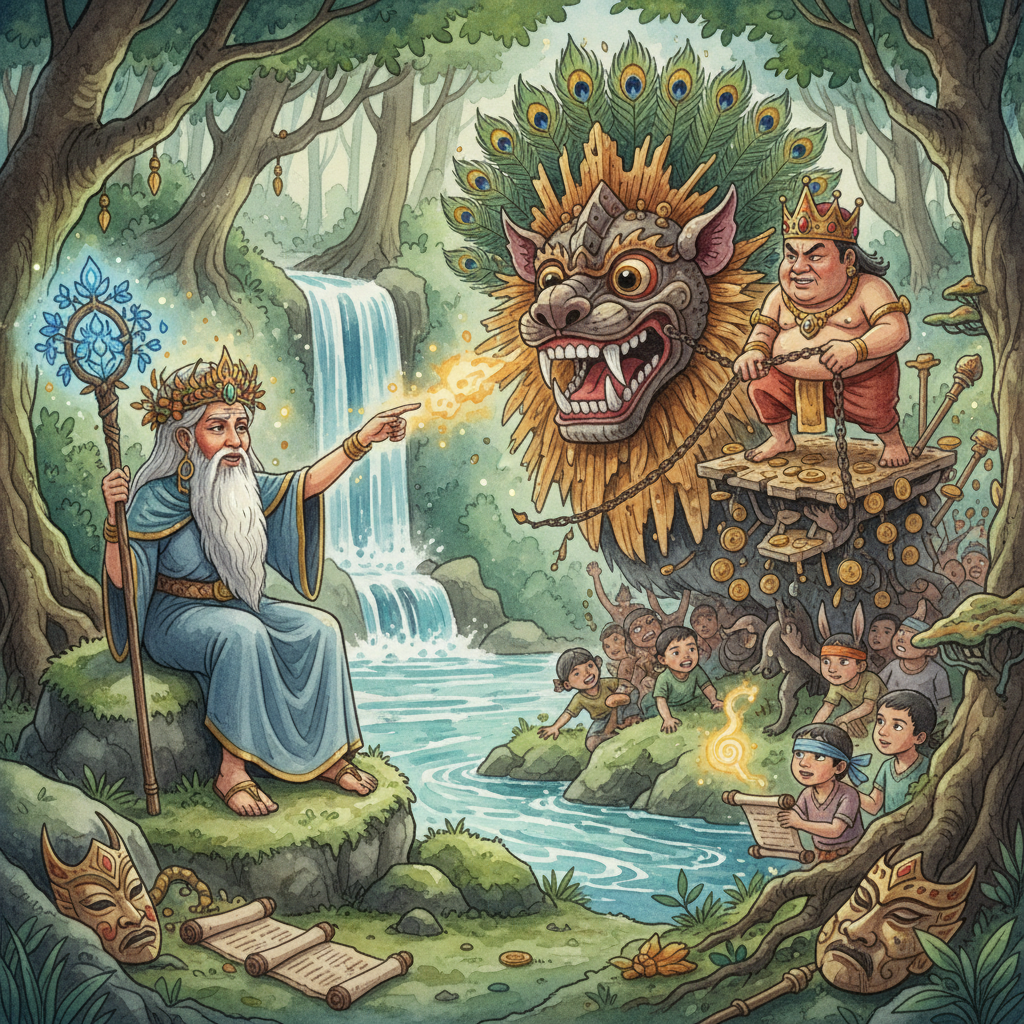
Adapted Version
Once, there was a very big kingdom. It had tall walls and golden roofs. A king lived there. But this king had a problem. He did not do his job. He only wanted to play. The Queen was very pretty. The King only liked her.
The kingdom had a wise helper. His name was the Wise Teacher. "Please listen," said the Wise Teacher. "The kingdom needs you." But the King did not listen.
The Wise Teacher was very sad. He could not help the King. So he walked away. He left the big palace.
He walked and walked. He found a small, quiet village. He made a new home there. He taught people to be strong. He taught them to be brave.
People called him the Wise Teacher. They all liked him very much. But he still thought about the kingdom. He thought and thought. "How can I help?" he asked. He could not fight. He had to find a new way.
Then he had a big idea! He would make a special dance! The dance would tell a story! He was so happy.
He worked and worked. He made big masks. He made pretty costumes. He made the Reog dance! It was bright and bold.
The best mask was the Big Lion. It was very, very big. It had pretty feathers on top. The feathers were blue and green. The Big Lion looked like a king. A king who forgot to listen.
There were Horse Dancers too! They rode on toy horses. They danced in silly, wobbly ways. They made them all laugh. They forgot to practice. See?
There was a funny Red Mask. It had a bright red face. It had a very long nose. The Red Mask was for the helpers. The helpers that no one heard.
The Wise Teacher grew very old. He taught the dance to his students. They loved the dance. They kept it always.
And do you know what? People still dance the Reog today! Kids and moms and dads watch it. They wear the Big Lion mask. They ride the toy horses. They think of the Wise Teacher. They think of his special dance.
That is the story of the Reog.
Original Story
Asal Usul Reog
puncak keemasannya pada masa pemerintahan Prabu Hayam Wuruk dan Mahapatih
Gajah Mada pelan-pelan mengalami kemunduran karena berbagai masalah di dalam
lingkungan pemerintahan dan istana. Luntumya kewibawaan dan kemunduran kekuasaan
kerajaan Majapahit kian nyata pada masa pemerintahan Raja Bre Kertabumi, yaitu raja
terakhir kerajaan Majapahit. Raja Bre Kertabumi tidak mampu menjalankan pemerintahan
seperti raja-raja kerajaan Majapahit sebelumnya karena terlalu tunduk pada permaisurinya
yang cantik.
Keadaan dalam istana yang demikian membuat sebagian besar pembantunya menjadi
gelisah karena khawatir dengan masa depan kerajaan Majapahit. Karena kekuasaan raja
sangat besar, para pembantunya tidak dapat memberi masukan, bahkan para penasihat pun
tidak kuasa memberi saran dan masukan karena sang raja lebih suka mendengarkan pendapat
permaisurinya.
Ki Ageng Ketut Suryo Alam adalah salah seorang penasihat Raja Bre Kertabumi yang
merasa gelisah dan khawatir melihat jalannya pemerintahan dan khawatir terhadap
kelangsungan kerajaan Majapahit yang sudah punya nama besar. Ia sudah berkali-kali
memberi nasihat pada raja agar tidak terlalu menuruti keinginan permaisuri, tetapi tidak
berhasil membuat Raja Bre Kertabumi sadar. Karena merasa kehadirannya sudah tidak ada
gunanya, Ki Ageng Ketut Suryo Alam pun menyingkir dari lingkungan istana kerajaan
Majapahit. Ki Ageng Ketut Suryo Alam menganggap Prabu Bre Kertabumi telah
menyimpang dari tatanan moral kerajaan. Penyimpangan moral inilah yang dinilai akan
menjadi awal kehancuran kerajaan Majapahit. Kebijakan politik Majapahit yang seharusnya
dipegang oleh sang raja, pada waktu itu nyatanya dikendalikan oleh permaisurinya sehingga
banyak keputusan dan kebijakannya yang tidak benar dan tidak sesuai dengan tatanan
peraturan kerajaan. Ki Ageng Ketut Suryo Alam menyingkir ke suatu daerah di selatan, yang
bernama Kutu, yaitu suatu desa kecil yang masuk wilayah Wengker.
Di Desa Kutu ini, Ki Ageng Ketut Suryo Alam mendirikan sebuah padepokan sebagai
tempat belajar olah kanuragan dan kesaktian. Ia mengajari para muridnya untuk menjadi
prajurit. Ia mengajarkan sikap seorang prajurit dan ksatria yang gagah perkasa. Menurutnya,
seorang prajurit harus taat kepada kerajaan dan memiliki kesaktian agar dapat membela
kerajaan. Untuk mencapai tujuan tersebut, Ki Ageng Ketut Suryo Alam melarang muridnya
berhubungan dengan wanita (wadaf). Menurut kepercayaanya, barang siapa melanggar ajaran
tersebut, kekuatan atau kesaktinnya akan berkurang, bahkan hilang sama sekali. Untuk itulah,
murid-muridnya harus tinggal di asrama di lingkungan padepokannya. Kepemimpinan Ki
Ageng Ketut Suryo Alam yang tegas dan disiplin membuahkan hasil. Banyak muridnya yang
berhasil menjadi prajurit yang memiliki sikap dan watak seorang ksatria. Oleh karena itu,
Padepokan Ki Ageng Ketut Suryo Alam cepat menyebar dan populer ke beberapa daerah.
& Ikisah, kerajaan Majapahit yang pernah berjaya menguasai Nusantara dan mencapai
165
Nama Ki Ageng Ketut Suryo Alam kemudian lebih dikenal dengan nama Ki Ageng Kutu
atau Ki Demang Kutu karena padepokannya berada di Desa Kutu.
Di samping mengajari murid-muridnya ilmu kanoragan, Ki Ageng Kutu tidak perah
lepas sedikit pun memikirkan keadaan kerajaan Majapahit. Setiap malam seusai mengajari
murid-muridnya, Kia Ageng Kutu akan masuk ke tempat persembahyangan untuk merenung
dan berpikir. Menurut pikirannya, kerajaan Majapahit harus diingatkan bukan lagi dengan
kata-kata dan nasihat. Oleh karena itu, ia terus memikirkan cara dan strategi untuk melawan
kerajaan Majapahit yang dianggapnya telah jauh meyimpang dari tatanan keprajan itu.
Menurutnya, perlawanan dengan senjata dan peperangan tidak akan menyelesaikan masalah
karena hanya akan menimbulkan penderitaan di kalangan rakyat. Di samping itu, dari segi
kekuatan prajurit, murid-muridnya tentu akan mudah ditaklukkan oleh bala tentara Majapahit
yang jumlahnya jauh lebih banyak. Ki Ageng Kutu memikirkan cara melakukan perlawanan
tanpa kekerasan dan peperangan, tetapi dapat mengena ke sasaran dan tercapai tujuan. Setelah
berhari-hari merenungkan dan memikirkan caranya, muncul pikiran untuk melakukan
perlawanan secara psikologis, yaitu dengan kritikan melalui media kesenian.
Dengan berbekal pengalamannya selama bertahun-tahun menjadi penasihat kerajaan
Majapahit dan mengetahui secara detail kondisi dalam pemerintahan dan istana serta berbekal
keahlian murid-muridnya, Ki Ageng Kutu akhirnya menciptakan drama tari yang disebut
reog. Kesenian ini digunakan untuk menggambarkan keadaan kerajaan Majapahit, menjadi
sindiran atau satire sekaligus mempunyai makna simbolis.
Ki Ageng Kutu berperan sebagai tokoh warok. Dalam drama tari reog, tokoh warok
dikelilingi oleh murid-muridnya. Hal itu menggambarkan fungsi dan peranan sesepuh masih
tetap diperlukan dan harus diperhatikan dalam sebuah tata pemerintahan.
Pelaku dalam drama tari tersebut adalah Singo Barong yang mengenakan bulu merak di
atas kepalanya. Tokoh Singo Barong merupakan sindiran terhadap kecongkakan atau
kesombongan sang raja yang tidak mau lagi mendengarkan nasihat dari para penasihat
kerajaan. Sang raja sangat mengagumi kecantikan permaisurinya sehingga apa pun keinginan
permaisurinya selalu dituruti, termasuk dalam menentukan kebijakan kerajaan.
Penari kuda atau Jathilan yang diperankan oleh seorang laki-laki yang lemah gemulai
dan berdandan seperti wanita menggambarkan hilangnya sifat keprajuritan kerajaan
Majapahit. Para prajurit kerajaan Majapahit dianggap sudah tidak berdaya. Tarian
penunggang kuda yang aneh menggambarkan ketidakjelasan peranan prajurit kerajaan,
ketidakdisiplinan prajurit terhadap rajanya, namun raja berusaha mengembalikan
kewibawaannya kepada rakyat yang digambarkan dengan penari kuda (Jathilan) yang
berputar-putarnya mengelilingi sang raja.
Seorang pujangga kerajaan digambarkan oleh Bujang Ganong yang memiliki wajah
berwama merah, mata melotot, dan berhidung panjang. Bujang Ganong menggambarkan
orang bijaksana dan bernalar panjang, tetapi tidak dihargai lagi pendapatnya oleh raja
sehingga dirinya harus menyingkir dari kerajaan.
Setelah Ki Ageng Kutu meninggal, kesenian ini diteruskan oleh Ki Ageng Mirah pada
masa Bathoro Katong (bupati pertama Ponorogo) hingga sekarang. Oleh Ki Ageng Mirah,
cerita yang berlatar belakang sindiran tersebut digantikan dengan cerita Panji. Kemudian,
dimasukkan tokoh-tokoh panji seperti Prabu Kelana Sewandana, Dewi Songgolangit yang
menggambarkan peperangan antara kerajaan Kediri dan Bantar Angin.
166
Story DNA
Moral
Art and satire can be powerful tools for social and political commentary, even when direct confrontation is impossible.
Plot Summary
The once-mighty Majapahit kingdom falters under King Bre Kertabumi, who is unduly influenced by his beautiful queen. A wise advisor, Ki Ageng Ketut Suryo Alam, leaves the court after his warnings are ignored, establishing a hermitage and training disciplined warriors. Renamed Ki Ageng Kutu, he devises a non-violent method of critique: a satirical dance drama called Reog. Each character in the Reog performance—the Warok, Singo Barong, Jathilan, and Bujang Ganong—symbolically represents aspects of the king's folly, the weakened military, and disregarded wisdom. The story concludes with the enduring legacy of Reog, which continues to be performed, though its direct satirical narrative eventually evolves into more generalized tales.
Themes
Emotional Arc
disillusionment to creative resistance to enduring legacy
Writing Style
Narrative Elements
Cultural Context
The story provides a mythological origin for the Reog Ponorogo dance, linking it to the decline of the historical Majapahit Empire and the reign of King Bre Kertabumi (Bhra Kertabhumi), though the specific events and characters like Ki Ageng Kutu are legendary rather than strictly historical. It reflects Javanese societal values regarding leadership, wisdom, and the role of art.
Plot Beats (13)
- Majapahit kingdom, once glorious, declines under King Bre Kertabumi, who is swayed by his beautiful queen.
- Royal advisors, including Ki Ageng Ketut Suryo Alam, are concerned but cannot influence the king.
- Ki Ageng Ketut Suryo Alam, feeling useless, leaves the palace, believing the king's moral deviation will destroy the kingdom.
- He settles in Desa Kutu, establishes a hermitage, and trains disciplined warriors, forbidding them from relationships with women to maintain their power.
- He becomes known as Ki Ageng Kutu and continuously contemplates how to address Majapahit's decline without direct, violent confrontation.
- Ki Ageng Kutu devises a plan for psychological resistance through a critical art form.
- He creates the Reog dance drama, using his knowledge of the court to embed symbolic critiques.
- The Warok character represents the necessary role of respected elders in governance.
- The Singo Barong, with its peacock feathers, symbolizes the king's arrogance and infatuation with his queen.
- The Jathilan (horse dancer) represents the weakened and undisciplined Majapahit military.
- The Bujang Ganong, with his red face and long nose, symbolizes the wise but disregarded advisors.
- After Ki Ageng Kutu's death, Ki Ageng Mirah continues the tradition.
- The Reog story is later adapted to the Panji tales, featuring characters like Prabu Kelana Sewandana and Dewi Songgolangit, shifting its direct satirical focus but preserving the art form.
Characters
Raja Bre Kertabumi ⚔ antagonist
None explicitly mentioned, but implied to be easily swayed by beauty.
Attire: Royal attire befitting a Majapahit king.
Weak-willed, easily influenced, neglects his duties.
Image Prompt & Upload
A middle-aged man with a cruel, sharp-featured face, a neatly trimmed black beard, and cold, calculating dark eyes. He wears an opulent, high-collared black tunic embroidered with intricate gold thread and dark red gemstones, paired with polished black boots. His posture is arrogant and imposing, one hand resting on the hilt of a ceremonial dagger at his belt. His expression is one of cold disdain and scheming intelligence. Plain white background, full body visible head to toe, single figure, no watermark, no text, no signature.
Permaisuri Raja Bre Kertabumi ⚔ antagonist
Beautiful, her beauty is a significant plot point.
Attire: Elaborate royal Javanese queen's attire.
Manipulative, influential over the king, self-serving.
Image Prompt & Upload
A regal woman in her late 40s with a cruel, imperious expression. She has sharp cheekbones, cold dark eyes, and hair styled in an elaborate, towering black and gold headdress. She wears a severe, high-collared robe of deep purple and black silk, heavily embroidered with gold thread in menacing patterns. She stands rigidly upright, one hand resting on the hilt of a ceremonial dagger at her waist, the other holding a long, dark wooden scepter topped with a jagged obsidian orb. Her posture is rigid and commanding, radiating cold authority and menace. Plain white background, full body visible head to toe, single figure, no watermark, no text, no signature.
Ki Ageng Ketut Suryo Alam ★ protagonist
None explicitly mentioned.
Attire: Simple, practical clothing of a Javanese sage or martial arts master.
Wise, concerned, disciplined, strategic, patriotic.
Image Prompt & Upload
A young man in his early twenties with a strong, noble bearing. He has warm brown skin, sharp dark eyes, and short black hair neatly combed back. He wears a traditional Javanese royal outfit: a dark blue velvet blangkon headdress with gold embroidery, a matching long-sleeved beskap tunic with intricate gold frogging closures, and a flowing batik sarong in deep indigo and cream patterns wrapped around his waist. A kris dagger with a golden hilt is tucked into the sarong's fold. He stands tall with a calm, determined expression, one hand resting lightly on the dagger's hilt. Plain white background, full body visible head to toe, single figure, no watermark, no text, no signature.
Singo Barong ◆ supporting
A lion-like creature with peacock feathers on its head.
Attire: A large, elaborate mask and costume, dominated by peacock feathers.
Represents arrogance and pride.
Image Prompt & Upload
A mythical guardian figure with a fierce lion-like face, ageless and imposing, wearing an elaborate Balinese ceremonial costume of gold and crimson silk, adorned with intricate beadwork, gemstones, and a large ornate mask. The body is humanoid and muscular, covered in dark, shaggy fur with a long, flowing mane. Expression is intense yet benevolent, with bright, glowing eyes. Pose is upright and commanding, standing tall with one hand raised in a protective gesture. Plain white background, full body visible head to toe, single figure, no watermark, no text, no signature.
Jathilan (Penari Kuda) ◆ supporting
A man dressed as a woman, performing graceful but strange horse dances.
Attire: Feminine Javanese dance attire, riding a hobby horse.
Represents weakness and lack of discipline.
Image Prompt & Upload
A young male dancer in his late teens, performing a traditional Javanese horse dance. He wears an elaborate costume of layered, draped batik fabric in deep indigo and gold, adorned with intricate sequins and beadwork. A stylized, ornate horse headpiece sits atop his head, with a flowing mane of black and gold yarn. His face is painted with bold, traditional makeup, featuring sharp, dramatic lines around the eyes and a focused, intense expression. He is captured mid-motion in a dynamic pose, leaning forward as if riding an invisible horse, one arm extended forward holding imaginary reins, the other raised behind him. His posture is strong and balanced. Plain white background, full body visible head to toe, single figure, no watermark, no text, no signature.
Bujang Ganong ◆ supporting
Red face, bulging eyes, long nose.
Attire: Traditional Javanese dance costume, possibly with a headpiece.
Wise, thoughtful, but unappreciated.
Image Prompt & Upload
A young male servant with a large, round wooden mask covering his entire face, featuring exaggerated wide eyes, a small red nose, and a wide smiling mouth with painted teeth. He wears simple dark brown cloth trousers and a matching vest over a bare chest, with a plain cloth tied around his head. His posture is slightly hunched with hands clasped together in front, conveying a humble and attentive demeanor. Plain white background, full body visible head to toe, single figure, no watermark, no text, no signature
Ki Ageng Mirah ○ minor
None explicitly mentioned.
Attire: Traditional Javanese clothing.
Continuator, adapter.
Image Prompt & Upload
A young boy of early teenage years with warm brown skin, standing respectfully with hands gently clasped before him. He wears a traditional Javanese batik sarong in deep indigo and cream patterns, draped over one shoulder, and a simple white fabric headpiece. His expression is calm and observant, with dark, thoughtful eyes. His posture is straight and poised. Plain white background, full body visible head to toe, single figure, no watermark, no text, no signature.
Bathoro Katong ○ minor
None explicitly mentioned.
Attire: Royal or noble attire of a Javanese regent.
Historical figure, patron.
Image Prompt & Upload
A young child, around eight years old, with a curious and bright expression. They wear a simple, knee-length tunic of faded indigo cotton, belted with a woven sash. Their dark hair is mostly hidden beneath a wide, conical straw hat. They are barefoot, standing in a dynamic pose, one hand adjusting their hat as if caught in a gentle breeze. Plain white background, full body visible head to toe, single figure, no watermark, no text, no signature.
Locations
Majapahit Royal Palace
The seat of power for the Majapahit kingdom, where King Bre Kertabumi resides, influenced by his beautiful queen. It is a place of internal turmoil and declining authority.
Mood: tense, uneasy, declining, luxurious but troubled
The king's inability to govern effectively due to his permaisuri's influence, leading to Ki Ageng Ketut Suryo Alam's departure.
Image Prompt & Upload
Overcast twilight descends upon the sprawling Majapahit Royal Palace complex. The grand central pendopo, with its towering multi-tiered thatched roof, stands amidst manicured yet slightly overgrown gardens. Moss creeps along the stone foundations of ornate, Hindu-Buddhist inspired pavilions. A still, reflecting pool mirrors the fading indigo sky, its surface broken by fallen frangipani blossoms. Warm, hesitant lamplight glows from within carved wooden screens, casting long shadows across deserted courtyards. The atmosphere is heavy, humid, and silent, with a sense of faded grandeur and quiet neglect. Muted earth tones, deep greens, and tarnished gold accents dominate the scene. no border, no frame, no watermark, no text, no signature, edge-to-edge illustration
Village of Kutu (Wengker region)
A small village located in the southern region of Wengker, where Ki Ageng Ketut Suryo Alam (later Ki Ageng Kutu) settles after leaving the palace.
Mood: peaceful, remote, new beginnings
Ki Ageng Ketut Suryo Alam establishes his new life and padepokan here.
Image Prompt & Upload
A serene late afternoon in a lush Javanese village, golden sunlight filtering through coconut palms and banyan trees. Traditional thatched-roof joglo houses with intricate carved wooden details are nestled among vibrant green terraced rice paddies. A clear, winding river reflects the warm sky, its banks lined with tropical flowers. Soft mist hangs in the distant hills, and smoke curls gently from a few chimneys. The atmosphere is peaceful and timeless, with rich colors of emerald green, warm earth tones, and golden highlights. No border, no frame, no watermark, no text, no signature, edge-to-edge illustration.
Padepokan of Ki Ageng Kutu
A learning center and dormitory established by Ki Ageng Ketut Suryo Alam in Desa Kutu, where he teaches martial arts, spiritual practices, and trains warriors. It includes living quarters for his students.
Mood: disciplined, focused, spiritual, strategic
Ki Ageng Kutu trains his students and conceives the idea of Reog as a form of psychological resistance against Majapahit.
Image Prompt & Upload
Dawn mist clings to a secluded Javanese compound nestled in a river valley. Traditional wooden joglo and limasan structures with dark thatched roofs form a tranquil courtyard. A wide, packed-earth training ground sits at the center, flanked by a serene meditation pavilion with open sides. Simple student dormitories with warm, glowing windows are arranged along a stone path lined with tropical plants and bamboo groves. The air is cool and humid, with soft pink and gold light filtering through the mist and illuminating the moss on the ancient stone walls. no border, no frame, no watermark, no text, no signature, edge-to-edge illustration.


