ORAISON FUNÈBRE
by Unknown · from Vie privée et publique des animaux
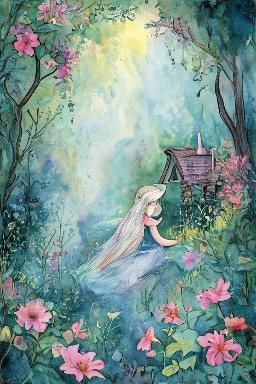
Adapted Version
The sun went down. It was a quiet night. All the little insects came close. They were very sad. Their friend, Little Silkworm, was in big sleep. He would not wake up.
Big Moth led the way. Many small beetles followed. Red bugs walked too. Wise Mantis walked with them. Little worms walked last. They walked in a long line.
They came near a big plant. Little Silkworm's group was there. Red Beetle asked some beetles to sing. He asked crickets to sing. They sang a soft, sad song.
The insects made sad sounds. They sighed. They cried a little. All the insects were sad. They missed their friend.
They came to a soft place. Other beetles made a small hole. It was a small, soft bed. This bed was for Little Silkworm.
The insects put Little Silkworm down. He lay in the soft bed. Then many insects cried again. They cried very much. They were very, very sad.
A Dark Beetle came near. He wore all black. "Why are you sad?" he asked. "He is free now." Insects still cried. They were still very sad.
A different Silkworm spoke then. "He had a good life," he said. "He ate green leaves. He is not sad now." Insects still cried. They were very sad.
A Sad Silkworm spoke next. He cried much. "We know life is hard," he said. "But we loved him very much. We miss our friend." Insects said, "We miss him."
Then Wise Mantis came close. She spoke in a soft voice. "He is not gone," she said. "He goes to a new place. It is a good place. Like a moth from a cocoon. He will be happy there. You will see him again. Many flowers grow there. The leaves are always green."
The insects listened to her. They felt better now. They stopped crying. Their hearts felt warm.
Each insect put a small flower. They put it on the soft bed. Then they walked away. They walked softly through the grass.
The insects felt warm inside. Their friend was in a good new place. They were not sad now. They felt happy for him.
Original Story
ORAISON FUNÈBRE
D’UN VER A SOIE
Le soleil, fatigué sans doute d’avoir brillé tout un long jour, s’était couché tout à coup;—les Oiseaux venaient d’achever leur prière du soir,—et la terre, tiède encore, se préparait dans le silence au repos de la nuit.
Le Sphinx à tête de mort donna alors le signal du départ, et le petit cortége se mit en marche, suivant à pas lents le sentier qui conduisait aux bruyères roses.
Des Faucheurs, dont l’emploi consistait à débarrasser le chemin, précédaient le corps, qui était entouré, d’un côté, par les Bêtes à bon Dieu, et, de l’autre, par les Mantes religieuses, que suivaient les Porte-Queue. Venaient ensuite les Fourmis communes, les Spectres, et enfin les Chenilles processionnaires.
Quand on fut à quelques pas du mûrier où étaient restés les frères et les sœurs désolés du Ver à soie qui venait de mourir, la Pyrochre cardinale, jugeant qu’il n’y avait plus de danger d’être entendu par eux, et de renouveler ou de troubler leur douleur, l’hymne des morts fut, sur son ordre, entonné par le chœur des Scarabées nasicornes, et chanté ensuite alternativement par les Grillons et par les Bourdons.
De temps en temps les chants cessaient, et l’on entendait distinctement des soupirs, et même des sanglots, qui témoignaient des regrets universels qu’inspirait la perte de l’humble Insecte que l’on conduisait à sa dernière demeure.
Arrivé au champ des bruyères, on aperçut, non loin de quelques tombeaux qui s’étaient refermés depuis peu, ainsi que l’indiquait la terre fraîchement remuée qui les couvrait, et parmi quelques fosses qui semblaient avoir été creusées en prévision peut-être des besoins futurs de quelques-uns même des assistants, une petite fosse sur laquelle étaient penchés encore les Fossoyeurs ou Nécrophores.
Ce fut vers cette fosse que le convoi se dirigea. Les chants avaient cessé, les sanglots aussi, et même les soupirs; car, dans toutes les grandes douleurs, il y a un moment de profond abattement qui les rend muettes.
Mais quand les Insectes qui portaient le corps l’eurent déposé dans la tombe, et quand on put voir que rien ne le séparait plus de la terre avide et nue, les cris et les sanglots éclatèrent de nouveau, et la douleur ne connut plus de bornes.
Alors s’approcha de la tombe encore ouverte un Insecte entièrement vêtu de noir:
«Pourquoi pleurez-vous? s’écria-t-il. Et jusques à quand ceux sur qui pèse le fardeau de la vie pleureront-ils ceux que la mort a délivrés? Mais pleurez, ajouta-t-il, car celui qui est là n’a rien à craindre de votre douleur; vos larmes ne le ressusciteront point. Après la mort, qui donc voudrait reculer vers la vie?»
Mais les sanglots se faisaient encore entendre, car personne n’était consolé.
«Frères, dit un autre orateur en s’avançant à son tour, c’est à leur naissance et non à leur mort qu’il faut pleurer les Vers à soie. Notre frère est mort, réjouissez-vous, car il n’a eu de la vie que les fleurs et les feuilles; en quittant la terre, il a quitté toutes les douleurs, et n’a perdu que les misères. Je vous dis la vérité; vous êtes de pauvres Vers comme moi, pourquoi vous flatterais-je? Ce n’est pas nous autres, malheureux, que la vue de la mort doit troubler.»
Mais ils pleuraient toujours.
Et un de ceux qui pleuraient, prenant la parole à son tour:
«Nous savons, dit-il, que tout ce qui commence a une fin, et qu’il faut donc mourir; nous savons ce qu’il faut de courage pour gagner sa vie feuille par feuille, et sa feuille bouchée par bouchée; nous savons ce qu’il faut de patience et d’abnégation pour qu’une feuille de mûrier devienne une robe de soie; nous savons combien sont durs les travaux de la cabane et ceux de l’atelier, et qu’une fois enfermés dans notre triste cellule nous pleurerions en vain les songes de notre courte jeunesse avant que notre tâche soit achevée; nous savons enfin qu’à tout prendre, mourir, c’est cesser de filer, la mort n’étant que l’autre bout de ce fil qui commence à la vie; nous nous disons aussi que de quelque côté qu’on se tourne on voit mourir, et que, quand on regarde en soi-même, on voit mourir encore, et que notre frère qui est mort n’a donc cédé qu’au destin; mais nous aimions notre frère, et rien ne nous consolera de l’avoir perdu.»
Et tous dirent avec lui: «Nous aimions notre frère, et rien ne nous consolera de l’avoir perdu.»
La Mante religieuse s’approcha alors.
«J’ai pleuré comme vous notre frère qui est mort, dit-elle, et pourtant, toutes les fois que je vois un Ver à soie sur le point de mourir, je ne puis empêcher mon cœur de s’épanouir. Va dans l’autre monde, lui dis-je; tu y seras mieux que dans celui-ci, où l’on est mal. Là, s’ouvriront pour toi les portes qui s’ouvrent pour les petits comme pour les grands; là, tu retrouveras ceux que tu as perdus, et tu les retrouveras au milieu des fleurs qui ne meurent pas et des mûriers toujours verts, sur le bord des neuf fontaines qui ne tarissent jamais; et quand tu les auras retrouvés, tu leur diras de nous attendre, nous que la vie retient encore; car mourir, c’est renaître à une vie meilleure.»
Et quand le bon Insecte eut ainsi parlé, les pleurs cessèrent tout à coup.
«Et maintenant, ajouta-t-elle, allez et volez sans bruit; notre frère n’a plus besoin de vous.»
Et chacun ayant déposé sur la tombe une fleurette de bruyère rose, les uns disparurent dans un pâle rayon de la lune qui venait de se lever, et les autres regagnèrent à travers les herbes leurs petites demeures.
Et tous étaient consolés, car ils disaient avec la Mante religieuse et Shakspeare: «Mourir, c’est renaître à une vie meilleure.»
P. J. Stahl.
Story DNA
Moral
Death is not an end but a transformation to a better existence, and grief, though natural, can be overcome by hope.
Plot Summary
A funeral procession of various insects gathers at dusk to mourn a deceased silkworm. As the silkworm is laid into its grave, the mourners' grief intensifies, and initial attempts by some insects to rationalize death or dismiss sorrow fail to console them. Finally, a wise Praying Mantis delivers a speech, reframing death not as an end but as a rebirth into a better, eternal life, filled with reunion and beauty. Her words bring immediate solace to the grieving insects, who then place flowers on the grave and depart, comforted by the promise of a hopeful afterlife.
Themes
Emotional Arc
sorrow to hope
Writing Style
Narrative Elements
Cultural Context
P. J. Stahl was a pseudonym for Pierre-Jules Hetzel, a prominent 19th-century French editor and publisher, known for children's literature and works by Jules Verne. This piece reflects the didactic and moralizing trend in children's literature of the era, often using nature and animals to convey lessons.
Plot Beats (13)
- The sun sets, birds finish their prayers, and the earth prepares for night as a funeral procession for a silkworm begins.
- Various insects, including the Death's-head Hawk-moth, Harvesters, Ladybugs, Praying Mantises, and Processionary Caterpillars, follow a path to the rose heaths.
- As they near the silkworm's family, the Cardinal Beetle orders the Scarab Beetles, Crickets, and Bumblebees to sing a hymn for the dead.
- The singing is punctuated by sighs and sobs, showing universal grief for the deceased silkworm.
- They arrive at the heath, where a small grave, freshly dug by Sexton Beetles, awaits the silkworm.
- The body is placed in the grave, and the sight of it separated from the earth causes renewed, boundless cries and sobs.
- An insect in black questions the mourners' tears, asking why they weep for one freed from life's burden, but fails to console them.
- Another speaker suggests rejoicing in the silkworm's death, as it only experienced life's pleasures and escaped its miseries, yet the weeping continues.
- A weeping insect expresses the deep sorrow of losing a loved one, acknowledging life's hardships and death's inevitability, but stating that love makes the loss inconsolable.
- The Praying Mantis approaches and speaks, acknowledging shared grief but offering a vision of death as a rebirth into a better world with eternal flowers, green mulberry trees, and reunion with loved ones.
- The mantis's words instantly console the mourners, who cease weeping.
- Each insect places a small rose heath flower on the grave, and then they quietly depart, some in moonlight, others through the grass.
- All are comforted, believing, like the mantis and Shakespeare, that "to die is to be reborn to a better life."
Characters
The Death's-head Hawkmoth ◆ supporting
A large, robust moth with a wingspan of up to 5 inches. Its body is thick and covered in dense, fuzzy brown and yellow fur. The wings are mottled brown and black with yellow bands on the hindwings.
Attire: Naturally occurring patterns on its body, specifically the skull-like marking on its thorax.
Wants: To ensure the funeral procession proceeds in an orderly and respectful manner.
Flaw: None explicitly shown, but perhaps a rigid adherence to tradition.
Remains consistent as a solemn leader.
Authoritative, solemn, a leader.
Image Prompt & Upload
A large, robust moth with a thick, fuzzy brown and yellow body. Its wings are mottled brown and black with yellow bands on the hindwings. The most striking feature is a distinctive pale yellow skull-like pattern on its dark brown thorax. It stands with a commanding presence, facing forward. Plain white background, full body visible head to toe, single figure, no watermark, no text, no signature.
The Cardinal Beetle ◆ supporting
A slender, elongated beetle, typically 10-15mm in length. Its body is entirely a vibrant, striking red, contrasting with its black antennae and legs.
Attire: Its natural, brilliant red exoskeleton.
Wants: To ensure the funeral rites are performed appropriately and without causing further distress to the immediate family.
Flaw: Perhaps overly concerned with propriety.
Remains consistent as a figure of authority.
Judicious, observant, responsible.
Image Prompt & Upload
A slender, elongated beetle, approximately 12mm long, with an entirely vibrant, brilliant cardinal red exoskeleton. Its antennae and legs are black. It stands upright, facing forward, with a watchful expression. Plain white background, full body visible head to toe, single figure, no watermark, no text, no signature.
The Insect Clothed in Black ◆ supporting
An insect of indeterminate species, entirely covered in a somber, matte black. Its form is likely sleek and unadorned, emphasizing the dark color.
Attire: Its natural exoskeleton, which is uniformly and entirely black, giving the appearance of mourning attire.
Wants: To offer a perspective on death as a release, rather than a cause for sorrow.
Flaw: Lacks empathy, struggles to connect with the emotional pain of others.
Attempts to console but fails, highlighting the depth of the mourners' grief.
Stoic, pragmatic, unsympathetic, philosophical.
Image Prompt & Upload
An insect of sleek form, entirely covered in a uniform, matte black exoskeleton. Its head is dark with unreflective eyes. It stands facing forward, with a direct and somewhat challenging posture. Plain white background, full body visible head to toe, single figure, no watermark, no text, no signature.
The Second Orator Insect ◆ supporting
An insect, likely a silkworm or similar caterpillar, with a soft, segmented body, possibly pale green or cream, reflecting its diet of leaves. Its form is humble and unassuming.
Attire: Its natural, unadorned body, which is described as 'poor' like other silkworms.
Wants: To offer a different, more grounded perspective on the silkworm's death, emphasizing the hardships of life.
Flaw: His own suffering makes him unable to fully appreciate the value of life, even a short one.
Attempts to console by highlighting the miseries of life, but also fails to fully comfort the mourners.
Humble, realistic, cynical, empathetic in a resigned way.
Image Prompt & Upload
A humble, segmented insect, resembling a silkworm, with a soft, pale green body. It has a simple head with small, dark eyes and short antennae. It stands facing forward, with a slightly weary but determined expression. Plain white background, full body visible head to toe, single figure, no watermark, no text, no signature.
The Grieving Orator Insect ◆ supporting
An insect, likely a silkworm or similar caterpillar, with a soft, segmented body, possibly pale green or cream. Its form is humble and appears burdened by sorrow.
Attire: Its natural, unadorned body, reflecting its common status.
Wants: To express the profound sorrow and love for the deceased, despite understanding the inevitability of death and the hardships of life.
Flaw: Overwhelmed by grief, unable to be consoled by logic alone.
Articulates the core reason for the collective grief: love and loss, which transcends philosophical arguments.
Grieving, philosophical, articulate, deeply emotional, loyal.
Image Prompt & Upload
A humble, segmented insect, resembling a silkworm, with a soft, pale green body. It has a simple head with small, dark eyes, showing clear signs of profound sorrow. It stands facing forward, with a heavy, grieving posture. Plain white background, full body visible head to toe, single figure, no watermark, no text, no signature.
The Praying Mantis ◆ supporting
A slender, elongated insect, typically green or brown, with a triangular head and large, prominent compound eyes. Its most distinctive feature is its large, spiky forelegs held in a 'praying' position.
Attire: Its natural, camouflaged exoskeleton, likely green or light brown, allowing it to blend with foliage.
Wants: To offer true consolation by providing a vision of a better afterlife.
Flaw: None explicitly shown; she is the most effective comforter.
Successfully consoles the grieving insects, bringing an end to their sorrow and inspiring hope.
Compassionate, spiritual, hopeful, comforting, wise.
Image Prompt & Upload
A slender, elongated insect, a praying mantis, with a green exoskeleton. It has a small, triangular head with large, widely spaced compound eyes. Its large, spiky forelegs are held in a characteristic 'praying' position. It stands facing forward, with a serene and compassionate expression. Plain white background, full body visible head to toe, single figure, no watermark, no text, no signature.
The Silkworm ○ protagonist (deceased)
A plump, segmented larva, typically creamy white or pale green, with a smooth, soft body. It has several pairs of stubby legs along its underside. Its body is designed for eating mulberry leaves and producing silk.
Attire: Its natural, unadorned larval body.
Wants: To eat mulberry leaves and spin silk, fulfilling its natural purpose.
Flaw: Its short, laborious life and vulnerability to death.
Its death is the central event, prompting reflection and grief among the other characters. It represents the cycle of life, labor, and loss.
Implied to have been industrious, patient, and dedicated to its task of spinning silk, as described by the grieving orator.
Image Prompt & Upload
A plump, segmented insect larva, a silkworm, with a creamy white, smooth body. It has a small, unassuming head with tiny dark ocelli. It lies still, facing forward, representing a deceased state. Plain white background, full body visible head to toe, single figure, no watermark, no text, no signature.
Locations
Path to the Heather Field
A slow-paced path leading from the vicinity of a mulberry tree towards a field of pink heather. The ground is still warm from the day's sun.
Mood: Solemn, processional, quiet grief
The funeral procession of the silkworm makes its way to the burial site, with various insects accompanying the body.
Image Prompt & Upload
A narrow, winding dirt path, slightly worn, meanders through low-lying, wild vegetation. On either side, clusters of vibrant pink heather are in full bloom, their small flowers catching the last vestiges of soft, diffused light from a sky transitioning from deep orange to twilight blue. The ground appears warm and dry, with scattered pebbles and sparse, short grasses. The path recedes into a gentle, rolling landscape. no border, no frame, no watermark, no text, no signature, edge-to-edge illustration.
Heather Field Burial Ground
A field of pink heather, where several freshly covered tombs and newly dug graves are visible. A small, open grave is the focal point, with gravedigger insects still present.
Mood: Somber, mournful, reflective, eventually hopeful
The silkworm is laid to rest in its grave, and various insects deliver eulogies, culminating in a message of hope and rebirth.
Image Prompt & Upload
A vast, open field carpeted with dense, low-growing pink heather, its delicate blossoms a soft, muted color under the deepening twilight sky. In the foreground, a small, freshly dug grave, barely larger than an insect, is visible, surrounded by loose, dark soil. Nearby, several other tiny mounds of freshly turned earth indicate recent burials. A sliver of a pale, rising moon casts a faint, cool glow across the distant horizon, subtly illuminating the undulating terrain. no border, no frame, no watermark, no text, no signature, edge-to-edge illustration.


