XLVII NUIT
by Unknown · from Les mille et une nuits - Tome premier
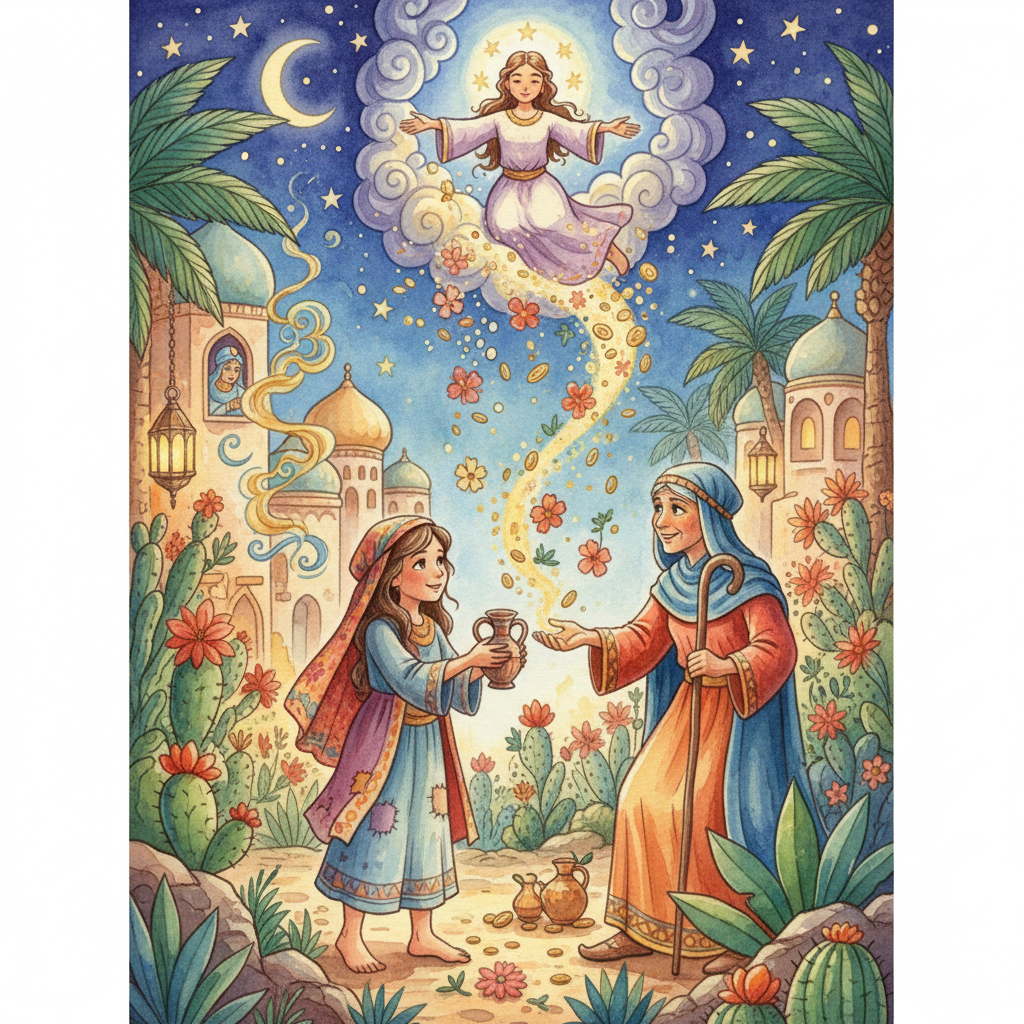
Adapted Version
Once upon a time, a kind man lives. He helps all. He smiles each day. One day, he falls into a hole. Oh no! But kind fairies live in the hole. They see the kind man. The kind fairies catch him. They hold him softly. The kind man is safe. He does not get hurt. He is happy.
The kind fairies talk to the man. They say, "You are kind. We help you." The kind man smiles. The fairies tell him a secret. "The princess is very sick," they say. "She is very sad. We want her to be happy."
The kind fairies tell the man more. "Find the little black cat," they say. "It has a white spot on its tail. Take some hairs from the white spot. These hairs are magic! Hold them near the princess. She will feel better."
The kind man goes home. He sees his little black cat. The cat has a white tail spot. The kind man smiles. He gently takes some hairs. The little black cat purrs. It is a happy cat.
Soon, the king comes to the man's home. The king is very sad. He says, "My daughter is very sick. Can you help her?" The king looks.
The kind man says, "Yes. I can help." He says, "Bring her." The king is happy. He goes to get her.
The princess comes. She looks sad and tired. The kind man holds the magic hairs. He holds them near her head. The hairs glow with warm light. It is a soft, pretty light.
The sickness goes away. It floats like a dark cloud. The princess opens her eyes. She smiles a big smile. "I feel better now!" She is not sad.
The king hugs his daughter. He is so happy. He says, "Thank you! You are so kind!" He thanks the man.
The king says, "Be with us." He says, "Live in my palace." The man and princess are friends. They are happy.
One day, the old king wants to rest. The kind man becomes the new king. All love him very much. He is a good, kind king. And the little black cat purrs on his lap. The end.
Original Story
XLVII NUIT.
Si vous ne dormez pas, ma soeur, s'écria Dinarzade à son réveil, apprenez-nous, je vous en conjure, si le bon derviche sortit sain et sauf de la citerne.
- Oui, répondit Scheherazade; et le second calender poursuivant son histoire: «La vieille citerne, dit-il, était habitée par des fées et par des génies, qui se trouvèrent si à propos pour secourir le chef des derviches, qu'ils le reçurent et le soutinrent jusqu'au bas, de manière qu'il ne se fit aucun mal. Il s'aperçut bien qu'il y avait quelque chose d'extraordinaire dans une chute dont il devait perdre la vie; mais il ne voyait ni ne sentait rien. Néanmoins il entendit bientôt une voix qui dit: «Savez-vous qui est ce bon homme à qui nous venons de rendre ce bon office?» Et d'autres voix ayant répondu que non, la première reprit: «Je vais vous le dire. Cet homme, par la plus grande charité du monde, a abandonné la ville où il demeurait et est venu s'établir en ce lieu dans l'espérance de guérir un de ses voisins de l'envie qu'il avait contre lui. Il s'est attiré ici une estime si générale que l'envieux, ne pouvant le souffrir, est venu dans le dessein de le faire périr, ce qu'il aurait exécuté sans le secours que nous avons prêté à ce bon homme, dont la réputation est si grande, que le sultan qui fait son séjour dans la ville voisine, doit venir demain le visiter, pour recommander la princesse sa fille à ses prières.»
«Une autre voix demanda quel besoin la princesse avait des prières du derviche. À quoi la première repartit: «Vous ne savez donc pas qu'elle est possédée du génie Maimoun, fils de Dimdim, qui est devenu amoureux d'elle? Mais je sais bien comment ce bon chef des derviches pourrait la guérir: la chose est très-aisée, et je vais vous la dire. Il a dans son couvent un chat noir[29], qui a une tache blanche au bout de la queue, environ de la grandeur, d'une petite pièce de monnaie d'argent. Il n'a qu'à arracher sept brins de poil de cette tache blanche, les brûler et parfumer la tête de la princesse de leur fumée. À l'instant elle sera si bien guérie et si bien délivrée de Maimoun, fils de Dimdim, que jamais il ne s'avisera d'approcher d'elle une seconde fois.»
«Le chef des derviches ne perdit pas un mot de cet entretien des fées et des génies, qui gardèrent un grand silence toute la nuit après avoir dit ces paroles. Le lendemain au commencement du jour, dès qu'il put distinguer les objets, comme la citerne était démolie en plusieurs endroits, il aperçut un trou par où il sortit sans peine.
«Les derviches, qui le cherchaient, furent ravis de le revoir. Il leur raconta en peu de mots la méchanceté de l'hôte qu'il avait si bien reçu le jour précédent, et se retira dans sa cellule. Le chat noir dont il avait ouï parler la nuit dans l'entretien des fées et des génies ne fut pas longtemps à venir lui faire des caresses à son ordinaire. Il lui arracha sept brins de poil de la tache blanche qu'il avait à la queue, et les mit à part pour s'en servir quand il en aurait besoin.
«Il n'y avait pas longtemps que le soleil était levé lorsque le sultan, qui ne voulait rien négliger de ce qu'il croyait pouvoir apporter une prompte guérison à la princesse, arriva à la porte du couvent. Il ordonna à sa garde de s'y arrêter, et entra avec les principaux officiers qui l'accompagnaient. Les derviches le reçurent avec un profond respect.
Le sultan tira leur chef à l'écart: «Bon scheikh[30], lui dit-il, vous savez peut-être déjà le sujet qui m'amène. - Oui, sire, répondit modestement le derviche: c'est, si je ne me trompe, la maladie de la princesse qui m'attire cet honneur que je ne mérite pas. - C'est cela même, répliqua le sultan. Vous me rendriez la vie si, comme je l'espère, vos prières obtenaient la guérison de ma fille. - Sire, repartit le bon homme, si votre majesté veut bien la faire venir ici, je me flatte, par l'aide et faveur Dieu, qu'elle retournera en parfaite santé.»
«Le prince, transporté de joie, envoya sur-le-champ chercher sa fille, qui parut bientôt accompagnée d'une nombreuse suite de femmes et d'eunuques, et voilée de manière qu'on ne lui voyait pas le visage. Le chef des derviches fit tenir un poêle au-dessus de la tête de la princesse, et il n'eut pas si tôt posé les sept brins de poil sur les charbons allumés qu'il avait fait apporter, que le génie Maimoun, fils de Dimdim, fit un grand cri, sans que l'on vît rien, et laissa la princesse libre.
«Elle porta d'abord la main au voile qui lui couvrait le visage, et le leva voir où elle était. «Où suis-je? s'écria-t-elle, qui m'a amenée ici?» À ces paroles, le sultan ne put cacher l'excès de sa joie; il embrassa sa fille et la baisa aux yeux. Il baisa aussi la main du chef des derviches, et dit aux officiers qui l'accompagnaient: «Dites-moi votre sentiment. Quelle récompense mérite celui qui a ainsi guéri ma fille?» Ils répondirent tous qu'il méritait de l'épouser. «C'est ce que j'avais dans la pensée, reprit le sultan, et je le fais mon gendre dès ce moment.».
«Peu de temps après, le premier vizir mourut. Le sultan mit le derviche à sa place. Et le sultan étant mort lui-même sans enfants mâles, les ordres de religion et de milice assemblés, le bon homme fut déclaré et reconnu sultan d'un commun consentement.»
Le jour, qui paraissait, obligea Scheherazade à s'arrêter en cet endroit. Le derviche parut à Schahriar digne de la couronne qu'il venait d'obtenir; mais ce prince était en peine de savoir si l'envieux n'en serait pas mort de chagrin, et il se leva dans la résolution de l'apprendre la nuit suivante.
Story DNA
Moral
Good deeds and a pure heart are eventually rewarded with prosperity and happiness, often through unexpected means.
Plot Summary
A kind dervish is pushed into a cistern by an envious neighbor but is saved by fays and genies. While trapped, he overhears them revealing a magical cure for the Sultan's possessed daughter, involving hairs from a specific black cat. Upon escaping, the dervish uses this knowledge to cure the princess, earning the Sultan's gratitude. He marries the princess, becomes Grand Vizier, and eventually ascends to the throne, fulfilling a destiny guided by his virtue and supernatural intervention.
Themes
Emotional Arc
peril to triumph
Writing Style
Narrative Elements
Cultural Context
Part of 'One Thousand and One Nights', reflecting medieval Islamic society's beliefs in magic, divine intervention, and social hierarchy.
Plot Beats (14)
- Dinarzade asks Scheherazade about the dervish's fate after being pushed into the cistern.
- Scheherazade continues the second calender's story: the dervish falls into the cistern but is saved by fays and genies.
- The dervish overhears the fays and genies discussing his good character, the envious neighbor's plot, and the Sultan's daughter being possessed by a genie.
- The fays and genies reveal the cure for the princess: seven hairs from a specific black cat's white tail spot, to be burned under her head.
- The dervish escapes the cistern through a hole at dawn and recounts the envious neighbor's treachery to his fellow dervishes.
- The dervish finds the black cat, extracts the seven hairs, and keeps them.
- The Sultan arrives at the convent, seeking the dervish's help for his possessed daughter.
- The dervish agrees to help and asks the Sultan to bring the princess.
- The princess arrives, veiled, and the dervish burns the cat hairs over her head.
- The genie Maimoun cries out and leaves the princess, who immediately recovers and asks where she is.
- The Sultan, overjoyed, embraces his daughter and asks his officers what reward the dervish deserves.
- The officers suggest marriage, and the Sultan declares the dervish his son-in-law.
- The dervish later becomes Grand Vizier after the previous one dies.
- Upon the Sultan's death without male heirs, the dervish is unanimously declared the new Sultan.
Characters
Scheherazade ◆ supporting
Slender build, graceful posture, with features typical of a woman from the Middle East, likely with dark eyes and hair.
Attire: Richly embroidered silk robes in deep jewel tones, possibly a kaftan or abaya, with intricate gold threadwork and delicate patterns. Adorned with fine jewelry such as necklaces, bracelets, and earrings, reflecting her royal status.
Wants: To survive by entertaining the Sultan with her stories, thereby delaying her execution.
Flaw: Her life is constantly at risk, dependent on the Sultan's whim.
She is in the process of transforming the Sultan's cruel nature through her narratives, gradually securing her own safety and potentially her future.
Intelligent, resourceful, captivating, resilient, and articulate.
Image Prompt & Upload
A young woman of Middle Eastern descent, standing upright, facing forward, full body visible from head to toe. She has an oval face, dark almond-shaped eyes, full lips, and long, dark, wavy hair styled with intricate braids and adorned with small pearls. She wears a flowing kaftan of deep sapphire blue silk, embroidered with gold thread in geometric patterns, and a delicate gold necklace with a single large pearl pendant. Her posture is elegant and composed, with a serene and attentive expression. Plain white background, full body visible head to toe, single figure, no watermark, no text, no signature.
Dinarzade ◆ supporting
Likely shares similar features with her sister, Scheherazade, perhaps slightly younger and less ornate in her presentation.
Attire: Comfortable, yet still elegant, silk robes in softer colors, perhaps less elaborately adorned than Scheherazade's, suitable for a companion in the royal chambers.
Wants: To encourage Scheherazade to continue her stories, thereby helping her sister survive.
Flaw: Dependent on her sister's survival.
Remains a constant, supportive presence for her sister.
Curious, supportive, loyal, and eager.
Image Prompt & Upload
A young woman of Middle Eastern descent, standing upright, facing forward, full body visible from head to toe. She has a gentle oval face, dark, slightly wide eyes, and long, dark, wavy hair flowing loosely down her back. She wears a flowing kaftan of soft rose-pink silk, with simple silver embroidery along the neckline and cuffs. Her posture is relaxed but attentive, with a curious and supportive expression. Plain white background, full body visible head to toe, single figure, no watermark, no text, no signature.
The Chief Dervish ★ protagonist
Lean and ascetic, with a calm and humble demeanor. Likely of Middle Eastern or North African descent, with sun-weathered skin.
Attire: Simple, unadorned robes of coarse wool or linen in earthy tones (brown, grey, off-white), possibly with a simple sash. No elaborate jewelry or adornments, reflecting his ascetic lifestyle. Wears a simple cap or turban.
Wants: To help others, particularly his envious neighbor, and to live a life of spiritual devotion. Later, to heal the princess.
Flaw: His charitable nature makes him vulnerable to the malice of others, like his envious neighbor.
Begins as a humble dervish, is tested by an envious neighbor, gains divine knowledge, heals a princess, and ultimately becomes a Sultan, demonstrating his inherent worthiness.
Charitable, humble, wise, observant, and devout.
Image Prompt & Upload
A middle-aged man of Middle Eastern descent, standing upright, facing forward, full body visible from head to toe. He has a kind, wise face with a neatly trimmed dark beard and mustache, and deep-set, observant brown eyes. His head is shaved, covered by a simple, off-white linen cap. He wears a flowing, unadorned robe of coarse, light brown wool, cinched at the waist with a simple rope belt. His posture is calm and humble, with a quiet dignity. He holds simple wooden prayer beads in his right hand. Plain white background, full body visible head to toe, single figure, no watermark, no text, no signature.
The Sultan ◆ supporting
Commanding presence, likely well-built and authoritative, befitting a ruler of a Middle Eastern kingdom.
Attire: Richly embroidered silk robes in royal colors (deep red, gold, purple), possibly a flowing thobe or kaftan, adorned with gold threadwork and precious jewels. A jeweled turban on his head. Carries a ceremonial curved dagger or scimitar.
Wants: To find a cure for his possessed daughter, the Princess.
Flaw: His daughter's illness causes him great distress and vulnerability.
Begins as a distressed father, finds joy in his daughter's healing, and ultimately rewards the Dervish by making him his son-in-law and successor.
Concerned (for his daughter), decisive, grateful, and just.
Image Prompt & Upload
A middle-aged man of Middle Eastern descent, standing upright, facing forward, full body visible from head to toe. He has a regal face with a dark, well-groomed beard and mustache, and stern, dark eyes. He wears a magnificent jeweled turban of deep crimson silk, adorned with a large emerald. His body is covered in a flowing thobe of rich purple silk, embroidered with intricate gold thread patterns, and a wide gold sash. He holds a ceremonial curved scimitar with a jeweled hilt in his right hand. His posture is authoritative and purposeful, with a concerned yet hopeful expression. Plain white background, full body visible head to toe, single figure, no watermark, no text, no signature.
The Princess ◆ supporting
Delicate and graceful, likely slender, with features typical of a Middle Eastern royal.
Attire: Initially veiled, suggesting modest but luxurious attire. Later, likely wears fine silk robes in soft, elegant colors, befitting a princess, possibly with delicate embroidery and subtle jewelry. Her initial veiled appearance is key.
Wants: To be freed from the genie's possession.
Flaw: Her vulnerability to the genie Maimoun.
Begins as a possessed, veiled figure, is miraculously cured, and then becomes the wife of the Chief Dervish, destined to be a Sultana.
Initially afflicted and passive, later curious, grateful, and perhaps a little bewildered.
Image Prompt & Upload
A young woman of Middle Eastern descent, standing upright, facing forward, full body visible from head to toe. She has a delicate, oval face, with dark, expressive eyes and soft features. Her long, dark hair is partially visible beneath a sheer, embroidered silk veil that covers her face. She wears a flowing gown of pale ivory silk, with delicate silver embroidery along the sleeves and hem. Her posture is graceful, with a slightly bewildered but grateful expression as she lifts her veil. Plain white background, full body visible head to toe, single figure, no watermark, no text, no signature.
Maimoun, son of Dimdim ⚔ antagonist
Invisible to human eyes, but his presence is felt through his actions and voice. Implied to be powerful and formidable.
Attire: Not applicable, as he is unseen.
Wants: To possess the Princess, whom he loves.
Flaw: Vulnerable to the smoke from the seven hairs of the black cat with a white tail spot.
Introduced as the cause of the Princess's affliction, he is swiftly defeated and expelled, never to return.
Possessive, powerful, stubborn, and easily defeated by specific magic.
Image Prompt & Upload
Not applicable, as the character is invisible and only heard.
The Black Cat ◆ supporting
A sleek, black cat with a distinctive small white spot at the very tip of its tail, about the size of a small silver coin. Agile and affectionate.
Attire: Its own fur.
Wants: To receive affection and live its cat life.
Flaw: None explicitly stated, but its hairs are easily plucked.
Remains an ordinary cat, but its unique feature becomes instrumental in a magical cure.
Affectionate, ordinary, and unknowingly crucial.
Image Prompt & Upload
A sleek, black domestic cat, standing upright, facing forward, full body visible from head to toe. It has bright green eyes and entirely black fur, except for a small, distinct white spot at the very tip of its tail. Its posture is alert and graceful, with a calm expression. Plain white background, full body visible head to toe, single figure, no watermark, no text, no signature.
The Envious Neighbor ⚔ antagonist
Not explicitly described, but implied to be ordinary in appearance, making his malice more insidious. Likely of Middle Eastern descent.
Attire: Ordinary clothing for a townsman, perhaps simple robes or tunic and trousers, not indicative of wealth or status.
Wants: To harm or kill the Chief Dervish out of jealousy for his widespread esteem.
Flaw: His overwhelming envy blinds him and drives him to foolish, dangerous acts.
Introduced as a threat, his plot is foiled by magical intervention, and he is left to suffer the consequences of his envy (implied by the Sultan's later concern for his fate).
Envious, malicious, treacherous, and cowardly.
Image Prompt & Upload
A middle-aged man of Middle Eastern descent, standing upright, facing forward, full body visible from head to toe. He has an unremarkable face with a perpetually sour and resentful expression, and dark, close-cropped hair. He wears a simple, loose-fitting tunic of drab grey linen over dark trousers, and worn leather sandals. His posture is slightly hunched, with a shifty, suspicious gaze. Plain white background, full body visible head to toe, single figure, no watermark, no text, no signature.
Locations
The Old Cistern
A deep, ancient cistern, partially demolished in several places, creating openings to the outside. It is inhabited by unseen fairies and genies.
Mood: Mysterious, echoing, magical, a place of hidden powers and unseen entities.
The chief dervish falls into it, is saved by genies, and overhears the cure for the princess.
Image Prompt & Upload
A deep, ancient stone cistern, partially ruined with large cracks and openings in its upper walls, allowing a sliver of pre-dawn light to filter into the darkness. The rough-hewn stone blocks are covered in patches of dry moss and dust. The bottom is unseen, shrouded in deep shadows, hinting at an unseen depth. The air feels still and cool. no border, no frame, no watermark, no text, no signature, edge-to-edge illustration.
The Dervish Convent
A tranquil religious dwelling, likely an Abbasid-era khanqah or zawiya, with simple cells and communal spaces. It houses dervishes and a notable black cat.
Mood: Peaceful, spiritual, humble, yet capable of hosting significant events.
The chief dervish extracts the cat's hairs, the Sultan visits, and the princess is cured.
Image Prompt & Upload
A serene Abbasid-era dervish convent courtyard, with whitewashed mud-brick walls and simple arched doorways. A few date palms cast dappled shadows on the packed earth ground. In the center, a small, dry fountain basin. The morning sun casts long, soft shadows, and the air is still and warm. no border, no frame, no watermark, no text, no signature, edge-to-edge illustration.


