PEPPELI
by Zacharias Topelius · from Lukemisia lapsille 7
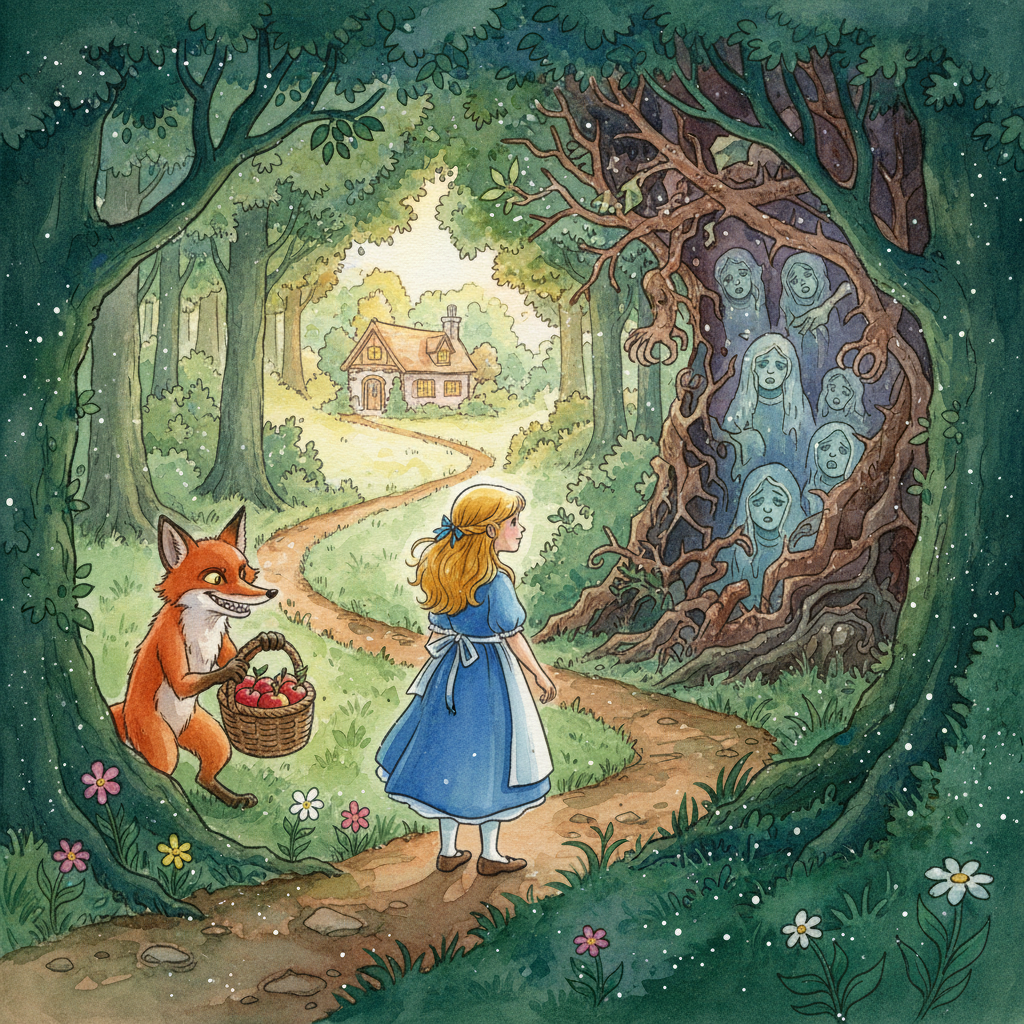
Adapted Version
Pep is a happy boy. He likes to run and play. But he does not listen to his sister. Pep does not listen.
One sunny day, Elsa looks away. Pep sees the gate. He runs fast through the gate. He runs into the woods. He is free! He is happy.
He sees birds and trees. He sees many creatures. He laughs and runs more. He feels very proud.
The sun goes down. It is dark. Pep is hungry. He is scared. He calls for his mama. He calls for his papa. He only hears the echo. He is lost.
An old woman comes. She looks kind. She has a big bag. "You are lost," she says. She gently puts him in her bag. She will carry him home.
At home, Mama is worried. "Where is Pep?" she asks. Elsa is worried too. "I will look for him," says Elsa.
Papa goes outside. "I will give a reward," he says. "Some coins for my boy." All the people look for Pep.
They are very sad. "He is lost in the dark woods," says Mama. They cry.
The old woman comes to the house. "I found something," she says. "It was grunting in my bag."
She puts the bag down. The bag opens. Pep falls out! He was asleep. He is safe!
"Pep!" shouts Mama. "You are safe!" They are so happy. Pep smiles. "I want porridge," he says.
"I put him in my bag," says the old woman. "He was running away. He would not listen."
"Thank you," says Papa. "Here is your reward." The old woman smiles. "I like coffee," she says. "Can I have some coffee?"
Pep eats his porridge. His kin is all together. He is safe at home. Pep learns to listen and stay close to home.
Original Story
PEPPELI.
Ol' kerran herra kolmevuotinen,
Se Peppeli ol', poika iloinen.
Ja hyötyä jo teki pikku veikka:
Harakkaa hyppi, pyöri kuperkeikkaa.
Hän reipas oli poika pallukka,
Ja muuten kiltti, kelpo mallukka;
Mut eipä totellut hän mielellänsä,
Vaan usein piti Peppe oman päänsä.
Niin valvojanpa Peppe tavallaan
Sai näppärästä Elsa siskostaan.
Hän seitsemän ol' vuoden tienohissa;
Kun Peppe leikki hiirtä, hän ol' kissa.
S'ei ollut oikein mieliin Peppelin;
Kuink' ikävää, jos missä liikkuikin,
Ettei saa koskaan tehdä mielin määrin,
Saa katsoa, vaan koskea on väärin.
Kesällä kerran marjat punertaa
Jo alkoivat, kun Elsa tarkastaa
Ei muista hiirtään — Peppe veräjästä
Kuin tuhka tuuleen haihtui näkymästä.
Hän juosta julkuttelee riemuiten,
Karitsaa, koiraa, heppaa katsellen
Ja laihaa lehmää, puolan raakiloita
Ja ylvästellen nauroi vartioita.
Pian poika maata, metsää oudoksuu;
Taivaalta paistoi kirkas illan kuu,
Ja Pepen vatsa hämillään ei tiennyt,
Mik' iltapuuron hältä oli vienyt.
Hän huutaa vanhempiaan, siskoaan,
Ja huutoon vastaa metsän kaiku vaan.
Hän istuu mättähälle, itkee, huokaa;
Ah, arvoton on vapaus ilman ruokaa!
Niin tuli — sus'ko? — älä säikähdä!
Tul' akka rahjus, ryysyt yllänsä,
Ja pussi kainalossa; kaunihisti
Yht'äkkiä hän Pepen pussiin pisti.
Huus' poika, rehki, potki vihasta;
Ei potkienkaan pääse pussista.
Puks' pussi puhkui. Kissi paistin sieppas,
Ja haukka kanan iski, lentoon kieppas.
— Mut miss' on Peppe? — äiti kyselee.
— Kai veräjällä vielä leikitsee.
— Käy tuomaan ressu! — Elsa läksi hakoon,
Mut ota kiinni lintu, kun lens' pakoon!
Tää ilta senkin sekamelskan toi!
Jo kadunkulmissakin rumpu soi:
Ken Pepen harhateiltä opastaapi,
Viistoistatuhat nekkaa palkaks saapi.
Nyt kaikki persot lapset jalkeillaan
Ja kynttilöillä nurkat nuuskimaan;
Ne märin sorkin sotki allikoissa,
Mut eipä löydy poika, jok' on poissa.
Ja Elsa itkee, äiti nyyhkyttää.
- Voi Peppe parka, puuros sulta jää!
Näin isä huokaa, nyyhkii, nenää niistää:
Sun aamuherkukseen kai susi riistää.
Näin itkettäiss' tul' akka tupahan:
— Ostaisko herra multa porsahan?
Se röhki tuolla metsässä niin pahoin;
Ma korjasin sen pussiin lihoin, nahoin.
— Ei, muori, nyt on laita onneton,
Meilt' oma possu karkuun juossut on.
— Tää rasvakas on, koetelkaapas kaulaa!
Tää painaa kyllä kuusitoista naulaa.
Ja muksis! pussi maahan laskettiin,
Sen suulta nuora auki päästettiin;
Ja tössähdykseen heräs poika nassu,
Hän nukkunut oli pussiin, Peppe hassu!
— Kah! Peppe! Oothan pikku Peppeli! —
Vaan Peppe, tuntein itsens vapaaksi,
Iloisna marssi juteltaissa siellä
Ja katsoi, saisko puuroa hän vielä.
— Mut pussissa? — Niin millä pyydyksin
Sen muuten oisin saanut kotihin?
En muilla keinoin potkureita suista,
Vaan pussin perään annan herran luistaa!
— Vaan muori kulta, tehän saatteki
Nuo viistoist' tuhat löytäjäisiksi…
— Viistoista kahvikuppia antakaatte
Kernaammin! Kai nyt Pepen pitää saatte.
Story DNA
Moral
Disobedience can lead to unpleasant and frightening consequences, and the freedom to do as one pleases is not always better than safety and care.
Plot Summary
Peppeli, a cheerful but disobedient three-year-old, escapes his sister's supervision and runs into the woods. He enjoys his freedom until night falls, leaving him lost, hungry, and afraid. An old woman finds him and, to bring him home, puts him into her sack. Meanwhile, Peppeli's family frantically searches for him, offering a reward. The old woman arrives at their home, offering a 'piglet' for sale, which turns out to be Peppeli. He is reunited with his relieved family, having learned a lesson about the consequences of his disobedience, and the old woman accepts coffee as her reward.
Themes
Emotional Arc
carefree to fear to relief
Writing Style
Narrative Elements
Cultural Context
Zacharias Topelius was a prominent Finnish-Swedish author, known for his fairy tales and historical novels, often emphasizing moral lessons and national identity. This story reflects common themes in children's literature of the era, focusing on obedience and the dangers of wandering off.
Plot Beats (13)
- Peppeli, a three-year-old boy, is cheerful and active but disobedient, often ignoring his older sister Elsa's supervision.
- One summer day, while Elsa is distracted, Peppeli slips through the gate and runs off into the woods, enjoying his freedom.
- He wanders, observing animals and nature, feeling proud of his escape.
- As night falls, Peppeli becomes hungry and realizes he is lost and alone, calling out for his family, but only hearing echoes.
- An old, ragged woman appears, quickly puts Peppeli into her sack, and carries him away despite his protests.
- Meanwhile, Peppeli's mother and Elsa realize he is missing and begin a frantic search.
- The father offers a reward of fifteen thousand 'nekka' (a sum of money) for Peppeli's return, and everyone in the village searches.
- The family laments Peppeli's disappearance, fearing he might be taken by a wolf.
- The old woman arrives at Peppeli's house, offering to sell a 'piglet' she found grunting in the woods.
- She drops the sack, and Peppeli, who had fallen asleep inside, tumbles out, waking up.
- Peppeli's family is overjoyed to find him safe, and Peppeli, feeling free, immediately asks for his porridge.
- The old woman explains she put him in the sack because he was kicking and wouldn't come home otherwise.
- The family offers her the reward, but she prefers fifteen cups of coffee instead.
Characters
Peppeli ★ protagonist
A sturdy, energetic three-year-old boy, likely of Finnish or Nordic descent, with a round face and a generally healthy, active build for his age. He is small and quick, capable of jumping like a magpie and doing somersaults.
Attire: Simple, practical clothing suitable for a child playing outdoors in a rural Finnish setting during summer. Likely a linen tunic or shirt, possibly with short trousers, in natural, muted colors like cream, grey, or light blue, allowing for ease of movement.
Wants: To explore, play freely, and satisfy his immediate desires, especially hunger.
Flaw: His disobedience and impulsiveness lead him into trouble; his desire for freedom outweighs his caution.
He learns the value of being cared for and the discomfort of unchecked freedom when he gets lost and hungry. He doesn't explicitly change his personality but experiences the consequences of his actions.
Joyful, lively, independent, disobedient, adventurous, and a bit stubborn. He enjoys exploring and having his own way.
Image Prompt & Upload
A three-year-old Finnish boy, full body visible head to toe, facing forward. He has a round, rosy-cheeked face, bright blue eyes, and short, light blonde hair. He wears a simple, loose-fitting cream linen tunic with a small, embroidered blue pattern at the collar, and practical dark grey linen trousers. He is captured mid-stride, a joyful, mischievous expression on his face. Plain white background, full body visible head to toe, single figure, no watermark, no text, no signature.
Elsa ◆ supporting
A nimble seven-year-old girl, likely of Finnish or Nordic descent, agile enough to 'play cat' to Peppeli's 'mouse'.
Attire: Practical, simple clothing suitable for a child in a rural Finnish setting during summer. Likely a linen dress or smock in a muted color, perhaps with an apron, allowing for movement and play.
Wants: To fulfill her role as Peppeli's caretaker and to find him when he is lost.
Flaw: Her momentary distraction allows Peppeli to escape, highlighting the difficulty of watching a very active child.
She experiences the distress of losing her brother, reinforcing her understanding of her responsibility.
Responsible (as Peppeli's watcher), diligent, caring, and worried when her brother goes missing.
Image Prompt & Upload
A seven-year-old Finnish girl, full body visible head to toe, facing forward. She has a slender build, a kind, earnest face with light blue eyes, and long, straight light brown hair tied in a single braid down her back. She wears a simple, long-sleeved pale blue linen dress with a white embroidered collar and a dark grey wool apron tied at the waist. She stands with a slightly worried but determined expression. Plain white background, full body visible head to toe, single figure, no watermark, no text, no signature.
The Old Woman ◆ supporting
A 'ragged old woman' (akka rahjus) with tattered clothes, carrying a bag under her arm. Her appearance suggests poverty or a life of hardship, but her actions are surprisingly effective and perhaps a bit cunning.
Attire: Tattered, worn-out clothes ('ryysyt yllänsä'). These would be simple, patched garments made of coarse fabric like homespun wool or linen, in drab, faded colors. She carries a large, sturdy bag or sack.
Wants: To 'collect' the lost boy, perhaps for the reward, or simply out of a practical desire to bring him to safety (or to sell him as a 'pig'). Her motivation is ambiguous but ultimately leads to Peppeli's return.
Flaw: Her somewhat unconventional and blunt approach to problem-solving (putting a child in a bag) might be seen as a social weakness, though effective.
She serves as a catalyst for Peppeli's return, demonstrating that even an unconventional approach can lead to a positive outcome. She gains a reward, though she prefers coffee cups to money.
Resourceful, pragmatic, perhaps a bit eccentric, and surprisingly effective. She is not malicious but rather sees an opportunity to 'collect' the lost boy.
Image Prompt & Upload
An elderly Finnish woman, full body visible head to toe, facing forward. She has a lean, slightly hunched build, a deeply wrinkled face with shrewd, dark eyes, and wispy grey hair pulled back into a messy bun. She wears a patched, faded brown wool skirt, a worn grey linen blouse, and a dark blue, tattered shawl draped over her shoulders. She carries a large, bulging, coarse canvas sack under her arm. Her expression is pragmatic and slightly weary. Plain white background, full body visible head to toe, single figure, no watermark, no text, no signature.
Locations
Family Farmyard and Gate
A typical Finnish farmyard, likely with a wooden gate (veräjä) marking the boundary. It would feature common farm animals like lambs, dogs, horses, and lean cows. The ground would be a mix of dirt and grass, possibly with some wild berries (lingonberries, puola) growing nearby. The overall impression is one of a simple, rural setting.
Mood: Initially carefree and adventurous for Peppeli, later becoming anxious and worried for the family.
Peppeli escapes through the gate, beginning his adventure and causing his family distress.
Image Prompt & Upload
A rustic wooden gate, slightly ajar, stands at the edge of a sun-drenched Finnish farmyard. Beyond the gate, a dirt path winds into a sparse pine forest, with patches of green grass and low-growing lingonberry bushes. In the yard, a few lean cows graze lazily, and a small dog naps in a sunbeam. The sky is a clear, bright summer blue. no border, no frame, no watermark, no text, no signature, edge-to-edge illustration.
Finnish Forest
A typical Finnish forest, characterized by pine and birch trees, with a mossy, uneven forest floor (mättähälle). The light transitions from bright afternoon to a clear, moonlit evening. It's a place that quickly becomes unfamiliar and daunting to a small child.
Mood: Initially exciting and free, quickly turning to loneliness, fear, and bewilderment.
Peppeli gets lost, feels hungry and alone, and is eventually captured by the old woman.
Image Prompt & Upload
A dense Finnish forest at dusk, with tall, slender pine trees and white-barked birches casting long shadows. The forest floor is covered in thick, vibrant green moss and scattered pine needles, with occasional exposed roots forming small hummocks. A bright, full moon begins to rise, casting a cool, silvery light through the canopy, creating an eerie yet beautiful atmosphere. no border, no frame, no watermark, no text, no signature, edge-to-edge illustration.
Family Cottage Interior
A simple, cozy Finnish cottage interior, likely with a warm hearth, wooden furniture, and a general air of domesticity. The family is distressed by Peppeli's disappearance, with signs of their evening routine (like porridge) being disrupted. The arrival of the old woman with the sack changes the mood dramatically.
Mood: Initially sorrowful and anxious, transitioning to surprise, relief, and joy.
The family mourns Peppeli's absence, and he is dramatically returned from the old woman's sack.
Image Prompt & Upload
The warm, dimly lit interior of a traditional Finnish timber cottage at night. Rough-hewn wooden walls glow softly in the light of a single candle on a simple wooden table. A half-eaten bowl of porridge sits on the table. In the center, an old woman in tattered clothes stands, her large, bulging sack resting on the plank floor. The atmosphere is one of anxious anticipation, soon to be replaced by joyous relief. no border, no frame, no watermark, no text, no signature, edge-to-edge illustration.


