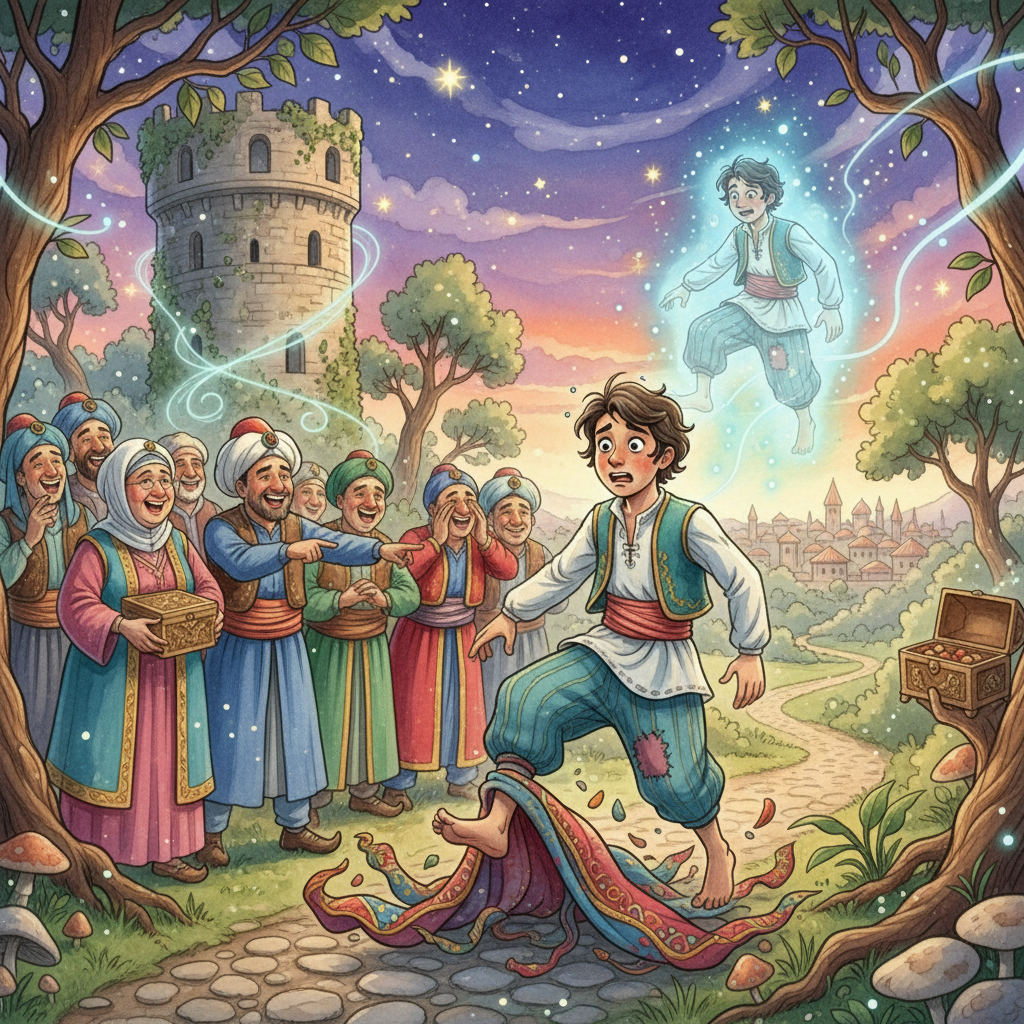
ALDONO
by V. M. Doroshevich · from Orientaj fabeloj
Adapted Version
A king did not like the truth. A Sneaky Advisor talked to the king. "Truth makes trouble," the Sneaky Advisor said. The king listened. He was not happy. "Truth must go away," the king decided.
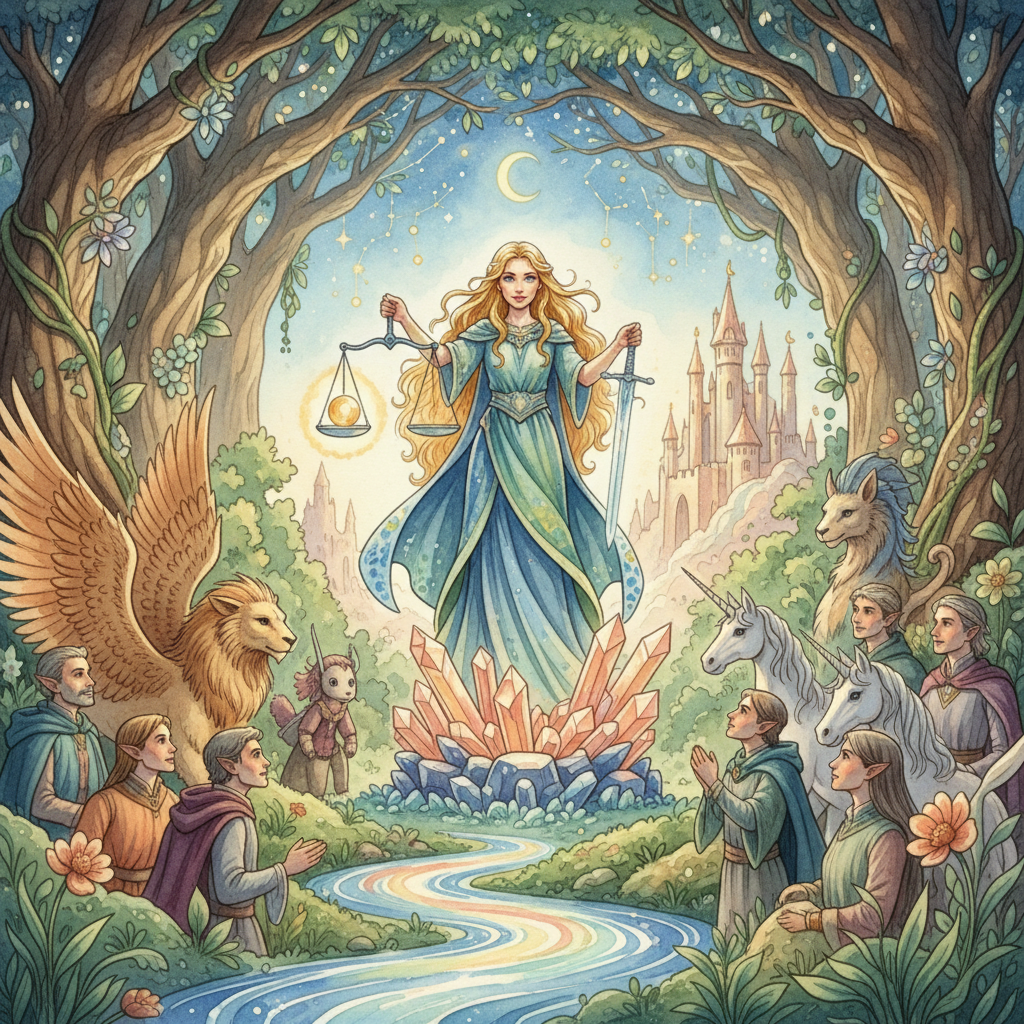
They brought Truth to a judge. Truth was a kind lady. The judge looked at her. "What should we do?" the judge asked. The Wise Advisor was there too. "Do not hurt her," the Wise Advisor said. "Just send her away. Let her go."
So Truth went to a quiet place. It was a sad desert. She felt very sad there. She missed the people.
Back in the kingdom, things went wrong. People were not kind to each other. They did not share their toys. All felt sad and messy.
The king saw the problems. He felt sorry. He asked the Wise Advisor for help. "Why is all so bad?" the king asked.
The Wise Advisor spoke calmly. "Truth is gone," he said. "That is why things are wrong. We need her back."
The king knew his mistake. "Bring Truth back!" he ordered. "Bring her home now!"
They found Truth in the desert. She came back to the kingdom. When Truth returned, things got better. People started to be kind again. They shared and helped each other. The kingdom became happy and calm.
Truth stayed to help all. She made things right. The king learned a good lesson. Truth always makes things right.
Original Story
ALDONO
LINGVAJ NOTOJ DE LA TRADUKINTO
Por konservi la brilan orientan koloron de la lingvo en la originala teksto, mi uzis en la traduko kelkajn neoficialajn vortojn kaj neologismojn, parte jam uzitajn en nia literaturo, parte de mi novadaptitajn, sen kies uzado, aŭ kun kies esperantaj klarigaj ekvivalentoj, la verko multe perdus kaj fariĝus malpli viva. En tiu rilato mi bone konsideris la principon de neceso, sed mi trovis por mi la pravigon en tio, ke eĉ nia oficiala vortaro entenas multajn „orientajn“ vortojn (trovatajn ankaŭ en mia libro) ekz.: kalifo, sultano, veziro, eŭnuko, minareto, moskeo, turbano, Korano, haremo. Tiuj vortoj siavice povus esti ankoraŭ unu fojon tradukitaj, klarigitaj per pli simplaj esperantaj vortoj, sed ni ne sentas tian bezonon, ĉar ili estas per si mem tute internacie konataj kaj uzataj. La enkondukitajn vortojn kiel: hurio, odalisko (haremanino), muftio, ŝejko, emiro, fetvo, kadio, nargileo, neguso (reĝo de Abisenujo), radĵaho (hinda reganta princo), mi ne altrudas por la nepra akcepto, sed mi volas, ke ili restu kiel pure „enciklopedia“ vortara valoraĵo por la pluaj eksperimentoj. Inter alie multaj el ili jam troviĝas en la plenaj nacie-esperantaj vortaroj.
La vortojn Alaho kaj padiŝaho mi uzis por la loka, akcentiga celo. Esperantan ortografion mi donis al ili por pli fleksebla kaj regula uzo en la stilo.
Krom tiuj „pure orientaj“ vortoj mi uzis kelkajn neologismojn, plejparte ankaŭ tre ofte renkontatajn en nia literaturo kaj vortaroj, ekz.: suvereno (monarko, solpotenca reganto), tempesto (ventego sur maro), tamburino (duontamburo kun tintiloj, uzata por la dancoj), pilavo, fugitivo (elmigrinto, forkurinto el sia lando, pro danĝero aŭ aliaj forpeligaj kaŭzoj), rivalo (konkuranta aŭ duelanta kontraŭulo), distribuo (disdivido, disdono, dislivero).
Mi permesis al mi ankaŭ uzi kelkajn novajn esperantajn formojn, ekz.: sukerumi, t. e. saturigi per la sukera siropo, fari konfitaĵon el iu frukto aŭ kreskaĵo, saturita per sukero; instruulo, nek instruisto, nek instruanto, sed ulo de la instruo, homo portanta en si la econ de instruemo, pro sia prudento kaj talento; homo de kiu oni konstante ion lernas.
Fine mi volus indiki ankaŭ tion, kion la traduko neeviteble devis perdi kompare kun la originalo. Unue, mi devis perforte uzi la virinan pronomon ŝi por Vero, alie la tuta senco de la fabelo ruiniĝus, almenaŭ laŭ la arbitra aspekto. Min pravigu la fakto, ke en ĉiuj lingvoj uzantaj la genrojn (la gramatikajn formojn, kiuj diversigas la partojn de la parolo laŭ la seksoj: vira, virina kaj neŭtra), Vero estas plejofte kompreno virinseksa.
Uzinte la pleonasmon juvelŝtono (anstataŭ simpla: juvelo) mi volis esti konsekvenca kaj konforma al la leĝo de la fabela fetvo, kiu ordonas mortigi per ŝtonoj. En rusa lingvo juvelo estas esprimata per du vortoj „multekosta ŝtono“, do en ĝi la konsekvenco estas plena. La legantoj bonvolu ne kritiki tro severe tiun necesan pleonasmon.
En la fabelo „Malĝuste trafitaj kalkanoj“ la frazo, „ke antaŭ la puno la homa animo sin kaŝas en la kalkanoj“ estas iomete neklara por tiuj, kiuj ne konas la rusan lingvon. Estas rusismo: „Pro teruro, mia animo foriris en la kalkanojn.“ Per tiu frazo la rusoj priskribas la staton de homo, kiu antaŭ la danĝero perdas la sinregadon kaj normalan pensmanieron.
En la sama fabelo:
„delikathaŭtaj mandarenoj“ signifas en la rusa lingvo ankaŭ specon de oranĝoj kreskantaj en Ĥinujo, kun ruĝaj fibroj kaj tre sukplenaj;
„alilandaj diabloj“ estas moke nomataj en Ĥinujo ĉiuj blankhaŭtuloj.
Restas al mi nur diri, ke mi transskribis la proprajn personajn kaj geografiajn nomojn plejparte fonetike. En la nomo Fatjma la meza „j“ estu legata kiel tre mallonga i, moliganta la antaŭan „t“.
La tradukinto.
Piednotoj
[1] Granda estas Alaho (Dio)! Araba aklamo.
[2] Paradizaj belulinoj, laŭ la religio de Mahometo.
[3] Imperiestro.
[4] Supera eklezia rango ĉe Mahometanoj.
[5] Princo (araba).
[6] Sortodestino.
[7] Religia dekreto ĉe mahometanoj.
[8] Orienta aroma brulaĵo.
[9] Juĝisto.
[10] Manĝaĵo el viando kun rizo.
[11] Tiu ĉi rakonto ne apartenas al la serio de „Orientaj Fabeloj“. Sed ĝi servas kiel bela ekzemplero de la lingvo de Doroŝeviĉ, per kiu li kvazaŭ vipis la socion. Malgraŭ la lastatempaj ŝanĝoj de la vivokondiĉoj en Rusujo, la rakonto ne perdis sian universalan signifon.
[12] Tre, tre serioza knabo!
[13] Li estas tre, tre porka!
Notoj de transskribinto:
Mi senrimarke ĝustigis etajn interpunkciajn kaj citilajn erarojn, kaj registris aliajn ŝanĝojn de mispresaĵoj per html-aj komentoj. Ankaŭ originalajn paĝkomencojn mi simile registris.
*** END OF THE PROJECT GUTENBERG EBOOK ORIENTAJ FABELOJ ***
Updated editions will replace the previous one—the old editions will be renamed.
Creating the works from print editions not protected by U.S. copyright law means that no one owns a United States copyright in these works, so the Foundation (and you!) can copy and distribute it in the United States without permission and without paying copyright royalties. Special rules, set forth in the General Terms of Use part of this license, apply to copying and distributing Project Gutenberg™ electronic works to protect the PROJECT GUTENBERG™ concept and trademark. Project Gutenberg is a registered trademark, and may not be used if you charge for an eBook, except by following the terms of the trademark license, including paying royalties for use of the Project Gutenberg trademark. If you do not charge anything for copies of this eBook, complying with the trademark license is very easy. You may use this eBook for nearly any purpose such as creation of derivative works, reports, performances and research. Project Gutenberg eBooks may be modified and printed and given away—you may do practically ANYTHING in the United States with eBooks not protected by U.S. copyright law. Redistribution is subject to the trademark license, especially commercial redistribution.
Story DNA
Moral
Truth, though often hidden and scorned, will ultimately reveal itself and triumph over falsehood, bringing justice to those who uphold it.
Plot Summary
A powerful Padiŝaho, influenced by his deceitful Veziro, banishes Truth from his kingdom. Truth, personified as a woman, is exiled to a desolate desert, leaving the land to descend into chaos and injustice. As the kingdom suffers, the wise Muftio reveals to the Padiŝaho that the absence of Truth is the cause of their woes. Realizing his error, the Padiŝaho orders Truth's return, and with her re-entry, order and prosperity are slowly restored to the land, though the memory of her suffering endures.
Themes
Emotional Arc
suffering to triumph
Writing Style
Narrative Elements
Cultural Context
The story uses an Orientalist setting common in 19th-century European literature to explore universal themes. The translator's notes highlight the deliberate use of 'oriental' vocabulary to maintain a specific cultural flavor, even in a Russian story.
Plot Beats (9)
- The Padiŝaho, swayed by his Veziro, decides to banish Truth from his kingdom, believing she causes trouble.
- Truth, personified as a beautiful woman, is brought before the Kadio for judgment.
- The Kadio condemns Truth to death by stoning, but the wise Muftio intervenes, suggesting exile instead.
- Truth is exiled to a desolate desert, where she lives in sorrow and isolation.
- The kingdom, now devoid of Truth, descends into chaos, injustice, and widespread suffering.
- The Padiŝaho observes the decline of his land and seeks counsel from the Muftio.
- The Muftio explains that the kingdom's woes are a direct result of Truth's banishment.
- The Padiŝaho, realizing his error, orders Truth to be brought back to the kingdom.
- Truth returns, and with her, order, justice, and prosperity are gradually restored to the land, though the memory of her suffering lingers.
Characters
Aldono ★ protagonist
Lean and agile, with the sun-kissed skin typical of a desert dweller. His build is suited for quick movement and endurance rather than brute strength. He is of average height for his region.
Attire: Simple, practical desert attire. Likely a loose-fitting, light-colored tunic (thobe) made of cotton or linen, perhaps in shades of cream, sand, or light blue, to reflect the sun. He would wear wide trousers (sirwal) gathered at the ankles and simple leather sandals. His clothing would be clean but unadorned, reflecting his humble status.
Wants: To understand the true nature of 'Vero' (Truth) and to live by its principles, even if it means challenging societal norms or personal comfort.
Flaw: His deep introspection can sometimes lead to a detached or overly analytical view of the world, making him seem aloof or slow to act in practical matters.
Aldono's journey is one of intellectual and spiritual discovery. He starts by seeking a definitive, tangible 'Vero' and through his experiences, learns that truth is multifaceted, often hidden, and not always what it appears to be on the surface.
Thoughtful, philosophical, humble, observant, and deeply moral. He is not easily swayed by superficial appearances or common opinion.
Image Prompt & Upload
A young adult man of Middle Eastern descent, standing upright, facing forward, full body visible from head to toe. He has a lean build and an average height. His skin is sun-kissed, with a warm, olive tone. His face is finely chiseled, with dark, thoughtful eyes and a straight nose. His dark brown hair is short and neatly kept. He wears a loose-fitting, cream-colored cotton thobe, wide white sirwal trousers, and simple brown leather sandals. His posture is dignified but slightly bowed, with a contemplative expression. Plain white background, full body visible head to toe, single figure, no watermark, no text, no signature.
Vero ◆ supporting
Her physical form is fluid and ever-changing, reflecting her elusive nature. She can appear beautiful and alluring, or harsh and unyielding, depending on the context. She is not bound by human physical limitations.
Attire: Her attire is symbolic and transformative. It could be a shimmering, ethereal gown when she appears beautiful, or rough, simple garments when she is unadorned. The fabrics and colors would change to reflect her current aspect.
Wants: To exist and to be sought, but not easily grasped. She reveals herself in fragments and tests those who seek her.
Flaw: Her abstract nature makes her difficult to fully comprehend or pin down, which can lead to misinterpretation or rejection by those who seek simple answers.
Vero does not change, but Aldono's understanding of her evolves. She remains constant in her elusive nature, serving as a mirror for Aldono's growth.
Elusive, multifaceted, sometimes beautiful, sometimes harsh, unyielding, and ultimately unknowable in a singular form. She challenges perceptions and demands deep understanding.
Image Prompt & Upload
An ethereal female figure, standing upright, facing forward, full body visible from head to toe. Her form is subtly shimmering and translucent, with features that seem to shift and flow. Her face is beautiful but not fixed, with eyes that hold ancient wisdom. Her hair is long and appears to be made of light or mist, flowing around her. She wears a flowing gown that seems woven from starlight and shadows, with no discernible fabric or color, constantly changing. Her posture is graceful and otherworldly. Plain white background, full body visible head to toe, single figure, no watermark, no text, no signature.
Locations
The Padiŝaho's Palace
A grand and opulent palace, likely in an Ottoman or Persian style, with rich decorations, possibly featuring intricate tilework, carved wooden screens, and luxurious fabrics. The atmosphere is one of power, wealth, and strict protocol.
Mood: Opulent, formal, powerful, with an underlying tension due to the Padiŝaho's authority.
The central setting for the Padiŝaho's rule, where decisions are made and Aldono's fate is determined.
Image Prompt & Upload
An interior view of a magnificent Ottoman or Persian palace throne room, bathed in soft, filtered light from high arched windows. The walls are adorned with intricate geometric tile mosaics in blues, greens, and golds, and the floor is covered with rich, patterned carpets. A large, ornate wooden throne with mother-of-pearl inlay stands on a raised dais, flanked by tall, slender columns. Sunlight streams through a mashrabiya screen, casting dappled shadows on the polished marble floor. no border, no frame, no watermark, no text, no signature, edge-to-edge illustration.
The City Streets
Bustling streets of an ancient Middle Eastern city, filled with merchants, common folk, and the sounds of daily life. The architecture would be typical of the region, with mud-brick or stone buildings, narrow alleys, and vibrant marketplaces.
Mood: Lively, bustling, sometimes chaotic, reflecting the everyday life of the populace.
Where the common people live and interact, and where the Padiŝaho's decrees are heard and discussed.
Image Prompt & Upload
A bustling, sun-drenched street in an ancient Middle Eastern city. Narrow, winding alleys are lined with two-story buildings made of light-colored sandstone and mud-brick, featuring small, shuttered windows and wooden balconies. Merchants display colorful textiles, spices, and pottery on woven mats on the dusty cobblestone ground. The air is hazy with dust and the scent of spices, and the bright midday sun casts sharp shadows from awnings and minarets in the distance. no border, no frame, no watermark, no text, no signature, edge-to-edge illustration.
The Desert
A vast, arid landscape of sand dunes and rocky outcrops, stretching to the horizon under a clear sky. It represents isolation, hardship, and the ultimate test of survival.
Mood: Desolate, vast, unforgiving, but also starkly beautiful.
A place of exile or journey, symbolizing the challenges faced by those who defy the Padiŝaho.
Image Prompt & Upload
A sweeping vista of an endless Arabian desert at midday. Rolling ochre and burnt sienna sand dunes stretch to the horizon, their crests sharply defined against a brilliant, cloudless azure sky. The sand is fine and rippled by wind, with occasional clusters of hardy desert scrub clinging to the lower slopes. The intense sunlight creates deep, contrasting shadows on the leeward sides of the dunes, emphasizing the vast, desolate expanse. no border, no frame, no watermark, no text, no signature, edge-to-edge illustration.
![HISTORIO DE PORKO[\[11\]](#Footnote11)](/library-files/eo/v_m_vlas_mikha_lovich_doroshevich/orientaj_fabeloj/historio_de_porko_11_footnote11/images/cover/cover_001.png?w=150)