The White Bride and the Black One
by Brothers Grimm · from Household Tales
Adapted Version
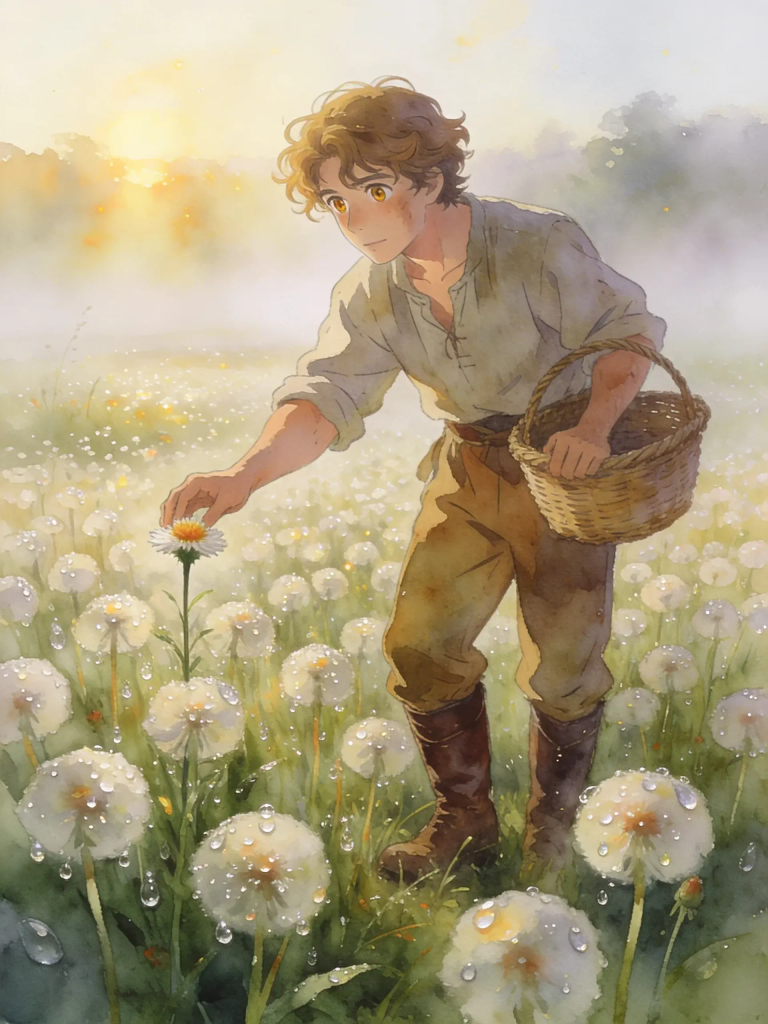
Once upon a time, there was a girl. Her name was Lily. She lived in a small house. Her mother and sister Marta lived there too. Lily was very kind. She helped others a lot.
One day, an old man came by. He had a long white beard. "Can you help me?" he asked. "I am lost."
"Go away!" said the mother. "No!" said Marta. But Lily smiled. "I can help you!" she said. She walked with the old man. She showed him the way.
The old man smiled at Lily. "Thank you, kind girl," he said. "This is for you." He gave her a dress. It was gold like the sun. Marta saw the dress. She wanted it very much.
Lily had a brother named Regi. He worked at the King's castle. "My sister is kind," he told the King.
"I want to meet her!" said the King.
The King asked Regi to bring Lily. Lily put on her gold dress. She was so happy. They rode in a big cart. Marta and the mother came too.
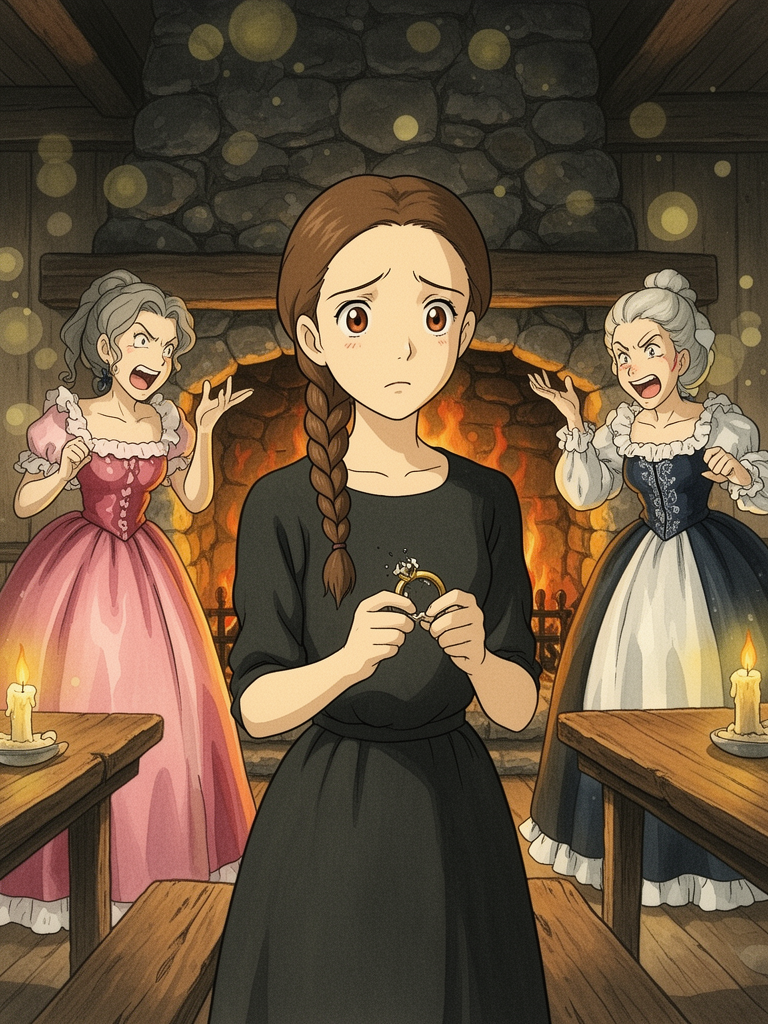
Lily fell asleep in the cart. Marta took the gold dress. She put it on. She gave Lily an old grey dress.
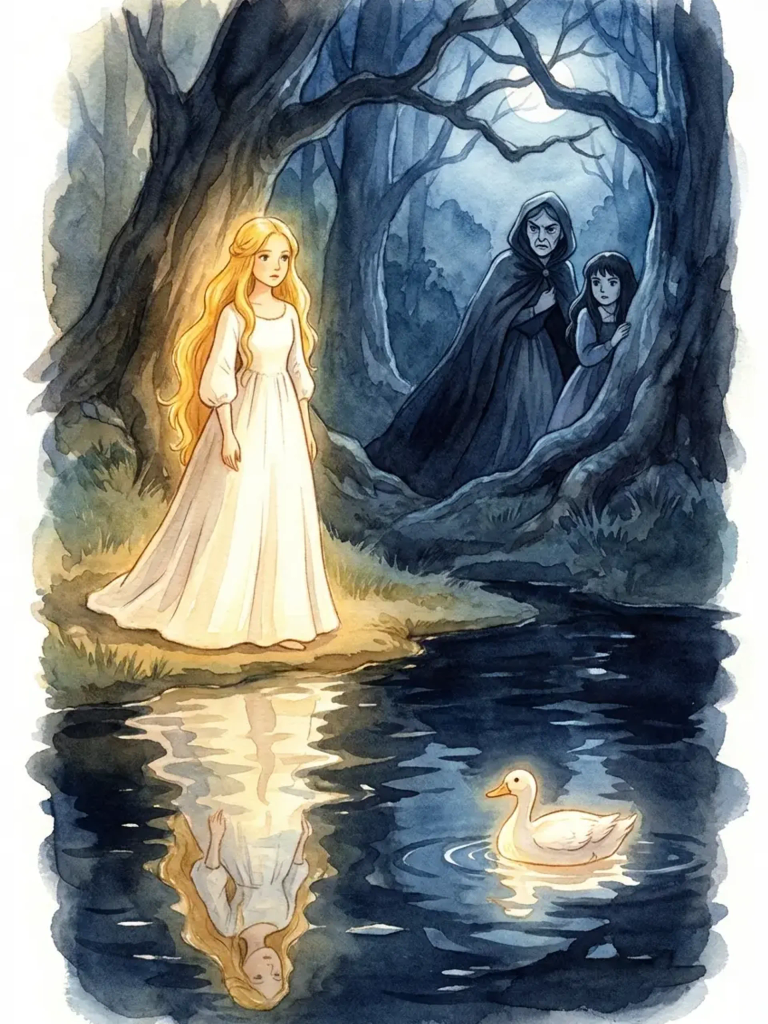
Lily woke up alone. She was lost in the forest. She was very sad. Then a good thing happened! She turned into a white duck! She could fly now.
Marta came to the castle. She wore the gold dress. The King was not happy. "This girl is not kind," he said. He sent Regi away. Regi was very sad.
That night, a white duck came. "Is my brother here?" she asked. "Is the King happy?" The kitchen boy heard her.
The next night, the duck came again. "Is my brother here? Is the King happy?"
The third night, the duck came again. "Is my brother here? Is the King happy?" The kitchen boy ran fast. "Come and see!" he said.
The King came. He saw the white duck. The duck turned back into Lily! She wore her simple dress. She was kind and pretty.
"My sister took my dress," Lily said. "I got lost." The King brought Regi back. Regi was so happy to see Lily.
Marta and the mother felt sorry. "We were wrong," they said. Lily smiled. "I forgive you," she said.
Lily and Regi lived at the castle. The King was their good friend. All were happy. And kind Lily smiled. She was home.
Original Story
The white bride and the black one
A fairy tale by the Brothers Grimm
A woman was going about the unenclosed land with her daughter and her step-daughter cutting fodder, when the Lord came walking towards them in the form of a poor man, and asked, "Which is the way into the village?" - "If you want to know," said the mother, "seek it for yourself," and the daughter added, "If you are afraid you will not find it, take a guide with you." But the step-daughter said, "Poor man, I will take you there, come with me." Then God was angry with the mother and daughter, and turned his back on them, and wished that they should become as black as night and as ugly as sin. To the poor step-daughter, however, God was gracious, and went with her, and when they were near the village, he said a blessing over her, and spake, "Choose three things for thyself, and I will grant them to thee." Then said the maiden, "I should like to be as beautiful and fair as the sun," and instantly she was white and fair as day. "Then I should like to have a purse of money which would never grow empty." That the Lord gave her also, but he said, "Do not forget what is best of all." Said she, "For my third wish, I desire, after my death, to inhabit the eternal kingdom of Heaven." That also was granted unto her, and then the Lord left her. When the step-mother came home with her daughter, and they saw that they were both as black as coal and ugly, but that the step-daughter was white and beautiful, wickedness increased still more in their hearts, and they thought of nothing else but how they could do her an injury. The step-daughter, however, had a brother called Reginer, whom she loved much, and she told him all that had happened. Once on a time Reginer said to her, "Dear sister, I will take thy likeness, that I may continually see thee before mine eyes, for my love for thee is so great that I should like always to look at thee." Then she answered, "But, I pray thee, let no one see the picture." So he painted his sister and hung up the picture in his room; he, however, dwelt in the King's palace, for he was his coachman. Every day he went and stood before the picture, and thanked God for the happiness of having such a dear sister. Now it happened that the King whom he served, had just lost his wife, who had been so beautiful that no one could be found to compare with her, and on this account the King was in deep grief. The attendants about the court, however, remarked that the coachman stood daily before this beautiful picture, and they were jealous of him, so they informed the King. Then the latter ordered the picture to be brought to him, and when he saw that it was like his lost wife in every respect, except that it was still more beautiful, he fell mortally in love with it. He caused the coachman to be brought before him, and asked whom the portrait represented? The coachman said it was his sister, so the King resolved to take no one but her as his wife, and gave him a carriage and horses and splendid garments of cloth of gold, and sent him forth to fetch his chosen bride. When Reginer came on this errand, his sister was glad, but the black maiden was jealous of her good fortune, and grew angry above all measure, and said to her mother, "Of what use are all your arts to us now when you cannot procure such a piece of luck for me?" - "Be quiet," said the old woman, "I will soon divert it to you," and by her arts of witchcraft, she so troubled the eyes of the coachman that he was half-blind, and she stopped the ears of the white maiden so that she was half-deaf. Then they got into the carriage, first the bride in her noble royal apparel, then the step-mother with her daughter, and Reginer sat on the box to drive. When they had been on the way for some time the coachman cried,
"Cover thee well, my sister dear,
That the rain may not wet thee,
That the wind may not load thee with dust,
That thou may'st be fair and beautiful
When thou appearest before the King."
The bride asked, "What is my dear brother saying?" - "Ah," said the old woman, "he says that you ought to take off your golden dress and give it to your sister." Then she took it off, and put it on the black maiden, who gave her in exchange for it a shabby grey gown. They drove onwards, and a short time afterwards, the brother again cried,
"Cover thee well, my sister dear,
That the rain may not wet thee,
That the wind may not load thee with dust,
That thou may'st be fair and beautiful
When thou appearest before the King."
The bride asked, "What is my dear brother saying?" - "Ah," said the old woman, "he says that you ought to take off your golden hood and give it to your sister." So she took off the hood and put it on her sister, and sat with her own head uncovered. And they drove on farther. After a while, the brother once more cried,
"Cover thee well, my sister dear,
That the rain may not wet thee,
That the wind may not load thee with dust,
That thou may'st be fair and beautiful
When thou appearest before the King."
The bride asked, "What is my dear brother saying?" - "Ah," said the old woman, "he says you must look out of the carriage." They were, however, just on a bridge, which crossed deep water. When the bride stood up and leant forward out of the carriage, they both pushed her out, and she fell into the middle of the water. At the same moment that she sank, a snow-white duck arose out of the mirror-smooth water, and swam down the river. The brother had observed nothing of it, and drove the carriage on until they reached the court. Then he took the black maiden to the King as his sister, and thought she really was so, because his eyes were dim, and he saw the golden garments glittering. When the King saw the boundless ugliness of his intended bride, he was very angry, and ordered the coachman to be thrown into a pit which was full of adders and nests of snakes. The old witch, however, knew so well how to flatter the King and deceive his eyes by her arts, that he kept her and her daughter until she appeared quite endurable to him, and he really married her.
One evening when the black bride was sitting on the King's knee, a white duck came swimming up the gutter to the kitchen, and said to the kitchen-boy, "Boy, light a fire, that I may warm my feathers." The kitchen-boy did it, and lighted a fire on the hearth. Then came the duck and sat down by it, and shook herself and smoothed her feathers to rights with her bill. While she was thus sitting and enjoying herself, she asked, "What is my brother Reginer doing?" The scullery-boy replied, "He is imprisoned in the pit with adders and with snakes." Then she asked, "What is the black witch doing in the house?" The boy answered, "She is loved by the King and happy."
"May God have mercy on him," said the duck, and swam forth by the sink.
The next night she came again and put the same questions, and the third night also. Then the kitchen-boy could bear it no longer, and went to the King and discovered all to him. The King, however, wanted to see it for himself, and next evening went thither, and when the duck thrust her head in through the sink, he took his sword and cut through her neck, and suddenly she changed into a most beautiful maiden, exactly like the picture, which her brother had made of her. The King was full of joy, and as she stood there quite wet, he caused splendid apparel to be brought and had her clothed in it. Then she told how she had been betrayed by cunning and falsehood, and at last thrown down into the water, and her first request was that her brother should be brought forth from the pit of snakes, and when the King had fulfilled this request, he went into the chamber where the old witch was, and asked, What does she deserve who does this and that? and related what had happened. Then was she so blinded that she was aware of nothing and said, "She deserves to be stripped naked, and put into a barrel with nails, and that a horse should be harnessed to the barrel, and the horse sent all over the world." All of which was done to her, and to her black daughter. But the King married the white and beautiful bride, and rewarded her faithful brother, and made him a rich and distinguished man.
- * * * *
Story DNA
Moral
Kindness and virtue are rewarded, while wickedness and deceit ultimately lead to just punishment.
Plot Summary
A kind step-daughter is blessed by God with beauty and good fortune, while her cruel step-mother and step-sister are cursed with ugliness. The step-daughter's portrait captures the King's heart, but her step-family conspires to replace her with the ugly step-sister during the journey to the palace, pushing the true bride into a river where she transforms into a duck. The duck repeatedly visits the palace kitchen, revealing her identity and her brother's unjust imprisonment to a kitchen-boy, leading the King to discover the truth. The true bride is restored, and the wicked step-mother and step-sister are punished according to their own judgment.
Themes
Emotional Arc
suffering to triumph
Writing Style
Narrative Elements
Cultural Context
Grimm's fairy tales often reflect a pre-industrial, rural European society with strong moral codes and a belief in supernatural forces and divine justice.
Plot Beats (15)
- A woman, her daughter, and step-daughter encounter God disguised as a poor man asking for directions.
- The mother and daughter are rude; the step-daughter is kind and guides him.
- God curses the mother and daughter to be black and ugly, and grants the step-daughter three wishes: beauty, an endless purse, and a place in heaven after death.
- The step-daughter's brother, Reginer, a royal coachman, paints her portrait and hangs it in his room.
- The King, mourning his beautiful late wife, sees the portrait and falls in love with the depicted maiden.
- The King sends Reginer to fetch his sister as his bride, providing rich garments.
- En route, the wicked step-mother uses magic to make Reginer half-blind and the bride half-deaf.
- The step-mother tricks the bride into giving her golden clothes and hood to the black maiden.
- The step-mother and black maiden push the true bride into a river from a bridge, where she transforms into a white duck.
- The black maiden is presented to the King as the bride; Reginer is imprisoned for bringing an ugly bride.
- The white duck visits the kitchen for three nights, asking about Reginer and the black witch.
- The kitchen-boy informs the King, who witnesses the duck's transformation back into the maiden.
- The maiden recounts her betrayal; the King frees Reginer.
- The King tricks the step-mother into prescribing her own gruesome punishment, which is then carried out on her and her daughter.
- The King marries the true bride, and Reginer is rewarded and honored.
Characters
The Step-Daughter ★ protagonist
Initially of normal appearance, transformed to be as beautiful and fair as the sun, white and fair as day.
Attire: Initially simple peasant clothes, later noble royal apparel (golden dress, golden hood), then a shabby grey gown, and finally splendid apparel provided by the King.
Kind, compassionate, faithful, patient.
Image Prompt & Upload
Young woman in her late teens with gentle doe eyes and a kind, hopeful expression, long flowing chestnut brown hair with loose waves cascading past her shoulders, fair skin with a light dusting of freckles across her nose. Wearing a simple faded blue cotton dress with a slightly tattered hem and patched elbows, a worn white apron tied at the waist, and scuffed brown leather boots. She stands with a graceful posture, shoulders back but slightly tilted head showing quiet determination, hands clasped gently in front of her. Her dress is modest and well-worn but clean, with a small embroidered flower detail on the collar. Soft rosy cheeks and pink lips with a subtle smile suggesting inner strength despite hardship. Slim figure, average height. Plain white background, full body visible head to toe, single figure, no watermark, no text, no signature
The Mother ⚔ antagonist
Initially of normal appearance, transformed to be as black as night and as ugly as sin.
Attire: Simple peasant dress, later implied to be more refined through her witchcraft to deceive the King.
Cruel, selfish, jealous, deceitful, a witch.
Image Prompt & Upload
A middle-aged woman with sharp, angular features and cold, piercing eyes, her expression stern and unforgiving. She wears a dark, high-collared gown of heavy brocade with intricate black lace at the cuffs, her graying hair pulled back into a severe, tight bun. She stands rigidly upright, one hand clenched at her side, the other gripping a long, slender wooden spoon held like a scepter. The lighting is dramatic and shadowy, casting harsh highlights on her pale skin and severe silhouette. Plain white background, full body visible head to toe, single figure, no watermark, no text, no signature.
The Daughter ⚔ antagonist
Initially of normal appearance, transformed to be as black as night and as ugly as sin.
Attire: Simple peasant dress, later the golden dress and hood stolen from the step-daughter, then implied to be more refined through her mother's witchcraft to deceive the King.
Rude, selfish, jealous, cruel.
Image Prompt & Upload
A young woman in her early twenties with alabaster skin and ice-blue eyes, her expression cold and calculating. She has sleek, raven-black hair pulled back into a severe bun. She wears a high-collared, form-fitting Victorian-style dress of deep burgundy velvet, with intricate black lace at the cuffs and throat. She stands tall and rigid, one hand resting on her hip, the other holding a slender, ornate silver dagger pointed downward. Her posture is proud and disdainful. Plain white background, full body visible head to toe, single figure, no watermark, no text, no signature.
Reginer ◆ supporting
No specific description, but implied to be a capable man, serving as the King's coachman.
Attire: Coachman's attire, later splendid garments of cloth of gold when sent to fetch the bride.
Loving, loyal, faithful, observant (despite being partially blinded by magic).
Image Prompt & Upload
A middle-aged man with warm brown eyes and a kind, weathered face. He has short, salt-and-pepper hair and a neatly trimmed beard. He wears a simple but sturdy olive-green tunic over dark brown trousers, with a leather belt at his waist and worn leather boots. His posture is relaxed and open, standing with a slight, reassuring smile as if ready to offer help or guidance. Plain white background, full body visible head to toe, single figure, no watermark, no text, no signature.
The Lord ◆ supporting
Appears in the form of a poor man.
Attire: Poor man's clothing.
Just, benevolent, punitive towards the wicked, gracious towards the kind.
Image Prompt & Upload
A middle-aged nobleman with a neatly trimmed salt-and-pepper beard and kind, wise eyes. He wears a rich, deep blue velvet doublet with gold embroidery at the collar and cuffs, dark fitted trousers, and polished black leather boots. A heavy gold chain of office rests across his chest. He stands tall with a posture of calm authority, one hand resting on the pommel of a sheathed sword at his hip, the other hand open in a welcoming gesture. His expression is thoughtful and benevolent. Plain white background, full body visible head to toe, single figure, no watermark, no text, no signature.
The King ◆ supporting
No specific description, but implied to be a powerful and just ruler.
Attire: Royal attire.
Grieving, just, discerning (eventually), capable of anger and love.
Image Prompt & Upload
A regal man in his late 50s with a neatly trimmed gray beard and wise, kind eyes. He wears an ornate golden crown adorned with rubies and sapphires, a luxurious crimson velvet robe with white ermine fur trim and a high collar, and a golden scepter in his right hand. His posture is upright and dignified, with a slight, benevolent smile. Plain white background, full body visible head to toe, single figure, no watermark, no text, no signature.
The White Duck ◆ supporting
Snow-white duck.
Attire: Feathers.
Persistent, loving (towards her brother), seeking justice.
Image Prompt & Upload
A graceful white duck with pristine snowy plumage, soft and fluffy feathers, bright orange beak, and gentle dark eyes. The duck stands elegantly with its neck slightly curved, head tilted in a curious and friendly manner. Its wings are neatly folded against its body, and its orange feet are visible. The duck has a serene and approachable expression, embodying purity and innocence. Plain white background, full body visible head to toe, single figure, no watermark, no text, no signature
Locations
Unenclosed Land
Open, uncultivated land where a woman, her daughter, and step-daughter were cutting fodder.
Mood: ordinary, then suddenly divine and transformative
The Lord appears and curses the mother and daughter, while blessing the step-daughter with beauty, an endless purse, and a place in Heaven.
Image Prompt & Upload
Late afternoon light bathes an open, uncultivated meadow in a golden glow. Tall, dry grasses and wildflowers sway gently across the rolling land under a vast, soft-blue sky. A single, well-worn dirt path cuts through the center, disappearing toward distant, hazy purple hills. The air is still and quiet, with a sense of quiet abandonment after a day's work. A few scattered trees dot the horizon, their long shadows stretching across the earth. The scene is peaceful, vast, and untouched by cultivation. no border, no frame, no watermark, no text, no signature, edge-to-edge illustration
The Road/Bridge
A road leading to the King's court, featuring a bridge over deep water.
Mood: deceptive, dangerous, treacherous
The step-mother and her black daughter trick the white bride, steal her clothes, and push her into the deep water from the bridge.
Image Prompt & Upload
At dawn, a grand stone bridge arches over a deep, mist-shrouded river, its ancient carved balustrades worn smooth by time. The wide, cobblestone road leading to it is flanked by towering, gnarled oaks, their branches forming a natural cathedral. Soft golden light filters through the morning fog, illuminating the damp stones and the dark, reflective water below. In the far distance, the spires of a magnificent castle rise above the forest canopy, hinting at the King's court. The atmosphere is serene, majestic, and slightly mysterious. Colors are muted pastels with accents of mossy green and stone grey. no border, no frame, no watermark, no text, no signature, edge-to-edge illustration
King's Palace Kitchen
A kitchen within the King's palace, with a gutter leading to it and a hearth for a fire.
Mood: cozy, secretive, a place of revelation
The white bride, transformed into a duck, repeatedly visits the kitchen to warm herself and inquire about her brother and the black witch, eventually leading to her discovery by the King.
Image Prompt & Upload
In the heart of the royal palace at night, a vast stone kitchen is illuminated by the warm amber glow of a great, crackling hearth. The fire casts dancing shadows across vaulted ceilings and walls lined with copper pots and dried herb bundles. A deep, stone-lined gutter runs along the floor, carrying a gentle stream of clear water that catches the flickering firelight. Moonlight streams through a high arched window, creating a cool blue rectangle on the worn flagstone floor. The air feels still and quiet, filled with the soft light and the promise of morning preparations. no border, no frame, no watermark, no text, no signature, edge-to-edge illustration.
Pit of Adders and Snakes
A dark, dangerous pit filled with venomous adders and snakes.
Mood: horrific, torturous, deadly
Reginer, the coachman, is unjustly thrown into this pit by the King, where he remains until his sister's rescue.
Image Prompt & Upload
Midnight in a treacherous pit, where dense fog clings to jagged, moss-covered walls. The ground is a tapestry of shadows, with serpentine coils and venomous adders barely discernible, their scales reflecting faint, eerie glows. Crumbling stone arches and ancient carvings are half-hidden by toxic vines and dark, damp foliage. The color scheme is dominated by deep emerald greens, obsidian blacks, and hints of bioluminescent yellow. The atmosphere is cold, damp, and suffocating, with a palpable sense of danger. No border, no frame, no watermark, no text, no signature, edge-to-edge illustration.