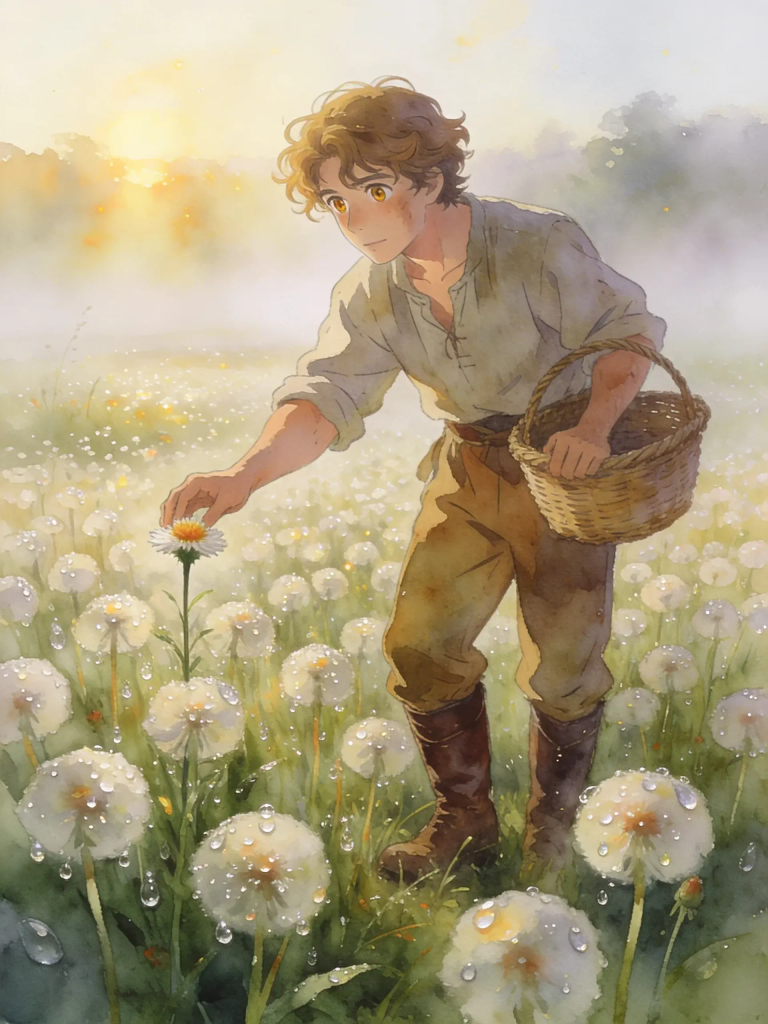
The Peasant's Wise Daughter
by Brothers Grimm · from Household Tales
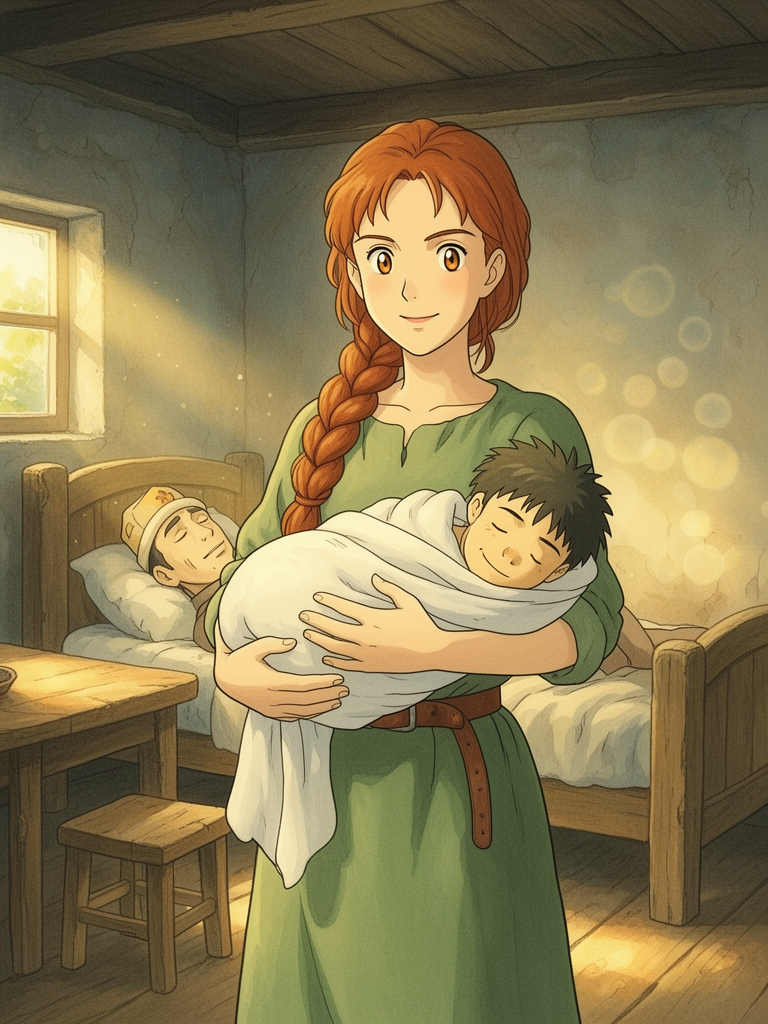
Adapted Version
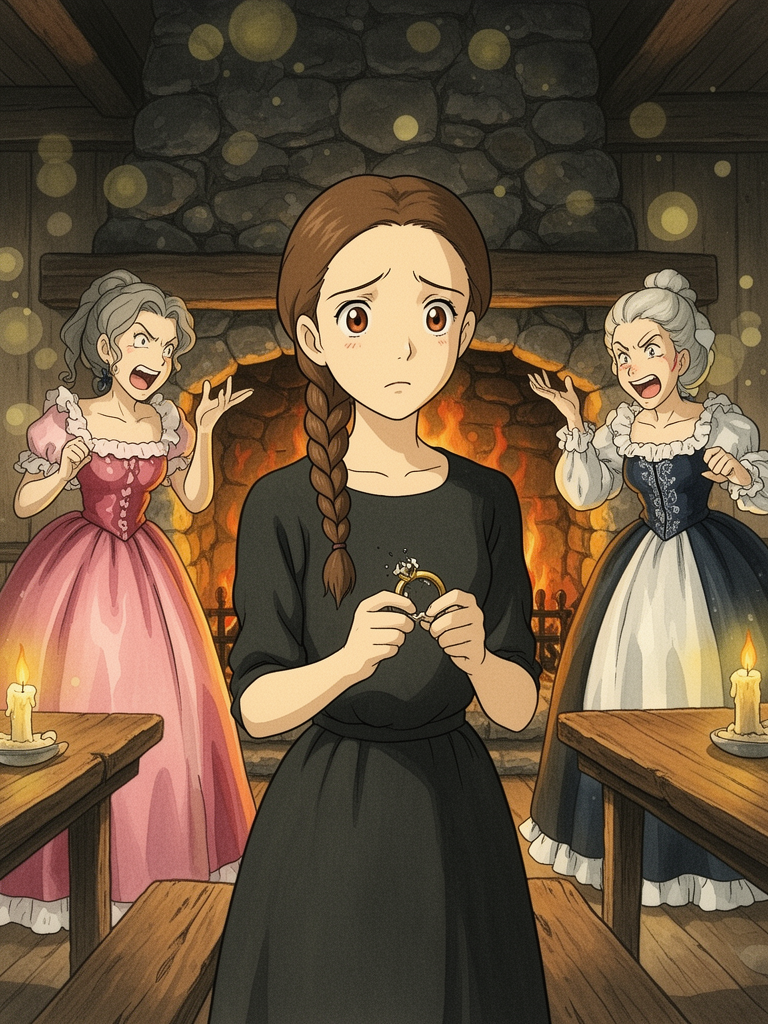
Once, Lily lived with her father. She was a clever girl. They had a small house. They were poor but happy. The kind King gave them a farm.
Lily and her father dug the dirt. They found a golden cup! "We should keep it safe," said Lily. Her father said, "I will give it."
Father gave the cup to the King. The King looked at it. "Where is the next piece?" he asked. Father did not know. The King was not happy. "Stay in this room," said the King.
Father sat in the room. He was very sad. "Lily told me so," he said. "She is so smart!" The King heard this.
The King wanted to meet Lily. "I have a fun game," he said. "Come to me. Not walking. And not riding!"
Lily thinks and thinks. She smiles a big smile. She hops on one foot! The King laughs and laughs.
"You are so clever!" said the King. Lily became the Queen. Her father came home. He was very happy.
One day, a farmer came. "That is my baby horse!" he said. But one man said, "No, it is mine!" The King gave it to the wrong man.
The sad farmer asked Lily for help. "I have an idea," she said. "Go fish in the road. No water is there!" The farmer trusted Lily.
The King saw the farmer. He fished on the dry road. "No fish are here!" said the King. "A baby horse cannot be his!" said the farmer.
The King stopped. He asked, "Who told you this?" The farmer said, "The Queen helped me."
The King was a bit upset. "You should have told me," he said. "Go back to your old house. But take one thing you love most."
That night, the King fell asleep. Lily smiled. She carried him to her old house. He woke up. "Where am I?" he asked. "You said I could take what I love most," said Lily. "I love you the most!"
The King laughed. "You are so clever! And you love me!" He gave the baby horse back. They all went home happy.
Original Story
The peasant's wise daughter
A fairy tale by the Brothers Grimm
There was once a poor peasant who had no land, but only a small house, and one daughter. Then said the daughter, "We ought to ask our lord the King for a bit of newly-cleared land." When the King heard of their poverty, he presented them with a piece of land, which she and her father dug up, and intended to sow with a little corn and grain of that kind. When they had dug nearly the whole of the field, they found in the earth a mortar made of pure gold. "Listen," said the father to the girl, "as our lord the King has been so gracious and presented us with the field, we ought to give him this mortar in return for it." The daughter, however, would not consent to this, and said, "Father, if we have the mortar without having the pestle as well, we shall have to get the pestle, so you had much better say nothing about it." He would, however, not obey her, but took the mortar and carried it to the King, said that he had found it in the cleared land, and asked if he would accept it as a present. The King took the mortar, and asked if he had found nothing besides that? "No," answered the countryman. Then the King said that he must now bring him the pestle. The peasant said they had not found that, but he might just as well have spoken to the wind; he was put in prison, and was to stay there until he produced the pestle. The servants had daily to carry him bread and water, which is what people get in prison, and they heard how the man cried out continually, "Ah! if I had but listened to my daughter! Alas, alas, if I had but listened to my daughter!" and would neither eat nor drink. So he commanded the servants to bring the prisoner before him, and then the King asked the peasant why he was always crying, "Ah! if I had but listened to my daughter!" and what it was that his daughter had said. "She told me that I ought not to take the mortar to you, for I should have to produce the pestle as well." - "If you have a daughter who is as wise as that, let her come here." She was therefore obliged to appear before the King, who asked her if she really was so wise, and said he would set her a riddle, and if she could guess that, he would marry her. She at once said yes, she would guess it. Then said the King, "Come to me not clothed, not naked, not riding, not walking, not in the road, and not out of the road, and if thou canst do that I will marry thee." So she went away, put off everything she had on, and then she was not clothed, and took a great fishing net, and seated herself in it and wrapped it entirely round and round her, so that she was not naked, and she hired an ass, and tied the fisherman's net to its tail, so that it was forced to drag her along, and that was neither riding nor walking. The ass had also to drag her in the ruts, so that she only touched the ground with her great toe, and that was neither being in the road nor out of the road. And when she arrived in that fashion, the King said she had guessed the riddle and fulfilled all the conditions. Then he ordered her father to be released from the prison, took her to wife, and gave into her care all the royal possessions.
Now when some years had passed, the King was once drawing up his troops on parade, when it happened that some peasants who had been selling wood stopped with their waggons before the palace; some of them had oxen yoked to them, and some horses. There was one peasant who had three horses, one of which was delivered of a young foal, and it ran away and lay down between two oxen which were in front of the waggon. When the peasants came together, they began to dispute, to beat each other and make a disturbance, and the peasant with the oxen wanted to keep the foal, and said one of the oxen had given birth to it, and the other said his horse had had it, and that it was his. The quarrel came before the King, and he give the verdict that the foal should stay where it had been found, and so the peasant with the oxen, to whom it did not belong, got it. Then the other went away, and wept and lamented over his foal. Now he had heard how gracious his lady the Queen was because she herself had sprung from poor peasant folks, so he went to her and begged her to see if she could not help him to get his foal back again. Said she, "Yes, I will tell you what to do, if thou wilt promise me not to betray me. Early to-morrow morning, when the King parades the guard, place thyself there in the middle of the road by which he must pass, take a great fishing-net and pretend to be fishing; go on fishing, too, and empty out the net as if thou hadst got it full" and then she told him also what he was to say if he was questioned by the King. The next day, therefore, the peasant stood there, and fished on dry ground. When the King passed by, and saw that, he sent his messenger to ask what the stupid man was about? He answered, "I am fishing." The messenger asked how he could fish when there was no water there? The peasant said, "It is as easy for me to fish on dry land as it is for an ox to have a foal." The messenger went back and took the answer to the King, who ordered the peasant to be brought to him and told him that this was not his own idea, and he wanted to know whose it was? The peasant must confess this at once. The peasant, however, would not do so, and said always, God forbid he should! the idea was his own. They laid him, however, on a heap of straw, and beat him and tormented him so long that at last he admitted that he had got the idea from the Queen.
When the King reached home again, he said to his wife, "Why hast thou behaved so falsely to me? I will not have thee any longer for a wife; thy time is up, go back to the place from whence thou camest to thy peasant's hut." One favour, however, he granted her; she might take with her the one thing that was dearest and best in her eyes; and thus was she dismissed. She said, "Yes, my dear husband, if you command this, I will do it," and she embraced him and kissed him, and said she would take leave of him. Then she ordered a powerful sleeping draught to be brought, to drink farewell to him; the King took a long draught, but she took only a little. He soon fell into a deep sleep, and when she perceived that, she called a servant and took a fair white linen cloth and wrapped the King in it, and the servant was forced to carry him into a carriage that stood before the door, and she drove with him to her own little house. She laid him in her own little bed, and he slept one day and one night without awakening, and when he awoke he looked round and said, "Good God! where am I?" He called his attendants, but none of them were there. At length his wife came to his bedside and said, "My dear lord and King, you told me I might bring away with me from the palace that which was dearest and most precious in my eyes I have nothing more precious and dear than yourself, so I have brought you with me." Tears rose to the King's eyes and he said, "Dear wife, thou shalt be mine and I will be thine," and he took her back with him to the royal palace and was married again to her, and at the present time they are very likely still living.
- * * * *
Story DNA
Moral
True wisdom and cleverness are more valuable than material possessions or social status, and can lead to justice and happiness.
Plot Summary
A poor peasant's wise daughter warns her father not to give a golden mortar to the King without its pestle, but he disobeys and is imprisoned. The King, hearing of her wisdom, challenges her with an impossible riddle, which she cleverly solves, leading to their marriage and her father's release. Years later, as Queen, she secretly helps a wronged peasant challenge the King's unjust ruling. When the King discovers her interference and banishes her, she takes him, drugged, to her old hut, explaining he is her dearest possession. The King, realizing her love and wisdom, takes her back, and they live happily.
Themes
Emotional Arc
suffering to triumph
Writing Style
Narrative Elements
Cultural Context
Grimm's fairy tales often reflect the social structures and moral values of pre-industrial German society, where cleverness and virtue could sometimes overcome rigid class distinctions.
Plot Beats (14)
- A poor peasant and his wise daughter receive land from the King.
- They find a golden mortar; the daughter warns against giving it to the King without the pestle.
- The father ignores her, gives the mortar to the King, and is imprisoned for not having the pestle.
- The King hears the father's lament about his daughter's wisdom and summons her.
- The King poses a riddle: come not clothed, not naked, not riding, not walking, not in the road, not out of the road.
- The daughter solves the riddle ingeniously, using a net, an ass, and specific movements.
- The King marries her, releases her father, and entrusts her with royal possessions.
- Years later, the King makes an unjust ruling in a dispute over a foal born between oxen.
- The wronged peasant seeks the Queen's advice, and she instructs him to 'fish' on dry land.
- The King questions the fishing peasant, who replies with a riddle-like statement about oxen having foals.
- The King, realizing the peasant was coached, forces him to reveal the Queen's involvement.
- The King, angered by her interference, banishes the Queen but allows her to take her dearest possession.
- The Queen drugs the King, takes him to her old hut, and explains he is her dearest possession.
- The King, upon waking, understands her love and wisdom, and takes her back to the palace.
Characters
The Daughter ★ protagonist
Not explicitly described, but implied to be of peasant stock.
Attire: Initially, simple peasant clothing. Later, a fishing net wrapped around her body for the riddle, and then royal attire as Queen.
Wise, clever, resourceful, obedient (initially to her father, later to the King's riddle), loyal.
Image Prompt & Upload
A young woman in her late teens with long, wind-tousled brown hair and determined hazel eyes. She wears a simple but sturdy blue dress with a white apron, both slightly travel-worn. Her posture is poised yet ready for action, one hand gently resting on the trunk of a mossy ancient tree as she looks forward with quiet resolve. She stands on a dappled forest path in the golden light of late afternoon. Plain white background, full body visible head to toe, single figure, no watermark, no text, no signature.
The Peasant ◆ supporting
Poor, implied to be a laborer.
Attire: Simple, worn peasant clothing.
Well-meaning, but foolish, easily swayed, prone to error, loving father.
Image Prompt & Upload
A middle-aged peasant man with a kind, weathered face and gentle brown eyes. He has short, tousled brown hair and a short beard. He wears a simple, earth-toned tunic with rolled-up sleeves, a worn leather apron, rough trousers, and muddy boots. His posture is humble, slightly bowed, with calloused hands clasped gently in front of him. He stands with a quiet, supportive demeanor. Plain white background, full body visible head to toe, single figure, no watermark, no text, no signature.
The King ⚔ antagonist
Not explicitly described, but implied to be of regal bearing.
Attire: Royal garments, possibly a crown or other symbols of authority.
Initially gracious, then demanding, prone to anger, but ultimately loving and just.
Image Prompt & Upload
An imposing older man in his late 50s with a severe, gaunt face, cold grey eyes, and a neatly trimmed salt-and-pepper beard. He wears a high-collared, deep crimson velvet robe with intricate black embroidery over polished black armor. A heavy, dark iron crown sits atop his short, slicked-back dark hair. His expression is one of cold disdain and cruel authority, standing rigid and tall with one hand resting on the pommel of a sheathed sword at his hip. Plain white background, full body visible head to toe, single figure, no watermark, no text, no signature
The Peasant with the Horses ○ minor
Not explicitly described.
Attire: Peasant clothing.
Aggrieved, persistent, seeking justice.
Image Prompt & Upload
A young teenage boy with a slender build and sun-weathered skin, wearing a rough-spun brown tunic tied at the waist, patched trousers, and worn leather boots. His messy, straw-colored hair falls over his forehead as he looks up with a determined expression. He stands in a relaxed but attentive posture, gently holding the lead ropes of two sturdy draft horses with thick manes. The horses are calm, one nuzzling his shoulder. The scene is set in a rustic, open-sided stable with wooden beams and hay on the ground. Plain white background, full body visible head to toe, single figure, no watermark, no text, no signature.
Locations
Peasant's Cleared Land
A newly-cleared field, recently dug up, where the peasant and his daughter intended to sow corn. It is implied to be somewhat barren or new, as it's 'newly-cleared'.
Mood: Hopeful, then tense
The discovery of the golden mortar and the father's decision to take it to the King, against his daughter's advice.
Image Prompt & Upload
A vast, newly-cleared field of dark, rich earth stretches under a pale late afternoon sky. The soil is freshly turned, with clods of dirt and broken roots scattered across the uneven surface. A few large, moss-covered tree stumps remain at the edges, marking the former forest boundary. The land is barren and empty, awaiting its first sowing. In the distance, a line of misty, blue-green trees borders the field, and the low sun casts long, soft shadows across the furrows, highlighting the raw, fertile texture of the soil. The air feels still and quiet, full of potential. no border, no frame, no watermark, no text, no signature, edge-to-edge illustration.
The King's Palace/Court
The grand residence of the King, where official business is conducted, judgments are made, and the King resides. It includes a prison.
Mood: Authoritative, formal, initially intimidating, later domestic
The peasant is imprisoned here; the daughter solves the riddle and becomes queen; the King makes his judgment on the foal; the Queen is banished and then returns.
Image Prompt & Upload
A sprawling Gothic palace of dark stone and gold filigree under a dramatic late afternoon sky, storm clouds parting to reveal shafts of golden light. Grand arched windows with stained glass depict royal crests, illuminating the vast courtyard paved with polished marble. A central fountain flows with clear water, surrounded by meticulously trimmed hedges and ancient oak trees. To the left, the imposing structure of the royal prison rises, its small barred windows stark against the ornate facade. The atmosphere is one of majestic authority mixed with solemn grandeur, shadows lengthening across the grounds. no border, no frame, no watermark, no text, no signature, edge-to-edge illustration.
The Road Outside the Palace
A public road or path leading to and from the palace, where the King parades his guard. It's dry ground, not near water.
Mood: Public, bustling, a place for observation and performance
The peasant with the foal disputes occur here; the peasant 'fishes' on dry land to deliver the Queen's message to the King.
Image Prompt & Upload
A grand, sun-drenched road of packed golden earth stretches toward a distant palace under a clear afternoon sky. The wide path is lined with evenly spaced, ornate wrought-iron lanterns and perfectly trimmed emerald-green hedges. On either side, lush, manicured lawns slope gently away, dotted with clusters of vibrant, colorful flower beds. In the far background, the majestic white stone palace with its blue-tiled domes and tall spires gleams in the warm sunlight, its grand gates slightly ajar. The air is still and dry, with a sense of ceremonial quiet and anticipation. Rich, saturated colors, sharp shadows, and a luminous, golden-hour glow. no border, no frame, no watermark, no text, no signature, edge-to-edge illustration
The Peasant's Little House/Hut
A small, humble dwelling, the original home of the peasant and his daughter. It contains a 'little bed'.
Mood: Humble, safe, a place of refuge and intimacy
The Queen brings the sleeping King here after her banishment, revealing her true affection for him.
Image Prompt & Upload
Early morning, soft dawn light filtering through misty air, a humble peasant's hut nestled in a quiet forest clearing. The small, weathered wooden structure has a thick thatched roof, uneven stone foundation, and a single tiny window glowing with warm, inviting light from within. A simple wooden door stands slightly ajar. Surrounding the hut is a patch of untamed wildflowers and tall grass, with a narrow dirt path leading to its entrance. Towering, ancient trees with dense green foliage frame the scene, their leaves damp with morning dew. The atmosphere is peaceful, secluded, and modest, with cool blue and grey tones contrasting the warm interior glow. no border, no frame, no watermark, no text, no signature, edge-to-edge illustration