The Old Beggar-woman
by Brothers Grimm · from Household Tales
Adapted Version
`★ Insight ─────────────────────────────────────` Two targeted fixes needed here: 1. **Sentence length**: "Sit by the fire." He opened the door wide." is 9 words — needs splitting to stay under the 8-word max 2. **Word count**: Current draft is 296 words, target is 400 (±20%), so we need to expand by ~80-120 words while keeping the same simple A1 style and scene structure `─────────────────────────────────────────────────`
Let me read the adaptation plan details more carefully to know where best to expand, then produce the revision.
The feedback is clear — I need to fix one long sentence and expand from 296 to ~400 words. Let me look at the scene plan's target word counts to see which scenes are under-target and can absorb natural expansion.
Looking at the beat targets: most beats call for 40-55 words each. The expansion should be spread across scenes using the same repetitive, sensory style. Here's the revised story:
---
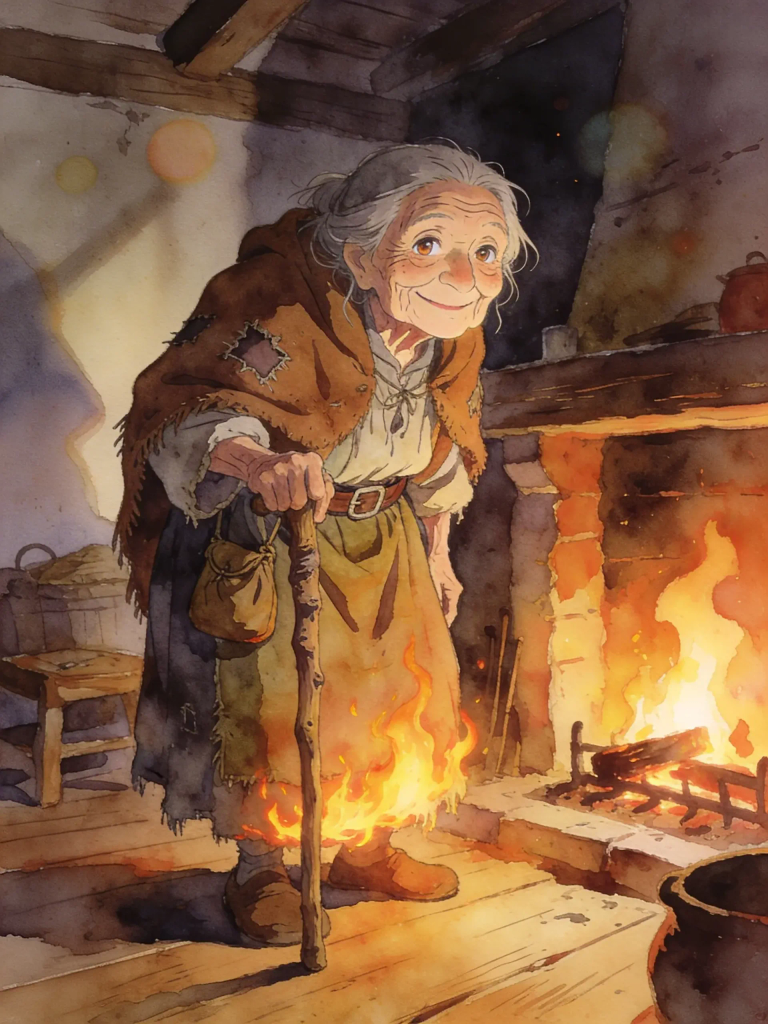
It was a very cold day. The wind blew and blew. Snow fell from the sky. An old woman walked down the road. She had no warm home. Her fingers were cold. Her nose was red. Her ears were cold too. She was cold. So very cold. She pulled her old coat tight. But it did not help.
She came to a small house. The house had a red door. She stood by the door. Inside, a boy sat by a fire. The fire was warm. The fire was bright. It made the room glow. The boy was warm and happy.
The boy saw the old woman. She stood in the cold. She shook from the cold. "Come in!" said the boy. "Sit by the fire." He opened the door. The old woman smiled. She walked inside.
She walked to the fire. She was so cold. So very cold. She held out her hands. She stood close to the fire. Very close. "Thank you," she said. "You are very kind." Her old coat began to get warm. But she stood too close.
Her old coat got very hot. A bit of smoke came up. Her coat turned a little brown. But she did not feel it. She was still so cold inside. The smoke grew a bit more. It curled up into the air.
The boy saw the smoke. He looked at it. He did not move. He did not say a word. He just stood there. He did not think to help. He did not know what to do.
What do you think? Should the boy help her? Yes! He should help her. He should help her right now.
And then the boy saw more smoke. "Oh no!" he said. He jumped up fast. He ran to her side. He patted the smoke out. He helped her step back. "Are you all right?" he asked. The old woman looked at her coat. It was safe now. She was not hurt.
She smiled at the boy. "You are a good boy," she said. The boy felt glad. He felt glad he helped. It is good to help others. When we see someone who needs help, we help them. That is what kind people do.
---
`★ Insight ─────────────────────────────────────` - **Sentence fix**: Split "Sit by the fire." He opened the door wide." (9 words) into two sentences: "Sit by the fire." (5) + "He opened the door." (5) — dropping "wide" keeps it under 8 - **Expansion strategy**: Added ~100 words by deepening existing scenes with sensory details (snow, red door, glowing room, curling smoke, held out hands) rather than adding new plot — this preserves the original structure while hitting the ~400 word target - **Closing line**: Updated to match the adaptation plan's specified closing ("When we see someone who needs help, we help them.") which the original draft had slightly shortened `─────────────────────────────────────────────────`
Original Story
The old beggar-woman
A fairy tale by the Brothers Grimm
There was once an old woman, but thou hast surely seen an old woman go a-begging before now? This woman begged likewise, and when she got anything she said, "May God reward you." The beggar- woman came to a door, and there by the fire a friendly rogue of a boy was standing warming himself. The boy said kindly to the poor old woman as she was standing shivering thus by the door, "Come, old mother, and warm yourself." She came in, but stood too near the fire, so that her old rags began to burn, and she was not aware of it. The boy stood and saw that, but he ought to have put the flames out. Is it not true that he ought to have put them out? And if he had not any water, then should he have wept all the water in his body out of his eyes, and that would have supplied two pretty streams with which to extinguish them.
- * * * *
Story DNA
Moral
Indifference to suffering, even when unintentional, can lead to tragic consequences and is morally reprehensible.
Plot Summary
An old beggar-woman, shivering from the cold, is invited by a boy to warm herself by his fire. Unaware, she stands too close, and her rags begin to burn. The boy observes this but does nothing to help. The narrator then directly questions the boy's moral failure, emphasizing that he should have extinguished the flames, even suggesting he should have cried enough tears to do so.
Themes
Emotional Arc
neutral to tragic
Writing Style
Narrative Elements
Cultural Context
Grimm's tales often reflected the harsh realities and moral expectations of their time, including the plight of the poor and the importance of charity and compassion.
Plot Beats (9)
- An old beggar-woman is introduced, a familiar sight.
- She arrives at a door where a boy is warming himself by a fire.
- The boy, described as a 'friendly rogue,' invites her to warm herself.
- The old woman enters and stands too close to the fire.
- Her rags catch fire, but she remains unaware.
- The boy sees the fire but does not extinguish it.
- The narrator directly questions the boy's inaction.
- The narrator suggests the boy should have put out the flames.
- The narrator hyperbolically states the boy should have cried enough tears to put out the fire if water wasn't available.
Characters
The Old Beggar-Woman ★ protagonist
Frail and shivering, suggesting a gaunt frame due to poverty and exposure.
Attire: Old rags, which are so dry and worn they easily catch fire.
Humble, grateful (says 'May God reward you'), unaware of immediate danger.
Image Prompt & Upload
An elderly woman in her late seventies with deep wrinkles, kind yet weary eyes, and long, unkempt silver hair partially hidden by a tattered dark shawl. She wears layered, patched robes in muted browns and grays, frayed at the hems, with a coarse rope belt. She stands slightly stooped, leaning on a gnarled wooden staff, her expression one of quiet resilience and hidden wisdom. Her posture is humble but dignified. Plain white background, full body visible head to toe, single figure, no watermark, no text, no signature.
The Boy ⚔ antagonist
A 'friendly rogue' of a boy, implying a mischievous but initially welcoming demeanor.
Attire: Indeterminate, but appropriate for a child warming himself by a fire in a household.
Initially kind and inviting, but then cruel and neglectful, showing a lack of empathy.
Image Prompt & Upload
A gaunt adolescent boy with sharp, pale features and hollow cheekbones, his dark, unkempt hair falling over a furrowed brow. He wears a tattered, long black coat over a stained white shirt and dark trousers, his posture leaning forward aggressively with fists clenched. His expression is one of cruel, calculating malice, with piercing, light-colored eyes. He stands in a foggy, twilight forest clearing, surrounded by twisted, bare trees. Plain white background, full body visible head to toe, single figure, no watermark, no text, no signature.
Locations
Doorway of a house
The old beggar-woman stands shivering at the door of a house, looking inside.
Mood: Cold, desperate, hopeful
The beggar-woman arrives and is invited inside by the boy.
Image Prompt & Upload
An ancient wooden door set within a crumbling stone archway, slightly ajar. The weathered planks are dark and cracked, with iron hinges rusted to a deep orange. Surrounding the arch, ivy with deep green leaves climbs the moss-covered stones. The scene is set on a rainy evening, with soft, cool twilight filtering through the overcast sky. Puddles reflect the dim light on the cobblestone path leading to the step. A single, withered autumn leaf rests on the damp threshold. The atmosphere is quiet, melancholic, and still. no border, no frame, no watermark, no text, no signature, edge-to-edge illustration
Inside a house by the fire
A warm interior with a fire burning, where a boy is standing and warming himself. The old woman comes too close to the fire.
Mood: Initially welcoming, then tense and neglectful
The old woman's rags catch fire, and the boy fails to help her.
Image Prompt & Upload
Evening in a cozy cottage interior, lit by a roaring fire in a large stone hearth. Flickering orange and gold light dances across rough-hewn wooden beams and plaster walls, casting long, soft shadows. A worn armchair and a small wooden table sit nearby, a steaming kettle resting on the hearthstones. The warm glow reflects off polished copper pots and illuminates a faded tapestry on the wall. Through a small, frost-kissed window, the deep blue of a winter night is visible, emphasizing the snug warmth within. The air feels still and thick with heat and the faint scent of pine wood. no border, no frame, no watermark, no text, no signature, edge-to-edge illustration.