King Thrushbeard
by Brothers Grimm · from Household Tales
Adapted Version
Once upon a time, there was a princess. She was very pretty. She lived in a big castle. But she was not kind.
One day, a king came to visit. He was a good king. He had a funny chin. The princess looked at him. She laughed. "Ha! His chin looks funny!" she said. The king felt sad. His name was King Thrushbeard. The princess was not kind to him.
Her father, the king, was sad. "You are not kind," he said. "You must go and learn."
A man came to the castle door. He played pretty music. He smiled. "Come with me," he said. The princess left the big castle. She walked with the fiddler.
They walked past tall trees. They walked past green fields. "I wish I had all this," she said.
They came to a small house. It was very tiny! The princess was so surprised.
She tried to cook food. Oh no! The food burned. She tried to clean. Oh no! She spilled the water. She did not know how. The fiddler helped her. They laughed.
Then she went to a big castle. She helped in the kitchen. She washed plates. She helped the cook. She put food in her pockets.
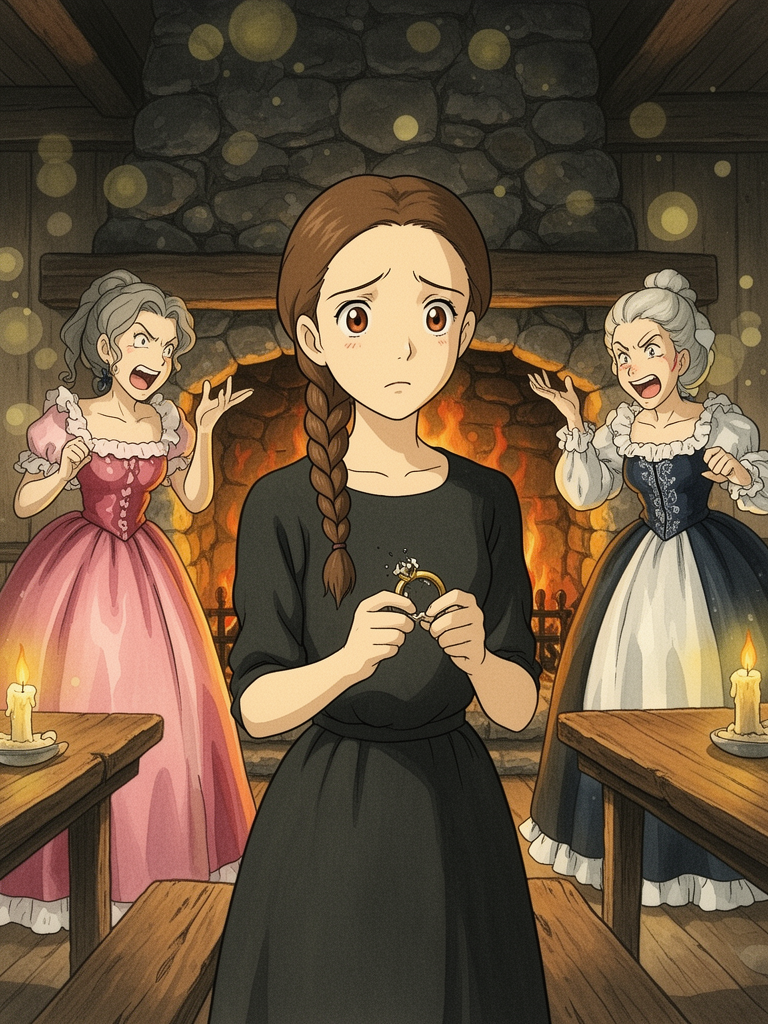
One night, there was a big party. She stood by the door. She watched the people dance. She felt sad. "I was not kind before," she said. "I am sorry."
A man in fine clothes came. He smiled at her. "Come and dance with me!" he said. She was shy. But she said yes.
They danced and danced. Oh no! The food fell from her pockets. Her face turned red. But the man smiled at her.
"Wait," he said. "Look at me! I am King Thrushbeard! I was the fiddler too!"
"I wanted to help you," he said. "I wanted you to be kind."
She looked at him. Tears came. "I am sorry," she said. "I was not kind to you." He smiled. "You are kind now," he said. "That is what matters." They smiled at each other.
She got a pretty new dress. Her father came to the castle. He was so happy. He hugged her. Everyone smiled. The princess was kind now. She had a good friend.
And she was always kind after that day.
Original Story
King Thrushbeard
A fairy tale by the Brothers Grimm
A King had a daughter who was beautiful beyond all measure, but so proud and haughty withal that no suitor was good enough for her. She sent away one after the other, and ridiculed them as well.
Once the King made a great feast and invited thereto, from far and near, all the young men likely to marry. They were all marshalled in a row according to their rank and standing; first came the kings, then the grand-dukes, then the princes, the earls, the barons, and the gentry. Then the King's daughter was led through the ranks, but to every one she had some objection to make; one was too fat, "The wine-cask," she said. Another was too tall, "Long and thin has little in." The third was too short, "Short and thick is never quick." The fourth was too pale, "As pale as death." The fifth too red, "A fighting-cock." The sixth was not straight enough, "A green log dried behind the stove."
So she had something to say against every one, but she made herself especially merry over a good king who stood quite high up in the row, and whose chin had grown a little crooked. "Well," she cried and laughed, "he has a chin like a thrush's beak!" and from that time he got the name of King Thrushbeard.
But the old King, when he saw that his daugher did nothing but mock the people, and despised all the suitors who were gathered there, was very angry, and swore that she should have for her husband the very first beggar that came to his doors.
A few days afterwards a fiddler came and sang beneath the windows, trying to earn a small alms. When the King heard him he said, "Let him come up." So the fiddler came in, in his dirty, ragged clothes, and sang before the King and his daughter, and when he had ended he asked for a trifling gift. The King said, "Your song has pleased me so well that I will give you my daughter there, to wife."
The King's daughter shuddered, but the King said, "I have taken an oath to give you to the very first beggar-man, and I will keep it." All she could say was in vain; the priest was brought, and she had to let herself be wedded to the fiddler on the spot. When that was done the King said, "Now it is not proper for you, a beggar-woman, to stay any longer in my palace, you may just go away with your husband."
The beggar-man led her out by the hand, and she was obliged to walk away on foot with him. When they came to a large forest she asked, "To whom does that beautiful forest belong?" - "It belongs to King Thrushbeard; if you had taken him, it would have been yours." - "Ah, unhappy girl that I am, if I had but taken King Thrushbeard!"
Afterwards they came to a meadow, and she asked again, "To whom does this beautiful green meadow belong?" - "It belongs to King Thrushbeard; if you had taken him, it would have been yours." - "Ah, unhappy girl that I am, if I had but taken King Thrushbeard!"
Then they came to a large town, and she asked again, "To whom does this fine large town belong?" - "It belongs to King Thrushbeard; if you had taken him, it would have been yours." - "Ah, unhappy girl that I am, if I had but taken King Thrushbeard!"
"It does not please me," said the fiddler, "to hear you always wishing for another husband; am I not good enough for you?" At last they came to a very little hut, and she said, "Oh goodness! what a small house; to whom does this miserable, mean hovel belong?" The fiddler answered, "That is my house and yours, where we shall live together."
She had to stoop in order to go in at the low door. "Where are the servants?" said the King's daughter. "What servants?" answered the beggar-man; "you must yourself do what you wish to have done. Just make a fire at once, and set on water to cook my supper, I am quite tired." But the King's daughter knew nothing about lighting fires or cooking, and the beggar-man had to lend a hand himself to get anything fairly done. When they had finished their scanty meal they went to bed; but he forced her to get up quite early in the morning in order to look after the house.
For a few days they lived in this way as well as might be, and came to the end of all their provisions. Then the man said, "Wife, we cannot go on any longer eating and drinking here and earning nothing. You weave baskets." He went out, cut some willows, and brought them home. Then she began to weave, but the tough willows wounded her delicate hands.
"I see that this will not do," said the man; "you had better spin, perhaps you can do that better." She sat down and tried to spin, but the hard thread soon cut her soft fingers so that the blood ran down. "See," said the man, "you are fit for no sort of work; I have made a bad bargain with you. Now I will try to make a business with pots and earthenware; you must sit in the market-place and sell the ware." - "Alas," thought she, "if any of the people from my father's kingdom come to the market and see me sitting there, selling, how they will mock me?" But it was of no use, she had to yield unless she chose to die of hunger.
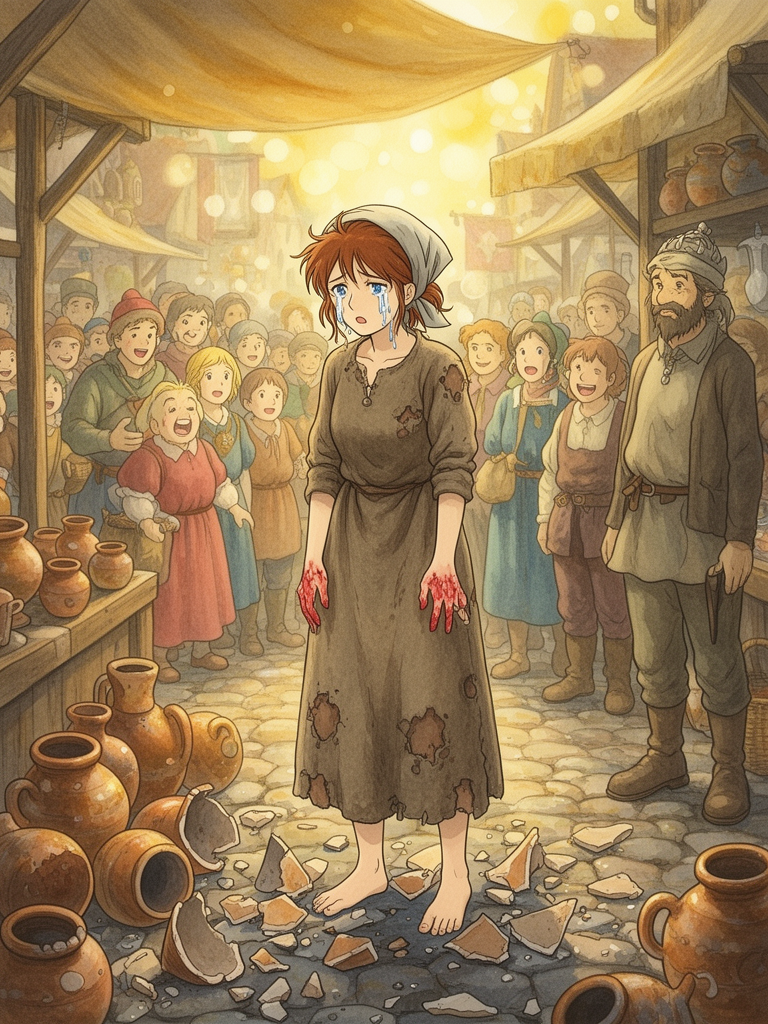
For the first time she succeeded well, for the people were glad to buy the woman's wares because she was good-looking, and they paid her what she asked; many even gave her the money and left the pots with her as well. So they lived on what she had earned as long as it lasted, then the husband bought a lot of new crockery. With this she sat down at the corner of the market-place, and set it out round about her ready for sale. But suddenly there came a drunken hussar galloping along, and he rode right amongst the pots so that they were all broken into a thousand bits. She began to weep, and did now know what to do for fear. "Alas! what will happen to me?" cried she; "what will my husband say to this?"
She ran home and told him of the misfortune. "Who would seat herself at a corner of the market-place with crockery?" said the man; "leave off crying, I see very well that you cannot do any ordinary work, so I have been to our King's palace and have asked whether they cannot find a place for a kitchen-maid, and they have promised me to take you; in that way you will get your food for nothing."
The King's daughter was now a kitchen-maid, and had to be at the cook's beck and call, and do the dirtiest work. In both her pockets she fastened a little jar, in which she took home her share of the leavings, and upon this they lived.
It happened that the wedding of the King's eldest son was to be celebrated, so the poor woman went up and placed herself by the door of the hall to look on. When all the candles were lit, and people, each more beautiful than the other, entered, and all was full of pomp and splendour, she thought of her lot with a sad heart, and cursed the pride and haughtiness which had humbled her and brought her to so great poverty.
The smell of the delicious dishes which were being taken in and out reached her, and now and then the servants threw her a few morsels of them: these she put in her jars to take home.
All at once the King's son entered, clothed in velvet and silk, with gold chains about his neck. And when he saw the beautiful woman standing by the door he seized her by the hand, and would have danced with her; but she refused and shrank with fear, for she saw that it was King Thrushbeard, her suitor whom she had driven away with scorn. Her struggles were of no avail, he drew her into the hall; but the string by which her pockets were hung broke, the pots fell down, the soup ran out, and the scraps were scattered all about. And when the people saw it, there arose general laughter and derision, and she was so ashamed that she would rather have been a thousand fathoms below the ground. She sprang to the door and would have run away, but on the stairs a man caught her and brought her back; and when she looked at him it was King Thrushbeard again. He said to her kindly, "Do not be afraid, I and the fiddler who has been living with you in that wretched hovel are one. For love of you I disguised myself so; and I also was the hussar who rode through your crockery. This was all done to humble your proud spirit, and to punish you for the insolence with which you mocked me."
Then she wept bitterly and said, "I have done great wrong, and am not worthy to be your wife." But he said, "Be comforted, the evil days are past; now we will celebrate our wedding." Then the maids-in-waiting came and put on her the most splendid clothing, and her father and his whole court came and wished her happiness in her marriage with King Thrushbeard, and the joy now began in earnest. I wish you and I had been there too.
- * * * *
Story DNA
Moral
Pride and haughtiness can lead to suffering, and true love often requires humility and understanding.
Plot Summary
A beautiful but arrogant princess cruelly rejects all suitors, particularly King Thrushbeard. Her enraged father marries her to a beggar, who is secretly King Thrushbeard in disguise, and banishes her. She endures poverty, struggles with menial labor, and eventually becomes a kitchen maid. At a royal ball, her hidden food scraps are exposed, humiliating her. King Thrushbeard then reveals his identity, explaining his plan to humble her. She repents, and they marry happily.
Themes
Emotional Arc
pride to humility
Writing Style
Narrative Elements
Cultural Context
Reflects societal norms where a king's oath was binding and daughters had little agency in marriage, and where social standing was paramount. The idea of a disguised royal is a common trope in European folklore.
Plot Beats (15)
- A beautiful but proud princess mocks all her suitors, particularly King Thrushbeard for his chin.
- Her father, angered by her insolence, vows to marry her to the first beggar who arrives.
- A fiddler appears, and the King forces his daughter to marry him and then banishes them from the palace.
- The princess and the fiddler walk through lands belonging to King Thrushbeard, which the princess laments not having.
- They arrive at a tiny, miserable hut, which the fiddler claims as their home.
- The princess struggles with basic household chores and manual labor like weaving and spinning, proving inept.
- The fiddler instructs her to sell pottery in the market, where she is initially successful but then has her wares destroyed by a drunken hussar.
- She becomes a kitchen maid in a royal palace, performing menial tasks and secretly collecting food scraps.
- During a royal wedding feast, she stands by the door, reflecting on her fallen state and the pride that led to it.
- The King's son, splendidly dressed, approaches her and insists on dancing, despite her reluctance.
- During the dance, her hidden jars of food scraps break, spilling their contents and exposing her poverty to the laughing court.
- She tries to flee but is stopped by the King's son, who reveals himself to be King Thrushbeard, and also the fiddler and the hussar.
- King Thrushbeard explains his elaborate plan to humble her pride.
- The princess expresses remorse and unworthiness, but King Thrushbeard comforts her and declares they will now truly marry.
- She is dressed in splendid clothes, and her father and court arrive to celebrate her wedding to King Thrushbeard.
Characters
King Thrushbeard ★ protagonist
Initially described as having a crooked chin resembling a thrush's beak; later handsome and regal
Attire: Initially, fine royal garments; later, ragged fiddler's clothes; finally, luxurious velvet and silk with gold chains
Resourceful, patient, forgiving, determined to teach the princess a lesson
Image Prompt & Upload
A noble man in his late thirties with a short, well-kept brown beard and kind, intelligent eyes. He wears a rich, deep blue velvet tunic with intricate gold embroidery at the collar and cuffs, over dark trousers and polished leather boots. A simple but elegant gold crown rests on his head. He stands with a confident, upright posture, one hand resting on the pommel of a sheathed sword at his hip, his expression thoughtful and slightly amused. Plain white background, full body visible head to toe, single figure, no watermark, no text, no signature.
The King's Daughter ★ protagonist
Beautiful beyond measure
Attire: Initially, rich princess gowns; later, ragged beggar's clothes, then simple kitchen-maid's dress with pockets, finally splendid wedding clothing
Proud, haughty, judgmental, later remorseful and humbled
Image Prompt & Upload
A young woman in her early twenties with flowing auburn hair adorned with a delicate golden tiara set with small rubies. She has bright green eyes, a determined yet kind expression, and fair skin with a light dusting of freckles across her nose. She wears an elegant floor-length gown of deep emerald green velvet with gold embroidered trim along the bodice and sleeves. A sheer golden cape drapes over her shoulders, clasped at the front with a jeweled brooch. She stands tall with confident posture, one hand resting gently on the hilt of a small ornate dagger at her waist, the other holding a rolled parchment. Her hair cascades in loose waves past her shoulders, with a few strands catching the light. She wears delicate gold rings on her fingers and simple pearl drop earrings. Her gown features a fitted waistline with a full flowing skirt that pools slightly at her feet, revealing pointed gold slippers beneath. Her expression is thoughtful and brave, gazing slightly off to the side as if contemplating an important decision. Plain white background, full body visible head to toe, single figure, no watermark, no text, no signature
The King ◆ supporting
Not described
Attire: Royal garments befitting his status
Stern, angered by his daughter's behavior, bound by his word
Image Prompt & Upload
An elderly king with a neatly trimmed white beard and kind, wrinkled eyes stands with a gentle, supportive posture. He wears a simple golden circlet atop his thinning white hair, and a deep blue velvet robe with subtle silver embroidery over a white tunic. His hands are clasped calmly before him, and he offers a faint, reassuring smile. Plain white background, full body visible head to toe, single figure, no watermark, no text, no signature.
Locations
Royal Palace Hall
A grand hall where suitors are presented, filled with kings, grand-dukes, princes, earls, barons, and gentry, all marshalled in a row according to their rank and standing.
Mood: Formal, opulent, judgmental
The King's daughter mocks the suitors, earning King Thrushbeard his name and leading to her father's curse.
Image Prompt & Upload
Late afternoon sun streams through tall arched windows of a grand palace hall, casting long shadows across polished marble floors. The vaulted ceiling features intricate gold-leafed moldings and enormous crystal chandeliers that catch the light. Ornate columns line the vast space, their surfaces veined with gold. Rows of gilded chairs and velvet-draped podiums frame a central aisle. The air is still and formal, with a palette of ivory, deep crimson, and burnished gold. Potted topiaries in gilded urns add touches of green near the windows. The atmosphere is majestic and silent, awaiting ceremony. no border, no frame, no watermark, no text, no signature, edge-to-edge illustration
Edge of a Large Forest
A beautiful, expansive forest, seen from its edge as the King's daughter is led away by the beggar.
Mood: Desolate, regretful
The King's daughter laments not marrying King Thrushbeard when she learns the forest could have been hers.
Image Prompt & Upload
A vast, ancient forest seen from its edge at dusk, the boundary marked by a narrow dirt path winding into deep shadows. Towering oak and birch trees form a dense, dark canopy, their leaves glowing with faint amber and deep green hues under the fading light. The sky above the clearing is a gradient of dusky purple and soft orange, with wispy clouds catching the last sunlight. Mist curls low among the ferns and moss-covered roots near the forest floor. The path is lined with wildflowers and tall grass, leading toward a mysterious, light-dappled opening between the massive trunks. A sense of quiet departure and deepening twilight pervades the scene. no border, no frame, no watermark, no text, no signature, edge-to-edge illustration
Miserable Little Hovel
A very small, mean hut with a low door, symbolizing poverty and hardship.
Mood: Bleak, cramped, impoverished
The King's daughter experiences the harsh reality of poverty and is forced to perform menial tasks.
Image Prompt & Upload
Dusk, heavy rain falling, a tiny dilapidated hut made of rough-hewn dark wood and crumbling mud daub, its thatched roof sagging and patched with moss. A low, crooked doorway glows with faint, weak candlelight from within. The hut sits in a barren, muddy yard surrounded by dead weeds and gnarled, leafless trees. The landscape is a bleak, foggy moor under a gloomy, purple-grey sky. The overall color palette is desaturated browns, greys, and sickly greens, with the only warmth being the faint yellow light from the window. no border, no frame, no watermark, no text, no signature, edge-to-edge illustration.
Marketplace Corner
A corner of the marketplace where the King's daughter sells pottery, exposed to the public and the risk of ridicule.
Mood: Humiliating, vulnerable
The King's daughter's wares are destroyed by a drunken hussar, leading to further shame and hardship.
Image Prompt & Upload
Late afternoon in a medieval marketplace corner, overcast sky with soft, diffused light. Cobblestone ground, a weathered wooden stall with a faded striped awning. A rustic table displays handcrafted pottery: glazed jugs, bowls, and plates in earthy tones of ochre, moss green, and deep blue. Scattered clay shards and a bucket of slip near the table leg. A stone well with a iron crank stands nearby. Distant view of timber-framed buildings and a castle spire. Atmosphere of quiet exposure, muted colors, detailed textures on wood and clay. no border, no frame, no watermark, no text, no signature, edge-to-edge illustration.
Royal Kitchen
A busy kitchen in the King's palace, filled with cooks and servants, where the King's daughter works as a kitchen-maid.
Mood: Servile, degrading
The King's daughter endures the humiliation of being a kitchen-maid, doing the dirtiest work and collecting scraps for food.
Image Prompt & Upload
A grand palace kitchen with high vaulted stone ceilings and arched windows letting in soft morning light. Copper pots hang from iron racks above a massive central hearth where embers glow. Long wooden tables are scattered with flour, half-kneaded dough, and baskets of vegetables. Stone floors are worn smooth, with scattered herbs and a faint steam haze from bubbling cauldrons. Shelves line the walls holding jars of spices, dried meats, and gleaming utensils. A large brick oven dominates one wall, its door slightly ajar revealing golden bread. The air feels warm and aromatic, with shafts of sunlight cutting through the steam, illuminating dust motes and the rich textures of the busy, lived-in space. no border, no frame, no watermark, no text, no signature, edge-to-edge illustration.