THE TWO TRAVELERS
by Brothers Grimm
Adapted Version
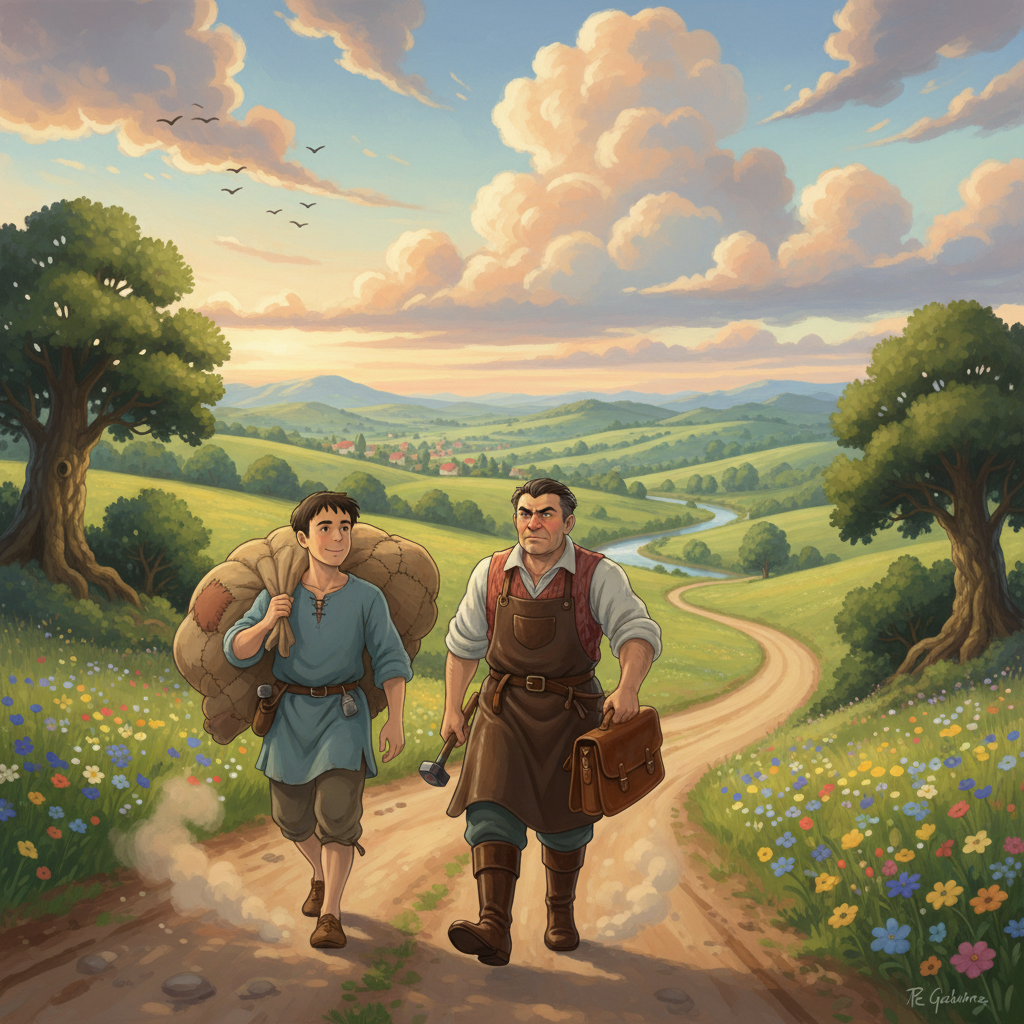
Tom the Tailor loved to make things. He could sew a coat. He could sew a hat. He could sew a dress too. And he always had a big smile.
One day, Tom met Grumpy Gus. Gus made shoes. But Gus never smiled. Not once. Tom said, "Hello! Let us walk together." Gus said, "Hmph. Fine." Tom had bread. He gave some to Gus. "Here! Have some bread," Tom said. Gus ate the bread. He did not say thank you. Tom smiled anyway. Tom was kind. Tom was always kind.
They came to a big forest. The trees were very tall. The trees were very dark. Gus had a big bag of food. Tom had a small bag. "I have lots of food," said Gus. Tom said, "My bag is small." Tom looked at the trees. "It will be okay!" They walked into the forest.
They walked and walked. Tom ate his bread. Then his bread was gone. His bag was empty. His tummy was empty. Tom was so hungry. "Gus, can I have bread?" Tom asked. Gus looked at Tom. "No!" said Gus. "My bread is mine." Tom was very sad. He was so sad.
Tom was so hungry. He sat down. "Please," Tom said. "Just a small piece." Gus said, "Fine. You can have bread." Gus held up the bread. "I take your lantern." Tom looked at his lantern. He did not want to give it. But he was so hungry. Tom gave Gus the lantern. Now Tom had no light. He ate the small bread. But the dark forest was scary. So very scary.
Then Gus ran away. He left Tom all alone. Tom sat by an old tree. The forest was dark. Tom was sad and scared. "What do I do now?" Tom said. He looked around. He could not see. He felt very small. He felt very lost.
Then Tom heard a sound. A little bird sat in the tree. The bird sang a pretty song. The song was soft and sweet. "Go to the stream," the bird sang. "Wash your face in the water." The bird sang more. "The water is magic." The bird looked at Tom. "You will find the way!" Tom got up. He walked to the stream. He washed his face. The water was cool. The water was nice. Tom opened his eyes. He could see! He could see the path! "Thank you, little bird!" Tom said. The bird sang a happy song. Then the bird flew away.
Tom walked on the path. He walked and walked. Then he met a big horse. The horse was stuck. His foot was in the mud. "Oh no!" said Tom. "I can help!" Tom pulled and pulled. He pulled so hard. The horse was free! "Thank you!" said Horse. Horse was so happy. "I will help you too!"
Tom walked some more. He met a little bird. The bird was so hungry. Tom had one small berry. Tom looked at the berry. He looked at the bird. "Here," said Tom. "Eat this." The bird ate the berry. The bird was so happy. "Thank you!" said Bird. "I will help you too!"
Then Tom met a little cat. The cat was lost. "I cannot find my way," Cat said. Cat was very sad. "Come with me!" said Tom. Tom walked with Cat. He showed Cat the path. "Thank you!" said Cat. Cat was so happy. "I will help you too!"
Tom came to a big castle. A King lived there. The King needed a tailor. "I can sew!" said Tom. "I can make you a coat!" The King was happy. But Grumpy Gus was there too. He made shoes for the King. Gus saw Tom. He was not happy. "Hmph!" said Gus. He told the King bad things. "Make Tom do hard things!"
The King said, "Tom, find my lost ring!" Tom was sad. "How can I find a ring?" He looked left. He looked right. But then Bird flew down. "I can find it!" said Bird. Bird flew high. Bird flew low. Bird looked and looked. Bird found the ring! "Here is the ring!" said Bird. The King was so happy. He clapped his hands.
Then the King said, "Tom, build a tiny castle!" Tom was sad. "How can I build a castle?" But then Cat came. "I can help build!" said Cat. Cat found small stones. Cat found small sticks. Tom and Cat worked together. They built a tiny castle. It was so pretty! The King was so happy. He clapped his hands again.
Then the King said, "Tom, make water from the ground!" Tom was sad. "How can I do that?" But then Horse came. Horse stamped his big foot. BOOM! Water came up from the ground! The water was clean and bright. It went up high! The King was so happy. He clapped and clapped.
The King said, "Tom, you are kind. You are brave. You helped everyone. You can stay here forever!" Tom was so happy. The King was his friend now. Tom lived in the castle. He sewed coats for the King. Bird came to visit. Cat came to visit. Horse came to visit. Tom had good friends. The best friends.
Grumpy Gus had to leave the castle. He walked alone in the forest. He was sad. No one walked with him. "I was not kind," Gus said. "I did not share." He sat by a tree. "I took Tom's lantern. That was wrong." Gus was all alone.
But Tom was in the castle. His friends were all around him. He was warm and happy. "I was kind," Tom said. "And kind is good."
And Tom still had his big smile.
Original Story
THE TWO TRAVELERS
Hill and vale do not come together, but the children of men do, good and bad. In this way a shoemaker and a tailor once met with each other in their travels.
The tailor was a handsome little fellow who was always merry and full of enjoyment. He saw the shoemaker coming toward him from the other side, and as he observed by his bag what kind of a trade he plied, he sang a little mocking song to him:
The shoemaker, however, could not endure a joke. He pulled a face as if he had drunk vinegar, and made a gesture as if he were about to seize the tailor by the throat.
But the little fellow began to laugh, reached him his bottle, and said, “No harm was meant, take a drink, and swallow your anger down.”
The shoemaker took a very hearty drink, and the storm on his face began to clear away.
214 He gave the bottle back to the tailor, and said, “I spoke civilly to you. One speaks well after much drinking, but not after much thirst. Shall we travel together?”
“All right,” answered the tailor, “if only it suits you to go into a big town where there is no lack of work.”
“That is just where I want to go,” answered the shoemaker. “In a small nest there is nothing to earn; and in the country, people like to go barefoot.”
They traveled therefore onward together, and always set one foot before the other like a weazel in the snow.
Both of them had time enough, but little to bite and to break. When they reached a town, they went about and paid their respects to the tradesmen.
Because the tailor looked so lively and merry, and had such pretty red cheeks, every one gave him work willingly. And when luck was good, the master’s daughters gave him a kiss beneath the porch, as well. When he again fell in with the shoemaker, the tailor had always the most in his bundle.
The ill-tempered shoemaker made a wry face, and thought, “The greater the rascal the more the luck.”
But the tailor began to laugh and to sing, and shared all he got with his comrade. If a couple of pence jingled in his pockets, he ordered good cheer, and thumped the table in his joy till the glasses danced, and it was lightly come, lightly go, with him.
When they had traveled for some time, they came to a great forest through which passed the road to the capital. Two foot-paths, however, led through it, one of them a seven days’ journey, 215 and the other only two. But neither of the travelers knew which way was the short one.
They seated themselves beneath an oak-tree, and took counsel together as to what they should do and for how many days they should provide themselves with bread.
The shoemaker said, “One must look before one leaps. I will take with me bread for a week.”
“What!” said the tailor, “drag bread for seven days on one’s back like a beast of burden, and not be able to look about. I shall trust in God, and not trouble myself about anything! The money I have in my pocket is as good in summer as in winter; but in hot weather bread gets dry and mouldy into the bargain. Even my coat does not go as far as it might. Besides, why should we not find the right way? Bread for two days, and that’s enough.”
Each, therefore, bought his own bread. And then they tried their luck in the forest.
It was as quiet there as in a church. No wind stirred, no brook murmured, no bird sang, and through the thickly-leaved branches, no sunbeam forced its way.
The shoemaker spoke never a word, the heavy bread weighed down his back until the perspiration streamed down his cross and gloomy face.
The tailor, however, was quite merry; he jumped about, whistled on a leaf, or sang a song, and thought to himself, “God in Heaven must be pleased to see me so happy.”
This lasted two days, but on the third the forest would not come to an end, and the tailor had eaten up all his bread, so 216 after all his heart sank down a yard deeper. In the meantime, he did not lose courage, but relied on God and on his luck.
On the third day, he lay down in the evening hungry under a tree, and rose again next morning hungry still.
So also passed the fourth day, and when the shoemaker seated himself on a fallen tree and devoured his dinner, the tailor was only a looker-on.
If he begged for a little piece of bread the other laughed mockingly, and said, “You have always been so merry, now you can try for once what it is to be sad. The birds which sing too early in the morning, are struck by the hawk in the evening,” in short he was pitiless.
But on the fifth morning, the poor tailor could no longer stand up, and was hardly able to utter one word for weakness. His cheeks were white, and his eyes red.
Then the shoemaker said to him, “I will give you a bit of bread to-day, but in return for it, I will put out your right eye.”
The unhappy tailor, who still wished to save his life, could not do it in any other way. He wept once more with both eyes, and then held them out. The shoemaker, who had a heart of stone, put out his right eye with a sharp knife.
The tailor called to remembrance what his mother had formerly said to him when he had been eating secretly in the pantry, “Eat what one can, and suffer what one must.”
When he had consumed his dearly-bought bread, he got on his legs again, forgot his misery and comforted himself with the thought that he could always see enough with one eye.
217 But on the sixth day, hunger made itself felt again, and gnawed him almost to the heart. In the evening he fell down by a tree, and on the seventh morning he could not raise himself up for faintness, and death was close at hand.
Then said the shoemaker, “I will show mercy and give you bread once more, but you shall not have it for nothing. I shall put out your other eye for it.”
And now the tailor felt how thoughtless his life had been, prayed to God for forgiveness, and said, “Do what you will, I will bear what I must, but remember that our Lord God does not always look on passively, and that an hour will come when the evil deed, which you have done to me and which I have not deserved of you, will be requited. When times were good with me, I shared what I had with you. My trade is of that kind that each stitch must always be exactly like the other. If I no longer have my eyes and can sew no more, I must go a-begging. At any rate, do not leave me here alone when I am blind, or I shall die of hunger.”
The shoemaker, however, who had driven God out of his heart, took the knife and put out his left eye. Then he gave him a bit of bread to eat, held out a stick to him, and drew him on behind him.
When the sun went down, they got out of the forest, and before them in the open country stood the gallows. Thither the shoemaker guided the blind tailor, and then left him alone and went his way.
Weariness, pain, and hunger made the wretched man fall asleep, and he slept the whole night. When day dawned he awoke, but knew not where he lay.
218 Two poor sinners were hanging on the gallows, and a crow sat on the head of each of them. Then one of the men who had been hanged began to speak, and said, “Brother, are you awake?”
“Yes, I am awake,” answered the second.
“Then I will tell you something,” said the first; “the dew which this night has fallen down over us from the gallows, gives every one who washes himself with it, his eyes again. If blind people did but know this, how many would regain their sight who do not believe that to be possible!”
When the tailor heard that, he took his pocket-handkerchief, pressed it on the grass, and when it was moist with dew, washed the sockets of his eyes with it. Immediately was fulfilled what the man on the gallows had said, and a couple of healthy new eyes filled the sockets.
It was not long before the tailor saw the sun rise behind the mountains. In the plain before him, lay the great royal city with its magnificent gates and hundred towers. The golden balls and crosses which were on the spires began to shine. He could distinguish every leaf on the trees, saw the birds which flew past, and the midges which danced in the air. He took a needle out of his pocket, and as he could thread it as well as ever he had done, his heart danced with delight.
He threw himself on his knees, thanked God for the mercy he had shown him, and said his morning prayer.
Then he took his bundle on his back, and soon forgot the pain of heart he had endured, and went on his way singing and whistling.
The first thing he met was a brown foal running about the 219 fields at large. He caught it by the mane, and wanted to spring on it and ride into the town.
The foal, however, begged to be set free. “I am still too young,” it said, “even a light tailor such as you are would break my back in two—let me go till I have grown strong. A time may come when I can reward you for it.”
“Run off,” said the tailor, “I see you are still a giddy thing.”
He gave it a touch with a switch over its back, whereupon it kicked up its hind legs for joy, leapt over hedges and ditches, and galloped away into the open country.
But the little tailor had eaten nothing since the day before. “The sun to be sure fills my eyes,” said he, “but the bread does not fill my mouth. The first thing that comes across me and is even half eatable, will have to suffer for it.”
In the meantime a stork stepped solemnly over the meadow toward him.
“Halt, halt!” cried the tailor, and seized him by the leg. “I don’t know if you are good to eat or not, but my hunger leaves me no great choice. I must cut your head off, and roast you.”
“Don’t do that,” replied the stork; “I am a sacred bird which brings mankind great profit, and no one ever does me an injury. Leave me my life, and I may do you good in some other way.”
“Well, be off, Cousin Longlegs,” said the tailor.
The stork rose up, let its long legs hang down, and flew gently away.
“What’s to be the end of this?” said the tailor to himself at last; “my hunger grows greater and greater, and my stomach 220 more and more empty. Whatsoever comes in my way now is lost.”
At this moment, he saw a couple of young ducks which were on a pond, come swimming toward him.
“You come just at the right moment,” said he, and laid hold of one of them and was about to wring its neck.
On this an old duck, which was hidden among the reeds, began to scream loudly and swam to him with open beak, and begged him urgently to spare her dear children.
“Can you not imagine,” said she, “how your mother would mourn if any one wanted to carry you off, and give you your death blow?”
“Only be quiet,” said the good-tempered tailor; “you shall keep your children,” and he put the prisoner back into the water.
When he turned round, he was standing in front of an old tree which was partly hollow, and saw some wild bees flying in and out of it.
“There I shall at once find the reward of my good deed,” said the tailor; “the honey will refresh me.”
But the Queen-Bee came out, threatened him and said, “If you touch my people, and destroy my nest, our stings shall pierce your skin like ten thousand red-hot needles. But if you will leave us in peace and go your way, we will do you a service for it another time.”
The little tailor saw that here also nothing was to be done. “Three dishes empty and nothing on the fourth is a bad dinner!” He dragged himself therefore with his starved-out stomach 221 into the town. It was just striking twelve, all was ready-cooked for him in the inn, and he was able to sit down at once to dinner.
When he was satisfied, he said, “Now I will get to work.”
He went round the town, sought a master, and soon found a good situation. As he had thoroughly learned his trade, it was not long before he became famous, and every one wanted to have a new coat made by the little tailor, whose importance increased daily.
“I can go no further in skill,” said he, “and yet things improve every day.”
At last the King appointed him court-tailor.
But how things do happen in the world! On the very same day his former comrade, the shoemaker, also became court-shoemaker. When the latter caught sight of the tailor, and saw that he had once more two healthy eyes, his conscience troubled him.
“Before he takes revenge on me,” thought he to himself, “I must dig a pit for him.”
He, however, who digs a pit for another, falls into it himself.
In the evening when work was over and it had grown dusk, he stole to the King and said, “Lord King, the tailor is an arrogant fellow and has boasted that he will get the gold crown back again, which was lost in ancient times.”
“That would please me very much,” said the King.
He caused the tailor to be brought before him next morning, and ordered him to get the crown back again, or to leave the town for ever.
“Oho!” thought the tailor, “a rogue gives more than he has 222 got. If the surly King wants me to do what can be done by no one, I will not wait till morning, but will go out of the town at once, to-day.”
He packed up his bundle, but when he was without the gate, he could not help being sorry to give up his good fortune and turn his back on the town in which all had gone so well with him. He came to the pond where he had made the acquaintance of the ducks.
At that very moment the old one whose young ones he had spared was sitting there by the shore, pluming herself with her beak. She knew him again and asked why he was hanging his head.
“You will not be surprised when you hear what has befallen me,” replied the tailor, and told her his fate.
“If that be all,” said the duck, “we can help you. The crown fell into the water, and lies at the bottom. We will soon bring it up again for you. In the meantime just spread out your handkerchief on the bank.”
She dived down with her twelve young ones. And in five minutes she was up again with the crown resting on her wings. The twelve young ones were swimming round about and had put their beaks under it, and were helping to carry it. They all swam to the shore and put the crown on the handkerchief.
No one can imagine how magnificent the crown was. When the sun shone on it, it gleamed like a hundred thousand carbuncles. The tailor tied his handkerchief together by the four corners, and carried it to the King, who was full of joy, and put a gold chain round the tailor’s neck.
When the shoemaker saw that one stroke had failed, he contrived 223 a second, and went to the King and said, “Lord King, the tailor has become insolent again. He boasts that he will copy in wax the whole of the royal palace, with everything that pertains to it, loose or fast, inside and out.”
The King sent for the tailor and ordered him to copy in wax the whole of the royal palace, with everything that pertained to it, movable or immovable, within and without. And if he did not succeed in doing this, or if so much as one nail on the wall were wanting, he should be imprisoned for his whole life underground.
The tailor thought, “It gets worse and worse! No one can endure that!” and threw his bundle on his back, and went forth.
When he came to the hollow tree, he sat down and hung his head. The bees came flying out, and the Queen-Bee asked him if he had a stiff neck, since he held his head so awry.
“Alas, no,” answered the tailor, “something quite different weighs me down,” and he told her what the King had demanded of him.
The bees began to buzz and hum amongst themselves, and the Queen-Bee said, “Just go home again. But come back to-morrow at this time, and bring a large sheet with you, and then all will be well.”
So he turned back again, but the bees flew to the royal palace and straight into it through the open windows, crept round about into every corner, and inspected everything most carefully.
Then they hurried back and modeled the palace in wax with such rapidity that any one looking on would have thought it was growing before his eyes. By the evening all was ready.
224 And when the tailor came next morning, the whole of the splendid building was there, and not one nail in the wall or tile of the roof was wanting, and it was delicate withal and white as snow, and smelt sweet as honey.
The tailor wrapped it carefully in his cloth and took it to the King, who could not admire it enough, placed it in his largest hall, and in return for it presented the tailor with a large stone house.
The shoemaker, however, did not give up, but went for the third time to the King and said, “Lord King, it has come to the tailor’s ears that no water will spring up in the courtyard of the castle. He has boasted that it shall rise up in the midst of the courtyard to a man’s height and be clear as crystal.”
Then the King ordered the tailor to be brought before him and said, “If a stream of water does not rise in my courtyard by to-morrow as you have promised, the executioner shall in that very place make you shorter by the head.”
The poor tailor did not take long to think about it, but hurried out to the gate, and because this time it was a matter of life and death to him, tears rolled down his face.
Whilst he was thus going forth full of sorrow, the foal to which he had formerly given its liberty, and which had now become a beautiful chestnut horse, came leaping toward him.
“The time has come,” it said to the tailor, “when I can repay you for your good deed. I know already what is needful to you, but you shall soon have help. Get on me, my back can carry two such as you.”
The tailor’s courage came back to him. He jumped up in one bound; and the horse went full speed into the town, and 225 right up to the courtyard of the castle. It galloped as quick as lightning thrice round it, and at the third time it fell violently down. At the same instant there was a terrific clap of thunder, a fragment of earth in the middle of the courtyard sprang like a cannon ball into the air, and over the castle. Directly after it, a jet of water rose as high as a man on horseback, and the water was as pure as crystal, and the sunbeams began to dance on it.
When the King saw that he arose in amazement, and went and embraced the tailor in the sight of all men.
But good fortune did not last long. The King had daughters in plenty, each one prettier than the other, but he had no son.
So the malicious shoemaker betook himself for the fourth time to the King, and said, “Lord King, the tailor has not given up his arrogance. He has now boasted that if he liked, he could cause a son to be brought to the Lord King through the air.”
The King commanded the tailor to be summoned, and said, “If you cause a son to be brought to me within nine days, you shall have my eldest daughter to wife.”
“The reward is indeed great,” thought the little tailor. “One would willingly do something for it, but the cherries grow too high for me. If I climb for them, the bough will break beneath me, and I shall fall.”
He went home, seated himself cross-legged on his work-table, and thought over what was to be done.
“It can’t be managed,” cried he at last. “I will go away. After all I can’t live in peace here.”
226 He tied up his bundle and hurried away to the gate. When he got to the meadow, he perceived his old friend the stork, who was walking backward and forward like a philosopher. Sometimes he stood still, took a frog into close consideration, and at length swallowed it down.
The stork came to him and greeted him. “I see,” he began, “that you have your pack on your back. Why are you leaving the town?”
The tailor told him what the King had required of him, and how he could not perform it, and lamented his misfortune.
“Don’t let your hair grow gray about that,” said the stork. “I will help you out of your difficulty. For a long time past, I have carried the children in swaddling-clothes into the town. So for once, I can fetch a little Prince out of the well. Go home and be easy. In nine days from this time repair to the royal palace, and there will I come.”
The little tailor went home, and at the appointed time was at the castle. It was not long before the stork came flying thither and tapped at the window. The tailor opened it, and Cousin Longlegs came carefully in, and walked with solemn steps over the smooth marble pavement.
He had a baby in his beak that was as lovely as an angel, and stretched out its little hands to the Queen. The stork laid it in her lap, and she caressed it and kissed it, and was beside herself with delight.
Before the stork flew away he took his traveling bag off his back and handed it over to the Queen. In it there were little paper parcels full of colored sweetmeats, and they were divided amongst the little Princesses.
227 The eldest, however, had none of them, but got the merry tailor for a husband.
“It seems to me,” said he, “just as if I had won the highest prize. My mother was right after all; she always said that whoever trusts in God and his own fortune can never fail.”
The shoemaker had to make the shoes in which the little tailor danced at the wedding festival. After which he was commanded to quit the town for ever.
The road to the forest led him to the gallows. Worn out with anger, rage, and the heat of the day, he threw himself down. When he had closed his eyes and was about to sleep, the two crows flew down from the heads of the men who were hanging there, and pecked his eyes out.
In his madness he ran into the forest and must have died there of hunger, for no one has ever either seen him again or heard of him.
Story DNA
Moral
Kindness, faith, and a good heart will ultimately be rewarded, while malice and cruelty will lead to ruin.
Plot Summary
A cheerful tailor and a malicious shoemaker travel together. When they get lost in a forest, the shoemaker cruelly blinds the tailor in exchange for bread, then abandons him at the gallows. The tailor miraculously regains his sight and, through acts of kindness, befriends several animals. Upon reaching a royal city, the shoemaker, now a royal shoemaker, repeatedly tries to ruin the tailor by instigating impossible tasks from the King. With the help of his animal allies, the tailor succeeds in every task, ultimately marrying the princess. The shoemaker is banished and meets a gruesome end, blinded by crows at the same gallows where he left the tailor.
Themes
Emotional Arc
suffering to triumph
Writing Style
Narrative Elements
Cultural Context
Fairy tales often reflected the social hierarchies and common occupations of pre-industrial Europe, with tradesmen like tailors and shoemakers being common figures. The gallows served as a stark symbol of justice and punishment.
Plot Beats (15)
- A cheerful tailor and a surly shoemaker meet and decide to travel together, with the tailor often sharing his earnings.
- They enter a forest with two paths; the shoemaker provisions for seven days, the tailor for two, trusting in luck.
- The tailor runs out of food and is forced to beg the shoemaker, who mockingly refuses.
- The shoemaker demands one of the tailor's eyes for a piece of bread, which the tailor reluctantly accepts.
- The tailor again runs out of food, and the shoemaker demands his second eye, blinding him completely.
- The shoemaker abandons the blind tailor at the gallows and leaves him for dead.
- The tailor overhears two hanged men speaking of magical dew that can restore sight; he uses it and regains his vision.
- The tailor encounters a wild boar, a goat, a raven, and a foal, all of whom he helps, earning their gratitude.
- The tailor arrives in a royal city and is hired by the King, but the shoemaker, now a royal shoemaker, recognizes him and plots his downfall.
- The shoemaker challenges the tailor to find the King's lost ring from the sea; the raven retrieves it with the help of the boar and goat.
- The shoemaker challenges the tailor to build a wax model of the palace; the bees, grateful for the tailor's past kindness, build it for him.
- The shoemaker challenges the tailor to make a fountain spring in the courtyard; the foal, now a horse, creates it by striking the ground.
- The shoemaker challenges the tailor to bring the King a son; the stork, a long-time friend, delivers a baby prince.
- The tailor marries the King's eldest daughter, fulfilling his mother's prophecy of trusting in God and fortune.
- The shoemaker is banished, returns to the gallows, and is blinded by crows, dying alone in the forest as retribution for his cruelty.
Characters
The Tailor ★ protagonist
Handsome, lively, merry
Attire: Simple but well-kept traveling clothes, likely including a coat and breeches typical of a journeyman tailor
Merry, optimistic, resourceful
Image Prompt & Upload
A young man in his late twenties with a focused, slightly smiling expression, intently working at a wooden workbench. He has short, tidy brown hair and wears a practical leather apron over a cream-colored linen shirt with rolled-up sleeves. His posture is slightly hunched as he carefully holds a needle and thread, stitching a piece of rich, emerald green fabric. The background is a cozy, cluttered tailor's workshop with bolts of colorful cloth, spools of thread, and measuring tapes on shelves. Plain white background, full body visible head to toe, single figure, no watermark, no text, no signature.
The Shoemaker ⚔ antagonist
Ill-tempered, cross, gloomy
Attire: Practical, sturdy traveling clothes suitable for a shoemaker, perhaps leather apron or tools visible
Grumpy, envious, cruel
Image Prompt & Upload
A sinister cobbler in his late 50s with a gaunt face, sharp cheekbones, and cold, calculating eyes. He has a cruel, thin smile and slicked-back grey hair. He wears a soiled, dark leather apron over a faded black shirt and trousers. His long, bony fingers expertly hold a wicked-looking awl. He is hunched over a worn wooden workbench, meticulously stitching a single, oversized, menacing-looking boot in a dimly lit, cluttered workshop filled with strange tools and ominous shadows. Plain white background, full body visible head to toe, single figure, no watermark, no text, no signature.
The King ◆ supporting
Not specifically described, but implied to be regal and commanding
Attire: Royal attire, including a crown, robes, and possibly jewelry
Demanding, easily swayed, ultimately fair
Image Prompt & Upload
An elderly male monarch with a neatly trimmed white beard and kind, wise eyes, wearing an ornate golden crown encrusted with rubies and sapphires. He is dressed in a rich, deep crimson velvet robe with ermine fur trim and gold embroidery, over a white silk tunic. He stands tall with a gentle, supportive posture, one hand resting on a jeweled scepter and the other open in a welcoming gesture. Plain white background, full body visible head to toe, single figure, no watermark, no text, no signature.
The Chestnut Horse ◆ supporting
Beautiful, strong, chestnut-colored
Loyal, grateful, helpful
Image Prompt & Upload
A majestic chestnut horse with a glossy, reddish-brown coat and a long, flowing dark mane and tail. It stands calmly in a noble, relaxed pose, with one front hoof slightly forward. Its eyes are kind and intelligent. It wears a simple, well-worn brown leather saddle and bridle with subtle, intricate tooling. The horse has a strong, sturdy build, suggesting reliability and gentle strength. Plain white background, full body visible head to toe, single figure, no watermark, no text, no signature.
The Stork ◆ supporting
Long-legged, with a long beak
Helpful, philosophical, reliable
Image Prompt & Upload
A tall, slender humanoid figure with the elegant features of a stork. Long, thin legs and neck, a sharp, elongated beak, and sleek white plumage with black accents on the wings. Wearing a simple, earth-toned tunic or robe. It stands in a helpful, supportive pose, perhaps gently holding a small basket or bundle. Expression is calm and observant. Plain white background, full body visible head to toe, single figure, no watermark, no text, no signature.
Locations
Great Forest
A dense, quiet forest with thickly-leaved branches that block sunlight. Two foot-paths lead through it, one a seven days’ journey and the other only two.
Mood: eerie, desolate
The tailor loses his eyes to the shoemaker in exchange for bread.
Image Prompt & Upload
Dense ancient forest at twilight, a dim ethereal glow filtering through a thick canopy of emerald and jade leaves. Two distinct earthen paths diverge from the foreground: the left path is narrow, overgrown with roots and ferns, disappearing into deep shadow, while the right path is wider, smoother, and sun-dappled, winding toward a faintly lit clearing. Towering gnarled oaks and pines with moss-covered bark create a cathedral-like atmosphere. Bioluminescent fungi glow softly on fallen logs, and fireflies drift in the humid air. Mist clings to the forest floor. no border, no frame, no watermark, no text, no signature, edge-to-edge illustration.
Royal Castle Courtyard
The courtyard of the castle, where the tailor is tasked with creating a spring of water.
Mood: anticipation, relief
The tailor, with the help of the horse, creates a spring of water.
Image Prompt & Upload
At dawn, a serene royal castle courtyard bathed in soft golden light. A newly sprung magical fountain gushes clear water from its central stone basin, surrounded by smooth pebbles. Ancient stone walls draped with flowering ivy and climbing roses frame the space. Moss-covered flagstones lead to arched doorways with intricate wooden doors. Dew-kissed spring flowers—bluebells and primrose—carpet the edges. Sunbeams filter through a lone blossoming cherry tree, its petals drifting onto the water’s surface. The air is misty and cool, with a sense of quiet enchantment. no border, no frame, no watermark, no text, no signature, edge-to-edge illustration.
Royal Palace
The palace where the king lives with his daughters.
Mood: grand, celebratory
The stork delivers a baby prince to the Queen, and the tailor is rewarded with the eldest daughter's hand in marriage.
Image Prompt & Upload
A grand royal palace at sunset, its towering spires and turrets glowing with golden light against a deepening pink and purple sky. The architecture is a blend of elegant gothic arches and fairy-tale whimsy, with intricate stained glass windows reflecting the fading sun. Lush, manicured gardens with blooming rose bushes and sculpted hedges surround the palace, leading to a wide, serene reflecting pool that mirrors the magnificent structure. The air is clear and calm, with a few first stars beginning to twinkle above. The scene feels majestic, peaceful, and slightly enchanted. no border, no frame, no watermark, no text, no signature, edge-to-edge illustration
Gallows Road to the Forest
The road leading from the town to the forest, marked by a gallows.
Mood: desolate, ominous
The shoemaker is blinded by crows after being banished from the town.
Image Prompt & Upload
Twilight settles over the ancient, cobbled Gallows Road, a pale lavender sky fading into deep indigo above. A single, rusted iron lantern glows weakly on a leaning wooden post, casting long, distorted shadows. The road, worn and mossy, stretches from the distant, hazy silhouettes of town rooftops towards the looming, impenetrable wall of the forest. At the road's edge, a weathered, splintered gallows stands starkly against the dimming light, its silhouette a dark, angular scar on the landscape. The air is still and cool, carrying the scent of damp earth and decaying leaves. The forest ahead is a mass of deep emerald and black, its ancient trees forming a dense, whispering canopy that swallows the path whole. no border, no frame, no watermark, no text, no signature, edge-to-edge illustration.