Pen and Inkstand
by Hans Christian Andersen · from Collected Fairy Tales
Adapted Version
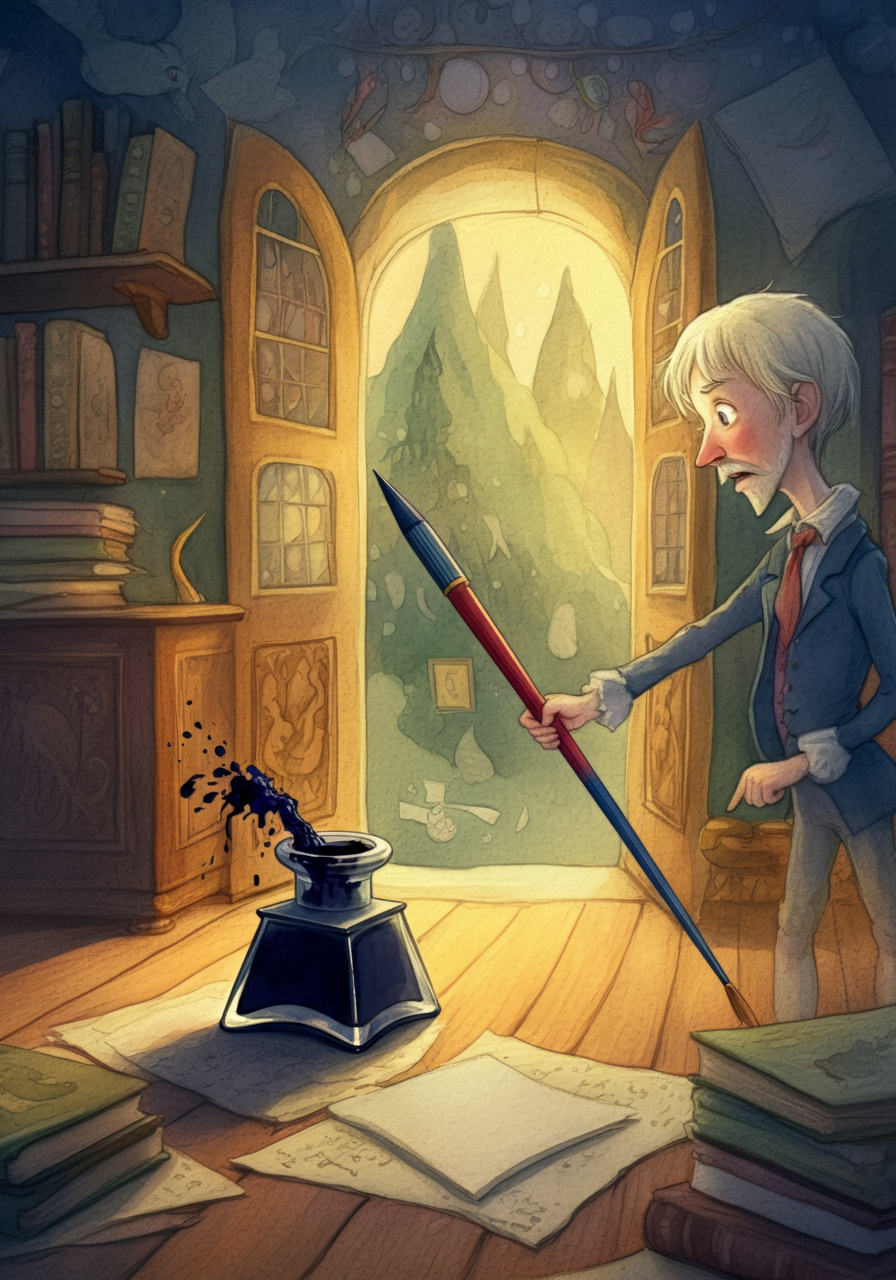
An Inkstand and Pen lived on a desk. They were very important to The Poet.
The Inkstand felt very important. "Many good things come from me," it said. "It is strange. It is wonderful!" The Inkstand told The Pen. "I make all The Poet's stories," it said. "All the words come from me. I am very special. I am very important."
The Pen did not agree. "No, you only hold ink," The Pen said. "I write the words. I make the stories. I am the one who writes."
The Inkstand laughed. "You are just a tool," it said. "Many pens come and go. I stay here always. You will be gone soon."
Later, The Poet came home. He heard beautiful music. A man played a violin. The music made The Poet feel happy. He felt special. He thought a lot. The Poet thought about the music. It was a gift. The violin was just a tool. The man was just a helper. The music came from a big, secret magic.
The Poet sat down. He wrote a story. It was about "Helper and Tools." He wrote.
The Pen heard the story. "Ah, The Inkstand is silly!" it thought. "The Poet wrote about you." Pen felt clever.
The Inkstand heard the story. "No, The Pen is silly!" it thought. "The Poet wrote about you." Inkstand felt clever.
The Pen and The Inkstand were happy. They both felt smart. They did not know the real meaning. They went to sleep.
But The Poet did not sleep. He thought about the music. He thought about the big, secret magic. This magic makes all good things. He felt happy and wise.
Original Story
Pen and inkstand
A fairy tale by Hans Christian Andersen
In a poet's study, somebody made a remark as he looked at the inkstand that was standing on the table: "It's strange what can come out of that inkstand! I wonder what the next thing will be. Yes, it's strange!"
"That it is!" said the Inkstand. "It's unbelievable, that's what I have always said." The Inkstand was speaking to the Pen and to everything else on the table that could hear it. "It's really amazing what comes out of me! Almost incredible! I actually don't know myself what will come next when that person starts to dip into me. One drop from me is enough for half a piece of paper, and what may not be on it then? I am something quite remarkable. All the works of this poet come from me. These living characters, whom people think they recognize, these deep emotions, that gay humor, the charming descriptions of nature - I don't understand those myself, because I don't know anything about nature - all of that is in me. From me have come out, and still come out, that host of lovely maidens and brave knights on snorting steeds. The fact is, I assure you, I don't know anything about them myself."
"You are right about that," said the Pen. "You have very few ideas, and don't bother about thinking much at all. If you did take the trouble to think, you would understand that nothing comes out of you except a liquid. You just supply me with the means of putting down on paper what I have in me; that's what I write with. It's the pen that does the writing. Nobody doubts that, and most people know as much about poetry as an old inkstand!"
"You haven't had much experience," retorted the Inkstand. "You've hardly been in service a week, and already you're half worn out. Do you imagine you're the poet? Why, you're only a servant; I have had a great many like you before you came, some from the goose family and some of English make. I'm familiar with both quill pens and steel pens. Yes, I've had a great many in my service, and I'll have many more when the man who goes through the motions for me comes to write down what he gets from me. I'd be much interested in knowing what will be the next thing he gets from me."
"Inkpot!" cried the Pen.
Late that evening the Poet came home. He had been at a concert, had heard a splendid violinist, and was quite thrilled with his marvelous performance. From his instrument he had drawn a golden river of melody. Sometimes it had sounded like the gentle murmur of rippling water drops, wonderful pearl-like tones, sometimes like a chorus of twittering birds, sometimes like a tempest tearing through mighty forests of pine. The Poet had fancied he heard his own heart weep, but in tones as sweet as the gentle voice of a woman. It seemed as if the music came not only from the strings of the violin, but from its sounding board, its pegs, its very bridge. It was amazing! The selection had been extremely difficult, but it had seemed as if the bow were wandering over the strings merely in play. The performance was so easy that an ignorant listener might have thought he could do it himself. The violin seemed to sound, and the bow to play, of their own accord, and one forgot the master who directed them, giving them life and soul. Yes, the master was forgotten, but the Poet remembered him. He repeated his name and wrote down his thoughts.
"How foolish it would be for the violin and bow to boast of their achievements! And yet we human beings often do so. Poets, artists, scientists, generals - we are all proud of ourselves, and yet we're only instruments in the hands of our Lord! To Him alone be the glory! We have nothing to be arrogant about."
Yes, that is what the Poet wrote down, and he titled his essay, "The Master and the Instruments."
"That ought to hold you, madam," said the Pen, when the two were alone again. "Did you hear him read aloud what I had written?"
"Yes, I heard what I gave you to write," said the Inkstand. "It was meant for you and your conceit. It's strange that you can't tell when anyone is making fun of you. I gave you a pretty sharp cut there; surely I must know my own satire!"
"Inkpot!" said the Pen.
"Scribble-stick!" said the Inkstand.
They were both satisfied with their answers, and it is a great comfort to feel that one has made a witty reply - one sleeps better afterward. So they both went to sleep.
But the Poet didn't sleep. His thoughts rushed forth like the violin's tones, falling like pearls, sweeping on like a storm through the forest. He understood the sentiments of his own heart; he caught a ray of the light from the everlasting Master.
To him alone be the glory!
- * * * *
Story DNA
Moral
True genius and creativity come from a higher source, and instruments, whether human or inanimate, should not claim credit for the inspiration they convey.
Plot Summary
In a poet's study, an Inkstand and a Pen engage in a petty argument, each claiming sole credit for the poet's literary creations. The Inkstand boasts of being the source of all the poet's ideas, while the Pen insists it is the one that actually writes and forms the words. Later, the Poet returns from a concert, deeply moved by a violinist's performance, which inspires him to write an essay titled 'The Master and the Instruments,' reflecting that all artists and their tools are merely instruments of a higher power. Ironically, both the Pen and the Inkstand misinterpret the essay, each believing it to be a clever jab at the other's conceit, while the Poet continues to ponder the true source of inspiration.
Themes
Emotional Arc
pride to subtle irony
Writing Style
Narrative Elements
Cultural Context
Andersen often used personification and simple objects to convey complex philosophical or moral ideas, reflecting the intellectual and spiritual currents of his time.
Plot Beats (11)
- Someone remarks on the wonders that come from the inkstand.
- The Inkstand boasts to the Pen about being the source of the poet's creations, claiming all works originate from it.
- The Pen retorts, arguing that the Inkstand only provides liquid, and it is the Pen that does the actual writing and holds the ideas.
- The Inkstand dismisses the Pen as a mere, temporary servant, reminding it of its many predecessors and its short lifespan.
- The Poet returns home, deeply inspired by a violinist's performance, which he perceives as coming from a source beyond the instrument or the musician.
- The Poet reflects on the humility required of artists, realizing they are merely instruments in the hands of a higher power.
- The Poet writes an essay titled 'The Master and the Instruments,' expressing these thoughts.
- The Pen, upon hearing the essay, believes it is a rebuke to the Inkstand's conceit.
- The Inkstand, in turn, believes the essay is a sharp satire aimed at the Pen's arrogance.
- Both the Pen and Inkstand are satisfied with their perceived witty retorts and go to sleep, still ignorant of the true message.
- The Poet, however, remains awake, continuing to contemplate the profound source of inspiration, attributing glory to the 'everlasting Master'.
Characters
The Inkstand ◆ supporting
An inkstand, presumably ceramic or glass
Attire: Plain, functional container
Conceited, argumentative, believes it is the source of the poet's creativity
Image Prompt & Upload
An elderly scholar with a dignified posture, standing beside a tall wooden lectern. He wears a tailored waistcoat of deep black velvet over a crisp white shirt, and his trousers are the color of dark oak. His most striking feature is a tall, cylindrical top hat made of polished obsidian, which resembles an inkwell, with a small golden nib-like ornament at its peak. His hair and neatly trimmed beard are the pure white of fine paper. He holds a large, leather-bound book open in his hands, looking down at its pages with a calm, helpful expression. Plain white background, full body visible head to toe, single figure, no watermark, no text, no signature.
The Pen ◆ supporting
A pen, either quill or steel
Attire: Simple, functional writing tool
Arrogant, believes it is the true writer, dismissive of the inkstand
Image Prompt & Upload
An elderly scholar with gentle, wise eyes and a neatly trimmed white beard. He wears a long, deep blue robe with silver embroidery along the hems, over a simple white tunic. His posture is slightly stooped but dignified, as if leaning forward to listen. One hand is raised, holding a large, ornate feathered quill pen, its tip glowing with faint golden light. His fingers are stained with ink. He has a kind, patient smile on his weathered face. Plain white background, full body visible head to toe, single figure, no watermark, no text, no signature.
The Poet ★ protagonist
Not described, but likely of average build
Attire: Typical attire for a 19th-century intellectual: perhaps a simple suit or robe
Thoughtful, introspective, humble, inspired by art
Image Prompt & Upload
A young adult with a thoughtful expression, gazing slightly upward as if inspired. They have tousled, ink-black hair and warm brown eyes. Their clothing consists of a cream-colored poet's shirt with billowy sleeves, a dark burgundy waistcoat, and fitted trousers. One hand holds a long feather quill to their lips, the other rests on a closed leather-bound journal. Ink stains are visible on their fingertips. They stand in a relaxed, contemplative posture. Plain white background, full body visible head to toe, single figure, no watermark, no text, no signature.
Locations
Poet's Study
A room containing a table with an inkstand and pen.
Mood: contemplative, creative
The poet reflects on the concert and writes his essay.
Image Prompt & Upload
Golden hour light streams through a tall, arched window, casting long shadows across a cluttered oak writing table in a cozy, book-lined study. The central focus is a brass inkstand holding a single raven-feather quill, its tip gleaming. Dust motes dance in the amber sunbeams, illuminating stacks of leather-bound books, crumpled parchment, and a half-melted candle. The walls are dark mahogany, lined with floor-to-ceiling shelves overflowing with volumes. A worn velvet chair is pushed back from the table. The atmosphere is quiet, contemplative, and warm, with a palette of deep browns, golds, and rich burgundies. Through the window, a blurred glimpse of a twilight garden with climbing roses is visible. no border, no frame, no watermark, no text, no signature, edge-to-edge illustration
Inkstand's Interior
A container filled with ink.
Mood: source of creativity, mysterious
The inkstand imagines the stories and characters that come from it.
Image Prompt & Upload
Inside a vast, ornate crystal inkstand, viewed from within the ink reservoir. The scene is a miniature, cavernous landscape of deep sapphire and indigo liquid, with slow, viscous currents swirling like dark nebulae. The walls of the container are faceted crystal, refracting the dim, ambient light into shimmering prismatic shards that dance across the ink's surface. Above, the distant, distorted lid of the inkstand forms a domed ceiling. The atmosphere is profoundly quiet and still, with a sense of immense depth and quiet contemplation. The lighting is low and dramatic, coming from an unseen source, highlighting the rich, glossy texture of the ink and the intricate, glass-like architecture of the container's interior. no border, no frame, no watermark, no text, no signature, edge-to-edge illustration
Concert Hall
A place where a violinist played, filled with music.
Mood: thrilling, musical
The poet is inspired by the violinist's performance.
Image Prompt & Upload
An empty, grand concert hall at twilight, bathed in the warm, golden glow of countless floating musical notes and softly glowing fairy lights. Ornate, arched windows reveal a deep blue evening sky. Polished wooden floors reflect the light, and rows of plush, crimson velvet seats face a majestic, empty stage. The air shimmers with a magical, silent melody, dust motes dancing in the beams of light. No border, no frame, no watermark, no text, no signature, edge-to-edge illustration.