A String of Pearls
by Hans Christian Andersen · from Collected Fairy Tales

Adapted Version
The train goes fast. It stops in towns. These towns are like pearls. Each one is special. Many towns are on the line. They are like pretty pearls.
Grandma heard about the pearls. She smiled. "Yes," she said. "It was pearls for me. I was young."
We went by carriage. It was a long trip. Then we got on a big boat. The boat sailed. There was much fog. The wind blew hard. We went slowly. It took a long time to Korsør.
We came to Korsør. It was dark. My father pointed to a house. It was special.
The next day, we went to Slagelse. It was a trip.
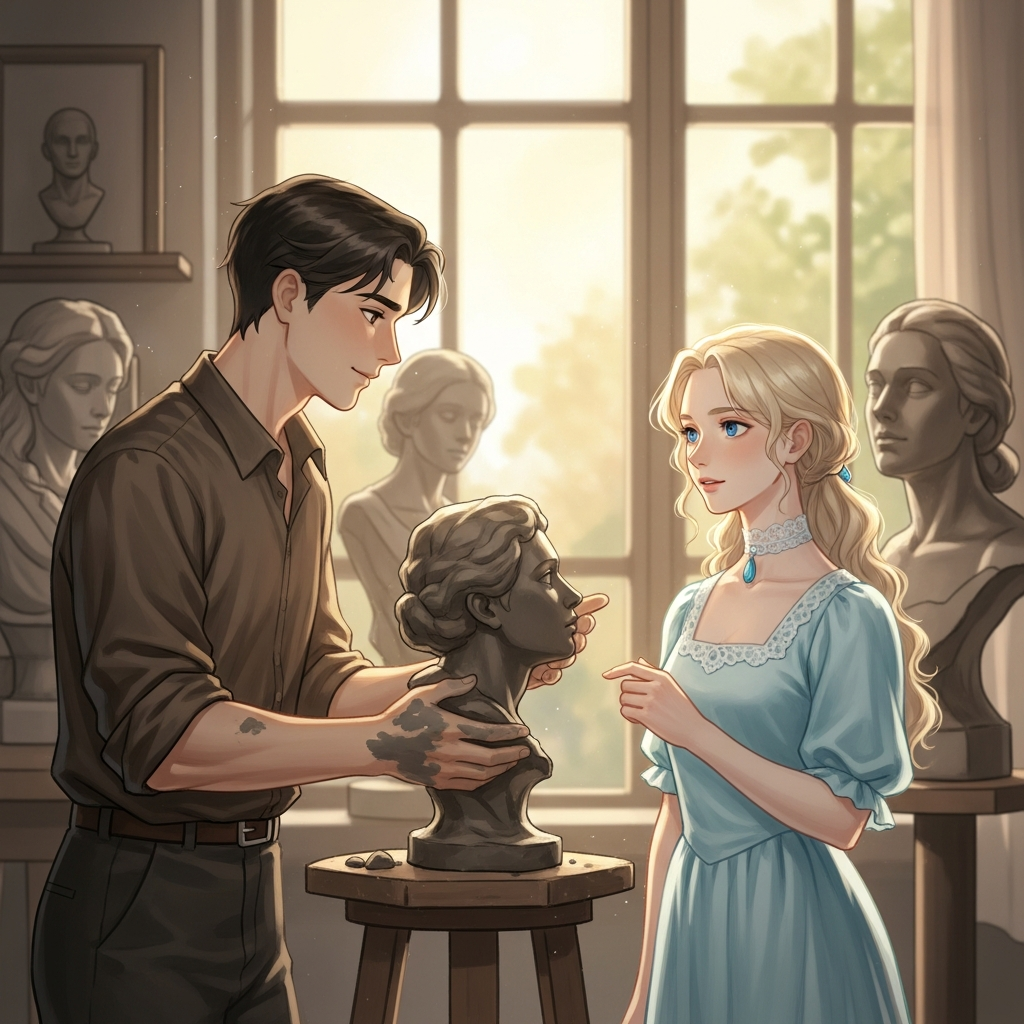
We went to Sorø. There I met Emil. He was a kind young man. He showed me the church. We went on a boat. It was a good night. We walked by the lake. The moon was bright. Emil would come to the city.
The next day, we went to Roskilde. We stayed there. Then we went to the city.
In the city, Emil came to see me. We were happy. We decided to get married. It was a happy time for us.
Grandma had a happy life with Emil. They had kids. She always thought of that trip. The journey was slow. But it was full of love. It was full of happy times. That made it the best journey. Her string of pearls was perfect. Grandma smiled. Her thoughts were bright. She knew she would see Emil again one day.
Original Story
A string of pearls
A fairy tale by Hans Christian Andersen
The railroad in Denmark still extends only from Copenhagen to Korsör; it is a string of pearls. Europe has a wealth of these pearls; its most costly are named Paris, London, Vienna, Naples. And yet many a man will point out as his favorite pearl not one of these great cities but rather some little country town that is still the home of homes to him, the home of those dearest to him. Yes, often it is not a town at all, but a single homestead, a little house, hidden among green hedges, a place hardly visible as the train speeds by.
How many pearls are there on the line from Copenhagen to Korsör? We will consider just six, which most people must notice; old memories and poetry itself give a luster to these pearls, so that they shine in our thoughts.
Near the hill where stands the palace of Frederick VI, the home of Oehlenschläger's childhood, one of these pearls glistens, sheltered by Söndermarken's woody ground. It used to be called "The Cottage of Philemon and Baucis." Here lived Rahbek and his wife, Camma; here, under their hospitable roof, assembled many of the generation's finest intellects from busy Copenhagen; it was the festival home of the intellectual. Now, don't say, "Ah, what a change!" No, it is still the home of the intellect, a conservatory for sick plants, for buds which do not have the strength to unfold their true beauty of color and form or show the blossoming and fruit-bearing which is hidden within them. The insane asylum, surrounded by human love, is truly a spot of holiness, a hospital for the sick plants that shall someday be transplanted to bloom in the paradise of God. The weakest minds are assembled now here, where once the strongest and keenest met to exchange thoughts and ideas, but still the flame of generosity mounts heavenward from "The Cottage of Philemon and Baucis."
Ancient Roskilde, the burial town of Kings, by Hroar's Spring, now lies before us. The slender towers of the church lift up above the low town and mirror themselves in Issefiord. Only one grave shall we seek here; it is not that of the mighty Queen Margrethe; no within the white-walled churchyard which we speed close by is the grave, and over it lays a small, plain stone. The master of the organ, the reviver of the old Danish romances, rests here. We recall, "The clear waves rolled" and "There dwelt a king in Leire." Roskilde, burial place of kings-in your pearl we see the insignificant gravestone whereon is cut a lyre and the name Weyse.
Now we reach Sigersted, near the town of Ringsted. The bed of the river is low here; yellow corn waves over the spot where Hagbarth's boat lay at anchor, not far from Signe's maiden bower. Who does not know the legend of Hagbarth, who was hanged on the oak tree while the bower of Signe burst into flames? Who can forget that legend of immortal love?
"Beautiful Sorö, encircled by woods!" Your quiet old cloistered town peeps out through its mossy trees; the keen eyes of youth from the academy can look across the lake toward the world's highway and hear the roar of the locomotive's dragon as it speeds through the woods. Sorö, pearl of poetry, you are guarding the dust of Holberg! Your palace of learning stands beside the deep woodland lake like a great white swan, and near by, like the bright starflower of the woods, there gleams a tiny cottage, whence pious hymns echo throughout the land; words are spoken within, and the peasant listens and learns of Denmark's bygone days. As the song of the bird is to the greenwood, so is Ingemann to Sorö.
On to the town of Slagelse! What is mirrored here in this pearl's luster? Gone forever is the cloister of Antoorskov (NB: Antvorskov); vanished are the rich halls of the castle, even the last remaining wing; yet one relic of olden times still lingers here, the wooden cross on the hill. It has been repaired again and again, for it marks the spot where, legend tells us, Saint Anders, holy priest of Slagelse, awoke, after having been brought there from Jerusalem in a single night.
Korsör, birthplace of Baggesen, master of words and wit! The ruined old ramparts of the fallen fortress are now the last visible witness of your childhood home; their lengthening sunset shadows point to the spot where stood the house in which you were born. From these hills you looked toward Sprogö and sang in undying verse.
Nowhere have roses so red a hue
And nowhere are feathers so light and so blue,
Nowhere the thorns so daintily grown,
As those to childhood innocence known.
Humorous, charming singer! We shall weave for thee a garland of woodbine and fling it into the lake, so that the current may bear it to the coast of Kielerfiord, where your ashes rest. The tide shall bring you a greeting from the new generation, a greeting from your birthplace Korsör - where I drop my string of pearls.
"That's quite right! A string of pearls does stretch from Copenhagen to Korsör," said Grandmother when she had heard this read aloud. "It's a string of pearls for me now, as it was more than forty years ago. We had no railroad then; we spent days on a trip that can now be made in as many hours. That was in 1815, and I was twenty-one; that is a charming age! Although to be up in the sixties, that is also a wonderful age! In my young days it was a much rarer event than it is now to come to Copenhagen, which we considered the town of all towns! My parents hadn't visited it for twenty years, but at last they were going, and I was going with them. We had talked about that journey for years before, and now it was actually coming true; it seemed as though a new life were beginning for me, and really in a way a new life did begin for me.
"There was such a bustle of sewing and packing; and when at last we were ready to start, such a crowd of friends came to bid us farewell! It was a long journey we had ahead of us. Shortly before noon we drove out of Odense in my parents' Holstein carriage, and our friends waved to us from the windows all the way down the street, till we passed through St. Jörgen's Gate. The weather was beautiful; the birds sang, and everything was joyful; we forgot what a long and tiresome road it was to Nyborg. We reached it toward evening; but the little sailing vessel had to wait for the mail, which didn't arrive until night. Then we got on board, and as far as we could see the wide, smooth waters lay before us. We lay down and went to sleep in our clothes. When I awoke and came on deck next morning, I could see nothing at all; a heavy fog covered everything. When I heard the cocks crowing, I knew it must be sunrise; bells were ringing, but I didn't know where; then the mist lifted, and we found we were still lying very close to Nyborg. Later in the day a wind came up, but it was against us; we tacked back and forth, and at last were lucky enough to reach Korsör by a little past eleven that night, having spent twenty-two hours to go sixteen miles!
It was good to get ashore, but it was dark; the lamps were weak, and it all seemed very strange to me, who had never been in any other town but Odense.
" 'Look!' said my father. 'Baggesen was born there! And Birckner lived in that house!' When I heard that, somehow the dark old town with its narrow little streets seemed to grow larger and brighter. And we were so glad to feel solid earth under our feet! There was no sleep for me that night, for I was so excited over all that I had seen and heard since I had left home the day before.
"Next morning we had to leave early; there was a terrible road ahead of us, with great bumps and holes as far as Slagelse, and not much better from there on, and we wanted to get to the Crab Inn early, so that on the same day we could reach Sorö and visit the Möllers' Emil, as we called him then; yes, he was your grandfather, my late husband, the dean. He was a student at Sorö then, and had just passed his second examination.
"That afternoon we reached the Crab Inn, which was a gallant place at that time, the very best inn on the whole trip, with the prettiest country around it. Yes, but you must all admit that it still is. Madame Plambek was an industrious hostess, and everything in her house was as smoothly scoured as a larding board. On the wall they had, framed under glass, Baggesen's letter to her; it was indeed worth seeing, and I greatly enjoyed looking at it. Then he went to Sorö and found Emil there. You can imagine how glad we were to see him, and he to see us. He was so thoughtful and charming; he took us to see the church, and the graves of Absalon and Holberg; he inspected the old monkish inscriptions with us, and sailed with us across the lake to Parnasset. It was the most wonderful evening I remember! I was thinking that to become a poet one had only to come to Sorö and meditate among those lovely, peaceful scenes. By moonlight we followed the 'Philosopher's Walk,' as it's called, the wonderful and lonely little path beside the lake that joins the highway near the Crab Inn. Emil stayed for supper with us, and my father and my mother declared he had grown so sensible and looked so well. It was almost Whitsuntide, and he promised that in a few days he would be in Copenhagen to join us and his family. Ah, those few hours in Sorö and at the Crab Inn I count among the choicest pearls of my life!
"Next morning we again started very early, for we had a long trip to Roskilde, where we wanted to see the church and Father wanted to visit an old school friend that evening. We spent that night in Roskilde and reached Copenhagen by noon the next day. So we had spent about three days on a journey that can now be made in three hours-Korsör to Copenhagen. The pearls on that way have not grown more costly-that could never be-but the string is new and wonderful.
"I stayed with my parents in Copenhagen for three weeks. Emil was with us for eighteen whole days, and when we returned to Fünen he went with us as far as Korsör. There, before we parted, we were betrothed. So it is no wonder I should call the road from Copenhagen to Korsör a string of pearls.
"Afterwards, when Emil received his post at Assens, we were married. We often talked about that journey to Copenhagen, and intended doing it again, but then your mother came along, and after her came her brothers and sisters, and with all of them there was so much to do and take care of! Then your grandfather was promoted and made a dean; yes, everything was happiness and joy, but we never got to Copenhagen again. No, I have never been there since, though we often thought and talked about it. Now I'm much too old to travel by rail, but still I'm right glad there is a railway; it's a real blessing, because it brings you young ones to me more quickly!
"Nowadays Odense is hardly farther from Copenhagen than in my youth it was from Nyborg; you can speed to Italy in the time it took us to reach Copenhagen! Yes, that is certainly something! It doesn't matter that I just sit here always; let the others travel, so long as they sometimes travel to me.
"And you needn't laugh at me, you young people, for sitting so still here, day after day! I have really a wonderful journey ahead of me; I shall soon have to travel at a speed far greater than the railway's. For when our Lord calls me I shall go to join your grandfather; and when you have completed your work on this dear earth, you too will join us; and then, if we talk over the days of our mortal life, believe me, dear children, I shall say then as I do now, 'From Copenhagen to Korsör is a perfect string of pearls!' "
- * * * *
Story DNA
Moral
The true value of a journey or place lies not in its physical attributes or speed of travel, but in the personal memories and emotional connections forged there.
Plot Summary
The story begins with a narrator describing the Danish railway line from Copenhagen to Korsør as a 'string of pearls,' each representing a culturally significant town. An elderly grandmother, upon hearing this, shares her own memories of traveling the same route over forty years prior, a multi-day journey by carriage and sailing vessel. She recounts the challenges and wonders of the trip, culminating in her meeting and betrothal to her future husband, Emil, in Sorø. The grandmother concludes by affirming that despite the advent of faster travel, the route remains a 'perfect string of pearls' for her, imbued with cherished personal memories and the anticipation of a final journey to reunite with her beloved.
Themes
Emotional Arc
nostalgia to contentment
Writing Style
Narrative Elements
Cultural Context
The story contrasts the slow, arduous travel of the early 19th century with the speed of the newly introduced railway, highlighting the rapid technological and social changes in Denmark. It also references significant figures of the Danish Golden Age.
Plot Beats (15)
- The narrator introduces the railway line from Copenhagen to Korsør as a 'string of pearls,' each pearl representing a significant town or landmark.
- The narrator describes six specific 'pearls' along the route: Rahbek's 'Cottage of Philemon and Baucis' (now an asylum), Roskilde (Weyse's grave), Sigersted (Hagbarth and Signe's legend), Sorø (Holberg and Ingemann), Slagelse (St. Anders' cross), and Korsør (Baggesen's birthplace).
- The grandmother, hearing this, agrees with the metaphor and begins to recount her own journey on the same route in 1815, when she was twenty-one.
- She details the preparations and emotional farewells for the long, multi-day trip from Odense to Copenhagen.
- The first leg of her journey involves a difficult carriage ride to Nyborg and a twenty-two-hour, sixteen-mile sailing trip to Korsør due to fog and headwinds.
- Upon arriving in a dark Korsør, her father points out Baggesen's birthplace, making the town seem more significant.
- The next day, they endure a terrible road to Slagelse and then reach the Crab Inn, a renowned establishment.
- They proceed to Sorø, where the grandmother reunites with her future husband, Emil, a student there.
- Emil gives them a tour of Sorø, including the church, graves of Absalon and Holberg, and a boat trip across the lake, creating a memorable evening.
- The grandmother and Emil walk the 'Philosopher's Walk' by moonlight, and Emil promises to join them in Copenhagen.
- The journey continues early the next day to Roskilde, where they spend the night, and then on to Copenhagen.
- After three weeks in Copenhagen, during which Emil joins them for eighteen days, the grandmother and Emil become betrothed before he accompanies her family back to Korsør.
- The grandmother reflects on her marriage to Emil, their family life, and how they never made the journey to Copenhagen again, despite wishing to.
- She expresses contentment with her current, stationary life, appreciating the railway for bringing her family closer.
- The grandmother concludes by stating that she anticipates a final, faster journey to join her husband in the afterlife, and that the route from Copenhagen to Korsør will always remain a 'perfect string of pearls' in her memory.
Characters
Grandmother ★ protagonist
Old, but with a youthful spirit in her memories.
Attire: Simple, comfortable dress appropriate for an elderly woman of the early 19th century in Denmark, perhaps with a shawl or apron.
Nostalgic, loving, content
Image Prompt & Upload
An elderly woman with deep smile lines and kind, crinkling eyes. Her silver hair is neatly pinned up in a bun, with a few loose strands framing her face. She wears a long-sleeved, high-necked dress in a soft, faded blue, covered by a starched white apron. A thick, hand-knitted shawl in earthy tones is draped over her shoulders. She stands with a gentle, welcoming posture, her hands clasped softly in front of her. Her expression is warm and wise, with a soft, knowing smile. Plain white background, full body visible head to toe, single figure, no watermark, no text, no signature.
Emil (Grandfather) ◆ supporting
Described as sensible and well-looking as a student.
Attire: Student attire of the early 19th century in Denmark, likely including a dark coat and possibly a hat.
Thoughtful, charming, intelligent
Image Prompt & Upload
An elderly man in his late seventies with deep smile lines around his kind, pale blue eyes and a full head of neatly combed silver hair. He wears a soft, cable-knit cardigan in a muted cream color over a simple white shirt, paired with comfortable brown corduroy trousers. He stands with a gentle, welcoming posture, one hand slightly extended as if offering help. His expression is warm and patient, radiating a calm, supportive presence. Plain white background, full body visible head to toe, single figure, no watermark, no text, no signature.
Baggesen ○ minor
Not described physically, but known as a master of words and wit.
Attire: Clothing appropriate for a poet and writer of the early 19th century.
Humorous, charming, witty
Image Prompt & Upload
A young child of about eight years old, with a round, curious face and bright eyes. They have messy, straw-colored hair and a smudge of dirt on one cheek. Dressed in simple, patched brown trousers, a loose-fitting cream-colored tunic, and worn leather suspenders. They stand with a slight, inquisitive lean forward, holding a small, smooth wooden toy in one hand. Plain white background, full body visible head to toe, single figure, no watermark, no text, no signature.
Madame Plambek ○ minor
Industrious and keeps a clean inn.
Attire: Practical clothing suitable for an innkeeper in the early 19th century, apron.
Industrious, hospitable, clean
Image Prompt & Upload
A stern elderly woman with sharp cheekbones and a tightly pinned silver bun. She wears a high-collared charcoal wool dress with jet buttons, her posture rigid as she clutches a leather-bound ledger. A single silver brooch shaped like a bird's skull adorns her collar. Her expression is severe, with thin lips pressed together and deep-set, pale eyes. Plain white background, full body visible head to toe, single figure, no watermark, no text, no signature.
Locations
The Cottage of Philemon and Baucis
Hospitable roof, festival home of the intellectual, conservatory for sick plants
Mood: warm, generous, intellectual
Home to Rahbek and his wife, Camma, and a gathering place for intellectuals; later, an insane asylum.
Image Prompt & Upload
A cozy thatched-roof stone cottage at golden hour, nestled within a lush, overgrown cottage garden. Warm light spills from mullioned windows onto a path of irregular flagstones. To one side, a glass-paneled conservatory annex glows softly, housing shelves of potted plants in various stages of recovery—some drooping, some sprouting new leaves. The architecture is rustic and inviting, with a heavy oak door slightly ajar. Climbing roses and wisteria frame the doorway. The atmosphere is serene, magical, and nurturing, with soft, dappled sunlight filtering through old oak trees. Colors are warm earth tones, deep greens, and the gentle pastels of flowering plants. no border, no frame, no watermark, no text, no signature, edge-to-edge illustration
Roskilde Churchyard
White-walled churchyard, small plain gravestone
Mood: peaceful, somber, reflective
Weyse's grave is located here.
Image Prompt & Upload
Early morning mist clings to the cobblestone path leading to the Roskilde Churchyard. Ancient, gnarled oak trees with pale green leaves frame the scene, their branches filtering soft, golden dawn light. The churchyard is enclosed by tall, pristine white-washed walls, slightly weathered with age. Within the walls, rows of small, plain, moss-covered gravestones of gray and white stone stand in quiet solemnity, some leaning gently. The ground is lush, dew-kissed grass, dotted with tiny white wildflowers. The atmosphere is profoundly peaceful, serene, and timeless, with a soft, ethereal glow. no border, no frame, no watermark, no text, no signature, edge-to-edge illustration
Signe's maiden bower
Near the riverbed, close to where Hagbarth's boat lay, bower that burst into flames
Mood: tragic, romantic, fiery
The legendary site of Signe's bower, which burst into flames when Hagbarth was hanged.
Image Prompt & Upload
A twilight scene by a slow-moving river, the last light of dusk casting long shadows. In the foreground, the charred, skeletal remains of a wooden bower smolder amidst a bed of white river stones, faint embers glowing orange within the ruins. Wisps of ethereal, silver mist rise from the blackened beams and curl towards the water. Nearby, a simple wooden boat rests half-submerged at the river's edge, its hull dark and weathered. The riverbank is lined with slender, drooping willows, their leaves tinged with the deep blues and purples of evening. The sky is a gradient of dusky lavender and deep navy, with the first pale stars beginning to appear. The atmosphere is one of tragic stillness and quiet magic. no border, no frame, no watermark, no text, no signature, edge-to-edge illustration
The Crab Inn
Gallant place, best inn on the trip, smoothly scoured, Baggesen's letter framed on the wall
Mood: pleasant, welcoming, clean
Grandmother visits with her parents and meets Emil (her future husband).
Image Prompt & Upload
A cozy, gallant inn at twilight, its warm golden light spilling from diamond-pane windows onto a cobblestone courtyard. The two-story timber-frame building is smoothly scoured, with a thatched roof and a hanging sign shaped like a crab. A neatly framed letter is visible on the interior wall through a window. The path is lit by wrought-iron lanterns, leading to a sturdy oak door. Climbing roses adorn the facade under a deep blue, star-pricked sky. The atmosphere is inviting, clean, and magically serene. no border, no frame, no watermark, no text, no signature, edge-to-edge illustration.
Sorø Lake and Philosopher's Walk
Deep woodland lake, Philosopher's Walk - a lonely path beside the lake, moonlight
Mood: peaceful, romantic, contemplative
Grandmother walks with Emil and her parents; she reflects on the beauty of the place.
Image Prompt & Upload
Deep midnight at Sorø Lake, a vast, mirror-still body of water reflecting a star-strewn sky. A full silver moon hangs low, casting a luminous path across the dark water. The Philosopher's Walk, a narrow, moss-covered stone path, winds along the shore beneath ancient, gnarled oak and pine trees. Their branches form a dense canopy, with moonlight filtering through in soft beams. The air is cool and misty, with a gentle haze hovering over the water's surface. Bioluminescent mushrooms glow faintly blue along the roots of trees, and fireflies drift silently over the reeds at the water's edge. The palette is deep blues, silvery whites, and dark emerald greens, creating a serene, mystical, and profoundly quiet atmosphere. no border, no frame, no watermark, no text, no signature, edge-to-edge illustration.