STONE BROTH
by Aesop · from Æsop's fables in words of one syllable
Adapted Version
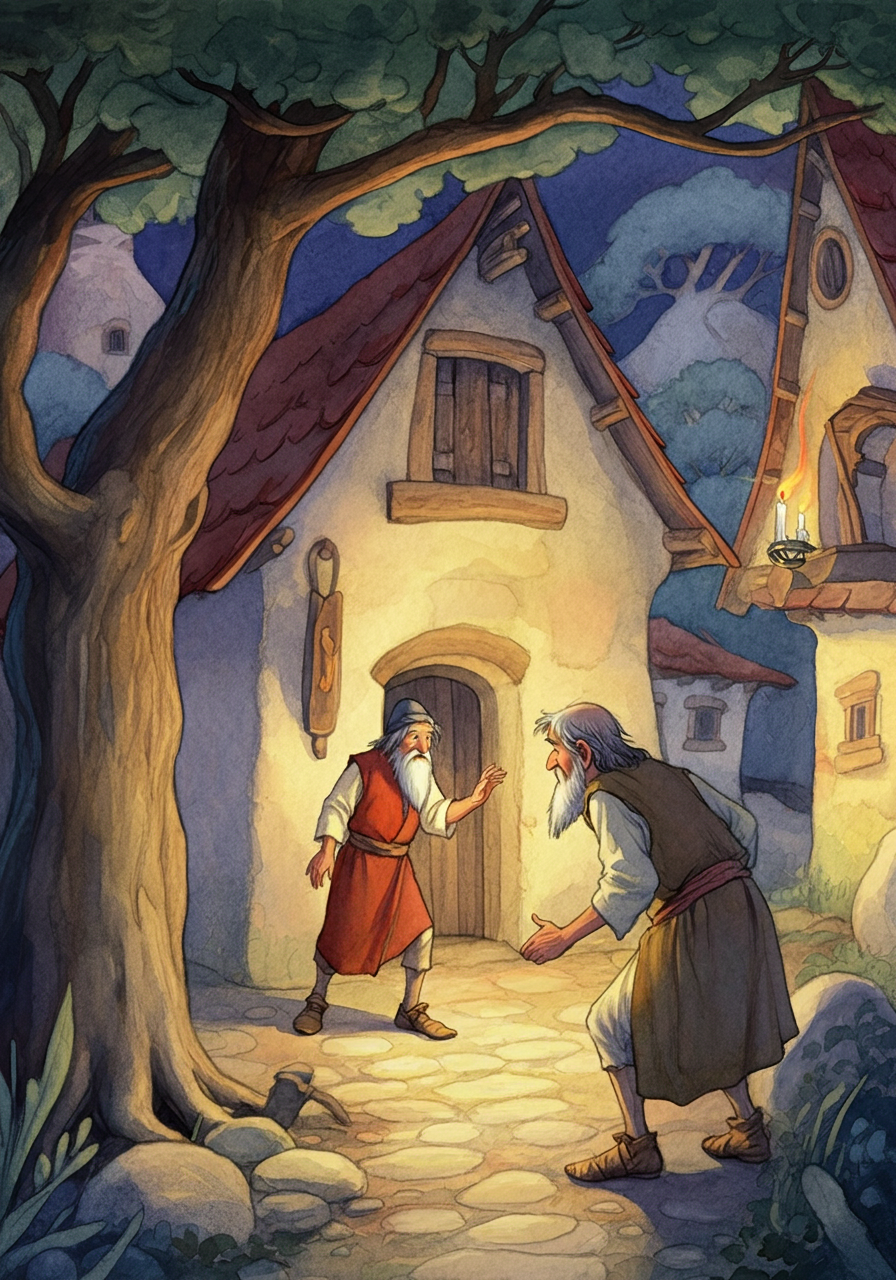
The Clever Traveler was very cold. Rain fell hard. He was wet from the storm. He came to a big house. He knocked on the door. He asked for some help. He asked for food. The people inside said no. They closed the door. The Clever Traveler felt sad.
The Clever Traveler went back to the door. He knocked again. The Maids opened the door. He looked very cold. "Can I dry my clothes?" he asked. The Maids saw his wet coat. They saw his wet boots. "Yes," they said. "Come by the fire." He went inside.
The Clever Traveler went to the kitchen. He saw The Cook there. "I can make stone broth," he said. The Cook looked very surprised. "Stone broth?" she asked. "That is new." "Yes," he said. "I just need a big pan. I need some water." He smiled. She thought his idea was clever.
The Cook was very eager. She wanted to see. "Yes, you can try," she said. She gave him a big pan. She filled it with water. The Clever Traveler took out a smooth stone. It was from the road. He put the stone in the pan. The pan was on the fire. The water got warm. The Cook watched him very well.
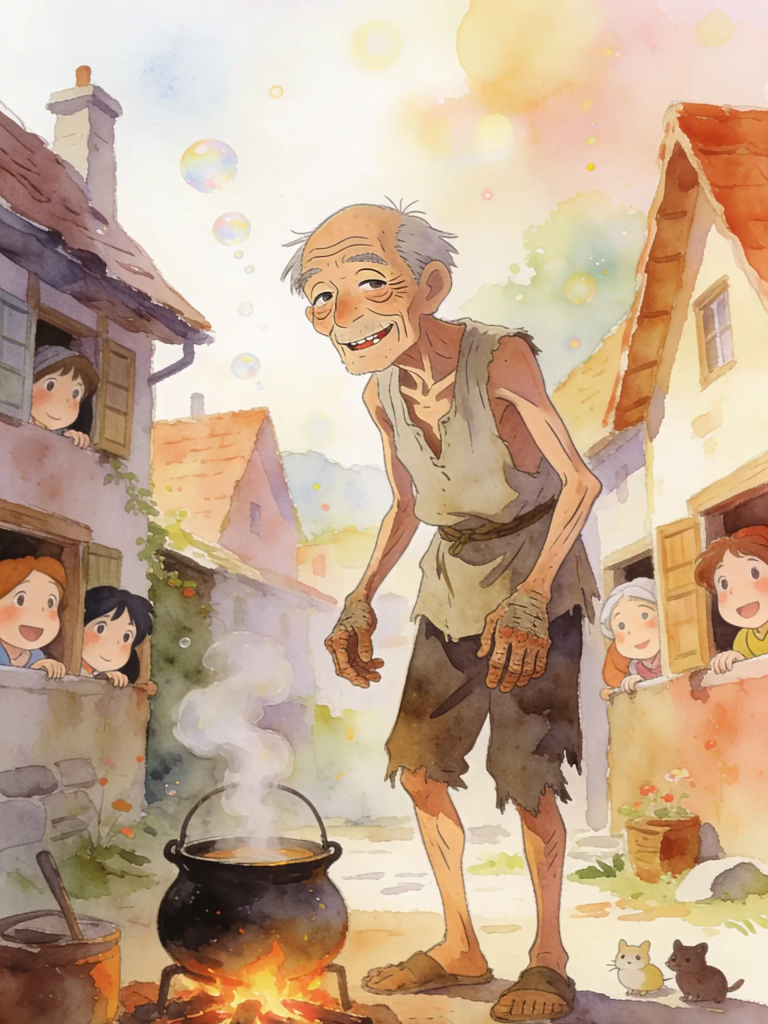
The water in the pan began to bubble. The Clever Traveler tasted the water. "It tastes good," he said. "Salt would make it better." The Cook added salt. He tasted it again. "Oh, some peas would be nice," he said. The Cook found some green peas. She put them in the pan. "And maybe a little meat?" he asked. The Cook found a small piece of meat. She put it in too. The broth smelled very good. The Cook was happy to help.
The stone broth was ready. It smelled so very good. The Clever Traveler poured the broth. He took out the smooth stone. Now he had a real, warm meal. The broth was very tasty. It had warm peas and meat. He was not cold now. He was very happy. He ate the good food.
The Cook was very impressed. "You are very clever!" she said. "You made a good meal. You used just a stone." She smiled at The Clever Traveler. "You found a way to make it. You were very smart." They both ate the warm broth. It was a happy meal.
Being clever and working as one can make good things happen, even from small starts.
Original Story
STONE BROTH.
A poor man, in a storm of wind and rain, came to a great house to beg for alms, and was sent off with cross words. But he went back, and said, “May I but ask to dry my clothes at your fire, for I am wet with rain?” This the maids thought would not cost them much, so they let him come in. He then told the cook that if she would but give him a pan, and let him fill it from the pump, he would make some stone broth. This kind of dish was so new to the cook, that she let him make it. The man then got a stone from the road, and put it in the pan. The cook gave him some salt, peas, mint, thyme, and all the scraps of meat that she could spare, to throw in. Thus the poor man made a rich mess, and the cook said, “Well done! you have made a silk purse out of a sow’s ear; and it just shows that ‘they who crave for food will break through stone walls.’”
Where there’s a will there’s a way.
Story DNA
Moral
Where there's a will, there's a way, and ingenuity can overcome scarcity.
Plot Summary
A poor man, initially rejected when begging for alms during a storm, returns to a grand house asking only to dry his clothes. Once inside, he cleverly convinces the cook he can make "stone broth" if she provides a pan and water. Intrigued, the cook watches as he places a stone in the pot, then, out of curiosity, adds various ingredients like salt, peas, and meat scraps. Through his ingenuity, the man creates a rich meal, impressing the cook who praises his resourcefulness and acknowledges that determination can achieve the impossible.
Themes
Emotional Arc
rejection to triumph
Writing Style
Narrative Elements
Cultural Context
Aesop's fables are ancient, often featuring animals or simple human characters to convey moral lessons. This story is a variant of the widely known 'Stone Soup' folk tale.
Plot Beats (7)
- A poor man, caught in a storm, seeks alms at a large house but is rudely dismissed.
- He returns, asking only to dry his clothes by the fire, a request the maids find harmless and grant.
- Inside, he tells the cook he can make "stone broth" if she provides a pan and water.
- Intrigued by the novel idea, the cook agrees and watches as he places a stone in the pan of water.
- As the broth simmers, the cook, out of curiosity or a desire to improve the dish, adds salt, peas, mint, thyme, and meat scraps.
- The man, through his cleverness, creates a rich and satisfying meal from the donated ingredients.
- The cook is impressed, remarking on his ability to make something substantial from nothing, and quotes a proverb about determination.
Characters

The Poor Man ★ protagonist
Lean and wiry from a life of hardship, of average height. His face is weathered by exposure to the elements, with visible lines around his eyes and mouth. His hands are calloused.
Attire: Simple, worn, and patched tunic of coarse, undyed wool, likely a drab grey or brown. He wears loose-fitting trousers of similar material, tucked into worn leather boots that are scuffed and cracked. His clothes are visibly damp and clinging to him.
Wants: To secure food and warmth for himself, and to demonstrate his ingenuity.
Flaw: His poverty and vulnerability to the elements and the charity of others.
He starts in a desperate situation, cold and hungry, and through his ingenuity, he secures a warm meal and demonstrates a valuable lesson.
Resourceful, persistent, clever, humble, persuasive.
Image Prompt & Upload
A lean adult man, facing forward, full body visible from head to toe. He has a weathered face with deep-set eyes and a sharp nose. His short, unkempt brown hair is matted. He wears a patched, drab grey wool tunic, loose-fitting trousers, and scuffed leather boots, all visibly damp. He holds a smooth, grey river stone in his right hand. He has a humble yet intelligent expression. Plain white background, full body visible head to toe, single figure, no watermark, no text, no signature.

The Cook ◆ supporting
A sturdy, robust woman, likely of average height, with strong arms from her work in the kitchen. Her frame suggests a practical, no-nonsense demeanor.
Attire: A practical, sturdy linen or coarse cotton dress, likely in a muted color like brown or forest green, covered by a large, clean white apron tied securely at the waist. Her sleeves are likely rolled up for work.
Wants: To maintain order in her kitchen, to satisfy her curiosity about the 'stone broth', and to ensure no waste.
Flaw: Her initial skepticism and perhaps a slight gullibility when presented with something novel.
Starts as a skeptical observer and becomes an impressed admirer of the poor man's ingenuity, learning a new trick.
Skeptical, curious, practical, eventually impressed, somewhat generous.
Image Prompt & Upload
A sturdy adult woman, facing forward, full body visible from head to toe. She has a round, flushed face with observant eyes and her brown hair is pulled back in a tight bun under a simple white cap. She wears a practical forest-green linen dress covered by a large, clean white apron tied at the waist. Her sleeves are rolled up. She stands with a grounded posture, a curious yet slightly skeptical expression. Plain white background, full body visible head to toe, single figure, no watermark, no text, no signature.
The Maids ○ minor
Of varying heights and builds, but generally neat and tidy in appearance, reflecting their roles in a great house.
Attire: Simple, practical dresses of coarse fabric, likely in muted colors like grey, brown, or dark blue, with clean white aprons over them. Their clothing is functional for household chores.
Wants: To follow the rules of the house, but also to avoid unnecessary trouble or expense.
Flaw: Their initial lack of empathy for the poor man's plight.
They facilitate the poor man's entry but do not undergo significant change.
Initially dismissive, then practical and somewhat sympathetic, willing to allow a small favor.
Image Prompt & Upload
A young woman in her late teens with a modest, plain face and hair neatly pinned under a white linen mob cap. She wears a simple, long-sleeved grey wool dress with a crisp white apron tied at the waist and a small lace collar. Her posture is straight but unassuming, hands clasped loosely in front of her. Her expression is neutral, observant, with a hint of weariness. Plain white background, full body visible head to toe, single figure, no watermark, no text, no signature.
Locations
The Road Outside the Great House
A muddy, windswept road leading to a large, imposing house, battered by heavy rain.
Mood: Desolate, harsh, unwelcoming
The poor man approaches the house to beg and later finds the 'magic' stone for his broth.
Image Prompt & Upload
A desolate, muddy dirt road stretches towards a large, imposing German Fachwerk-style manor house in the distance, its half-timbered walls dark with rain. Heavy, slanting rain streaks across the scene, driven by strong winds that whip at the sparse, leafless trees lining the road. The sky is a uniform, dark grey, casting a bleak, unwelcoming light over the waterlogged landscape. no border, no frame, no watermark, no text, no signature, edge-to-edge illustration.
The Kitchen of the Great House
A bustling, warm kitchen with a large hearth, a pump for water, and various cooking implements. It smells of food.
Mood: Warm, busy, initially skeptical but becoming curious and generous
The poor man prepares the stone broth, demonstrating his ingenuity and receiving ingredients from the cook.
Image Prompt & Upload
A bustling, warm kitchen in a 17th-century German manor house, with rough-hewn timber beams supporting a high ceiling. A massive stone hearth dominates one wall, a roaring fire casting flickering light on the copper pots and pans hanging nearby. In the corner, a simple hand-pump draws water into a wooden bucket. Wooden worktables are laden with fresh vegetables and earthenware bowls, while the air is thick with the inviting aroma of cooking. no border, no frame, no watermark, no text, no signature, edge-to-edge illustration.